本集简介
双语字幕
仅展示文本字幕,不包含中文音频;想边听边看,请使用 Bayt 播客 App。
您正在收听《大脑开窍》,我们以认真的态度探索好奇。
You're listening to Brains On, where we're serious about being curious.
《大脑开窍》部分资金由美国国家科学基金会赞助。
Brains On is supported in part by a grant from the National Science Foundation.
嘿。
Hey.
你收听《大脑开窍》,这意味着你对我们而言非常宝贵。
You listen to Brains On, so that means you have something really valuable to us.
你对节目的看法。
Your thoughts about the show.
我们正与美国国家科学基金会合作改进《大脑开窍》,希望能听到你的声音。
We're working with the National Science Foundation to make Brains On even better, we'd love to hear from you.
你通过什么方式收听?
How do you listen?
你为什么要收听?
Why do you listen?
你从节目中获得什么收获?
What are you taking away from the show?
我们想知道。
We want to know.
你可以通过在线填写简短问卷或报名参加家庭访谈来帮助我们。
You can really help us out by answering a short survey online or by signing up to be a part of family interviews.
作为感谢,你将获得一份很酷的惊喜礼物。
And you'll get a cool thank you surprise for helping us out.
直接访问brainson.org/supernova。
Just go to brainson.org/supernova.
那是brainson.org/supern0va。
That's brainson.org/supern0va.
感谢你的帮助,击个掌吧。
Thanks and high fives for the help.
让我们开始表演吧。
Let's start the show.
闭上眼睛仔细听。
Close your eyes and listen.
听。
Listen.
当你听到这些声音时,脑海中浮现出什么画面?
What are you picturing when you hear these sounds?
外星行星?
An alien planet?
或者是宇宙飞船降落,还是幽灵的舞会?
Or maybe a spaceship landing or a dance party for ghosts?
听起来像科幻小说,但这些都来自大自然的真实声音。
It sounds like science fiction, but these are real noises from nature.
那是北极的声音。
That is the sound of the Arctic.
你听到的是动物——髯海豹和独角鲸的声音。
Those are animals you're hearing, bearded seals and narwhals.
今天我们将带您前往北极,来回答来自俄勒冈州库斯湾的西尔维提出的这个问题。
And today we're taking you to the Arctic to answer this question from Sylvie in Coos Bay, Oregon.
我的问题是为什么独角鲸会长角?
My question is why do narwhals have horns?
不知道什么是独角鲸吗?
Don't know what a narwhal is?
对它那强大的角感到好奇吗?
Curious about its mighty horn?
那就继续听下去吧。
Well Keep listening.
您正在收听的是美国公共媒体的《Brains On》节目。
You're listening to Brains On from American Public Media.
我是莫莉·布鲁姆,今天的共同主持人是来自洛杉矶的莉娅和玛雅。
I'm Molly Bloom, and my cohost today are Leah and Maya from Los Angeles.
你好。
Hello.
嗨。
Hi.
非常感谢你们能来参加节目。
Well, thank you guys so much for being here.
今天我们非常兴奋,因为我们要讨论关于独角鲸的一切。
Today, we are excited because we are talking all about narwhals.
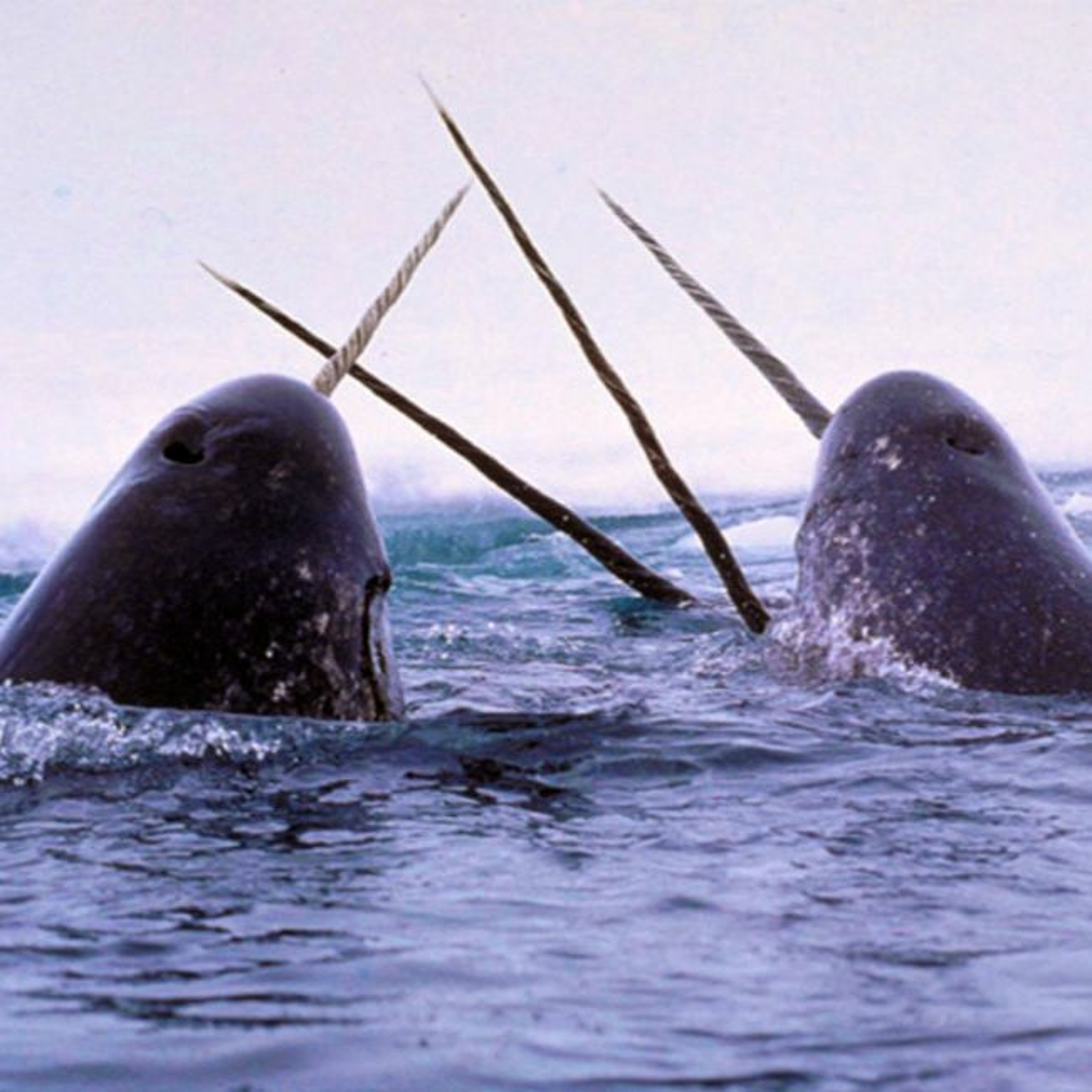
以防您之前没见过独角鲸,先来看看它们长什么样。
And just in case you haven't seen a narwhal before, here's what they look like.
它们是鲸鱼的一种。
They're a kind of whale.
它们身长与汽车相当,通常体重超过一吨。
They're about as long as a car, and they usually weigh more than a ton.
它们
They
有着斑驳的浅色皮肤,
have pale skin dappled with
上面有深灰色斑点。
dark gray spots.
但最显著的特征
But the feature that makes them most distinctive
是它们的角。
Is their horn.
你可能
You might have
见过独角鲸的图画或照片,看起来就像头上长着独角的鲸鱼。
seen a drawing or a picture of a narwhal that makes it look kind of like a whale with a single horn coming out of its head.
像独角兽一样。
Like unicorn.
对。
Right.
只是没有闪光、彩虹,也没有蹄子和腿。
But without the sparkles and rainbows or hooves and legs.
实际上,那根本就不是角。
And actually, it's not a horn at all.
那是长牙。
It's a tusk.
就像你在大象或海象身上看到的那样。
Just like you see on an elephant or a walrus.
而且长牙其实就是牙齿。
And tusks are teeth.
所以独角鲸的角只是一颗特别长的牙齿。
So the narwhal's horn is just a really long tooth.
而且它不是从独角鲸的额头长出来的。
And it's not coming out of the narwhal's forehead.
它是从独角鲸嘴里穿出,通过前唇的一个洞延伸出来的。
It's coming out of the narwhal's mouth and through a hole in its front lip.
与光滑的曲面不同,
Instead of a smooth curved surface, the
长牙实际上是螺旋状的。
tusk actually spirals.
如果你没见过独角鲸,可以访问我们的网站brainson.org,看看这些超酷海洋哺乳动物的照片和视频。
If you haven't seen a narwhal before, you can head to our website brainson.org to see some photos and videos of these very cool marine mammals.
Leah和Maya,你们第一次看到独角鲸照片时是什么感觉?
Leah and Maya, what did you first think when you saw a picture of a narwhal?
看起来挺酷的。
It looked pretty cool.
我当时还在想为什么它只有一根长牙。
And I was wondering why it only had one tusk.
我觉得我可能会称它为海里的独角兽,因为它看起来就像是从海里冒出来的独角兽。
I think I might have called it a unicorn of the sea because it looked like a unicorn that was coming out of the sea.
完全同意。
Totally.
它们看起来太酷了。
They are so cool looking.
那它们为什么会长这些长牙呢?
So why do they have these tusks?
只是为了装饰吗?
Are they just for decoration?
就像一种极端的唇部穿孔?
Like an extreme lip piercing?
还是说它们有实际用途?
Or do they have a purpose?
你觉得这些长牙是用来做什么的?
What do you think the tusks are used for?
我听说它们的长牙上有某种孔洞,可能用来感知温度变化。
I've heard they have some kind of holes in them that maybe detect change in warmth.
我觉得它们可能是用来破冰的,这样它们就能浮出水面呼吸。
I feel like they're for breaking through ice so they can get to surface to breathe out of the water.
幸运的是,我们这里有位专家能解答所有关于独角鲸的问题。
Well, we are lucky enough to have someone here who can answer all of our narwhal questions.
克里斯汀·莱德拉是西雅图华盛顿大学的海洋生物学家。
Kristen Lydra is a marine biologist at the University of Washington in Seattle.
你好,克里斯汀。
Hello, Kristen.
你好,莉娅。
Hi, Leah.
你好,玛雅。
Hi, Maya.
独角鲸是怎么长出这些角的?
How do narwhals get these horns?
或者我应该说长牙。
Or I should say tusks.
是啊。
Yeah.
独角鲸是怎么长出长牙的?
How do the narwhals get the tusks?
独角鲸并不是生来就有长牙的。
So narwhals are not born with their tusk.
无论是雄性还是雌性,出生时看起来都一样。
Both both boys and girls, when they're born, they look the same.
随着雄性幼鲸逐渐成熟,长牙会从上颚冒出并开始生长。
And slowly, as the young boys mature, the tusk erupts out of the out of the upper jaw and starts to grow.
而且长牙会持续生长很长时间。
And the tusk grows for quite a long time.
它可能需要生长十到十二年,直到那只年轻的雄性成长为成年雄性。
It can grow for for ten or twelve years to the point where that young male becomes an adult male.
那么为什么只有雄性有长牙,雌性没有呢?
So why do only males have the tusks, not female?
长牙基本上是用来炫耀的。
The tusk is basically for showing off.
如果你想想世界上其他动物,比如有浓密鬃毛的狮子,或者有巨大鹿角的不同鹿种,通常都是雄性。
And so, if you think about other animals across the world, like the lion that has a big mane or the, different deer that have big antlers, they're often males.
这些雄性会用那些花哨的附属物相互竞争,基本上就是决定谁是老大,或者谁应该赢得雌性的青睐。
And those males use those kind of fancy flashy appendages to compete with each other and basically decide who's the boss or who's, you know, who's the person that should get the girl.
所以我们认为独角鲸的长牙在科学上被称为性征,但本质上就是雄性用来帮助竞争和决定谁当老大的华丽装饰。
And so what we think is the narwhal tusk is is scientifically what we call a sexual trait, but it's basically something flashy that the boys have to help them compete and decide who's the boss.
最近有无人机拍摄到独角鲸用它们的牙做了一些有趣的事情。
A drone recently captured narwhals doing something interesting with their tusks.
是什么?
What was it?
是的,最近有一些影像资料流传出来,显示一只长牙独角鲸在水面游过鱼群时,头部来回摆动。
So, yeah, recently there was some footage that was distributed, of a narwhal with a tusk at the surface swimming through a school of fish, and the whale was moving its head back and forth.
看起来它可能是在用长牙搅动甚至击晕鱼群。
And it looked like it may have been using its tusk to either disturb or even possibly stun the fish.
这非常有趣。
And so, that was very interesting.
我想说我们绝对需要更多信息才能真正了解独角鲸是否这样使用长牙来捕鱼,但这就是科学的本质——学习新事物并探索它们。
I would say we definitely need more information to really understand if if narwhals use their tusk in that way for finding fish, but, that's what science is all about, learning new things and exploring them.
要知道,多年来关于独角鲸长牙的假说层出不穷,无论是用它来破冰、击剑,还是进行其他活动。
You know, there have been a lot of hypotheses about the tusk over the years, whether it's used to break ice or it's used to sword fight or, you know, do do other things.
而且我得说,这些假说大多缺乏有力证据支持。
And, I would say there's not a lot of evidence for any of those other hypotheses.
有观点认为长牙非常敏感,这或许是真的。
There's been some suggestions that it's, very sensitive and, that may be true.
就像你吃冰冷冰淇淋时,牙齿会感受到那种刺激一样。
If you think about your teeth when you eat cold ice cream, you often feel that on your teeth.
但这并不意味着长牙对生存至关重要,因为最关键的事实是:只有雄性独角鲸才长有这种长牙。
But it doesn't mean that the tusk is really what we would say critical for survival because the number one thing is that only the males or the boys have a tusk.
所有雌性独角鲸都没有长牙,但它们照样活得很好。
So all of the female narwhals that are swimming around out there have no tusk and they manage just fine.
它们能顺利觅食。
They're able to find food.
能够完成迁徙。
They're able to migrate.
可以生育并抚养幼崽。
They're able to give birth and raise their young.
所以我们认为长牙并非生存必需器官。
So we really don't think the tusk is something critical for survival.
除了长牙之外,它们还有其他牙齿吗?
Do they have other teeth besides the tusk?
实际上独角鲸口腔内没有其他牙齿。
Narwhals actually have no teeth inside their mouth.
所以如果你打开独角鲸的嘴,里面全是牙龈。
So if you open up the mouth of a narwhal, it's all gums.
实际上它们还有另一颗长牙嵌在头骨里,在极少数情况下会发育成第二根长牙,形成双长牙的独角鲸。
And they what they actually have, they have another long tooth that remains embedded inside the skull, and that's the that's the second tooth that will grow in the very rare case where you have the double tusked narwhal.
但除此之外,它们没有牙齿。
But otherwise, they have no teeth.
它们直接整个吞下猎物。
They just swallow swallow their prey whole.
独角鲸能活多久?
How long does a narwhal live?
根据记录,我们已知最长寿的独角鲸大约能活到100岁。
A narwhal, the oldest living narwhals that we have documented are about a 100 years old.
那真是相当长的寿命。
That's a very long time.
独角鲸和独角兽的神话有关联吗?如果有,是怎样的关联?
Are narwhals connected to the myth of unicorns and if so, how?
是的,这个问题问得好。
Yeah, great question.
独角鲸确实与独角兽神话有关。很久以前在维京时代,维京人会航行到格陵兰附近的北极海域,与因纽特人交易,将独角鲸的长牙带回欧洲。
So, narwhals are connected to the myth of unicorns and a long time ago in the Viking era, the Vikings would actually sail up to the Arctic to waters around Greenland and they would barter with the Inuit people and they would bring narwhal tusks back to Europe.
回到欧洲后,他们会编造关于这些长牙来历的故事——准确说是谎言——让人们愿意花大价钱购买。
And when they got back to Europe, they would tell stories or well basically lies about where those those tusks came from and make up stories that made people wanna pay a lot of money for them.
比如谎称这些长牙来自独角兽。
Like, for example, that the tusks came from unicorns.
所以人们非常想要这些长牙。
And so people, really wanted these tusks.
国王们会购买这些长牙,并用它们制作王座。
Kings would buy the tusks and make their thrones out of them.
直到十八世纪末,才有人站出来说,嘿。
It wasn't until the late seventeen hundreds when somebody basically came out and said, hey.
这些不是独角兽的角。
These aren't from unicorns.
这些是鲸鱼的牙齿。
These are from a whale.
就像一副好假牙,我们先暂时把牙齿放一边,关注一下我们的耳朵。
Like a nice set of dentures, we're going to put teeth aside for a minute and focus on our ears.
现在是神秘声音时间。
It's time for the mystery sound.
神秘声音。
Mystery sound.
来了。
Here it is.
好的。
Okay.
你们有什么猜测吗?
Do you guys have any guesses?
听起来像是海鸥的叫声?
It sounds like seagulls maybe?
听起来像是海滩,但仿佛有上千只海鸥。
It sounds it sounds like the beach but with like a thousand of seagulls.
不是真的有一千只。
Not like literally a thousand.
听起来像是有很多海鸥的海滩。
Sounds like a beach with a lot of seagulls.
是的。
Yes.
嗯,这是个绝妙的猜测。
Well, that is an excellent guess.
我们稍后会揭晓答案。
We will be back with the answer in just a bit.
好的,现在回到克里斯汀·莱德拉,了解更多关于独角鲸的信息。
Okay, now back to Kristen Leidra so we can learn some more about narwhals.
气候变化对独角鲸是有益还是有害呢?
Is the narwhals climate change helping them or affecting them in any way?
这是个好问题,科学家们正在研究这个问题。
That's a great question and that's something scientists are studying right now.
我们知道北极乃至全球正在发生巨大变化,这都是由气候变化引起的。
So we know that there are big changes happening across the Arctic and of course across the globe and that is due to climate change.
北极发生的一些最重大的变化可能会影响独角鲸,比如海冰正在消失。
And some of the biggest things that happen in the Arctic that could affect narwhals are the fact that the sea ice is disappearing.
当北极发生这种情况时,整个生态系统都会改变。
And then when that happens in the Arctic, it changes the whole ecosystem.
海水变得更温暖了。
The water gets warmer.
洋流会发生变化,这会影响到独角鲸所食鱼类的分布位置。
The currents can change, it can affect where the fish are that narwhals eat.
我们尚未完全理解气候变化对独角鲸意味着什么,但有一点可以确定,它们对冰层环境有着独特的适应性。
And we don't completely understand what the climate change will mean for narwhals, but one thing we know for certain is that narwhals are very uniquely adapted to be in the ice.
它们是鲸类中最适应冰层生活的物种之一。
They're some of the kind of best they're the whales that do the best in the ice.
因此如果失去冰层环境,很可能会对它们产生负面影响。
And so if you take that away, it's likely to have some negative effects.
但目前我们还未完全理解所有这些影响。
But we don't completely understand all of those yet.
独角鲸如何交流?
How do narwhals communicate?
独角鲸通过水下声波进行交流。
So narwhals use sound, underwater sound, to communicate.
基本上它们会发出高频咔嗒声,类似于声纳或潜水艇使用的技术。
And, basically, what they do is they're able to send off very high frequency clicks, kind of like sonar, like an underwater submarine.
这些声波在水下遇到物体会反射回来,独角鲸接收这些信号后,就能通过声音构建出水下环境的图像。
And those clicks bounce off of different objects underwater, and then they come back to the narwhal, and they receive the signals, and they're able to basically use the sound to make a picture of what's underwater.
我们知道独角鲸使用回声定位来寻找鱼类,或是探测冰层中的呼吸孔。
So we know that narwhals use sound that's called echolocation to basically find fish or to, look for holes in the ice where they come up to breathe.
独角鲸还会发出哨声、吱吱声等有趣的水下噪音来相互交流。
And narwhals will also use sound like they'll make whistles and squeaks and kind of kind of funny noises basically underwater to communicate with one another.
所以有点像海豚或蝙蝠?
So sort of like a dolphin or a bat?
完全像海豚或蝙蝠。
Exactly like a dolphin or a bat.
那真的很酷。
That's really cool.
确实很酷。
It is so cool.
我要告诉你一件事。
And I'll tell you one thing.
我们最近发现。
We we recently found out.
我们一直在研究独角鲸如何在水下利用声音,我们认为独角鲸是整个动物界中利用声音的物种之一,它们基本上拥有最精确的声呐定位能力。
We've been doing studies of how narwhals use sound underwater, and we think that the narwhals are are one of the species across the whole animal kingdom that use sound that have basically the most precise ability to use sound to see.
你可以想象一下,就像一盏可调节的手电筒。
So you can kind of imagine, like, an adjustable flashlight.
你知道,如果你有一把手电筒,你可以旋转它,它会发出很宽的光束。
You know, you have if you have a flashlight, you can turn it, and it will make a really wide beam.
它能照亮你面前的一大片区域。
It'll light up a whole bunch of stuff in front of you.
然后你可以朝另一个方向旋转,它会发出像激光一样的超窄光束,将光线精确指向某个位置。
And then you can turn it the other way, and it makes a super narrow beam like a laser, and it points the light in a very precise place.
我们认为独角鲸基本上能在水下用声音做到这一点。
Well, we think narwhals are basically able to do that with sound but underwater.
谢谢你今天能来,克里斯汀。
Thanks for being here today, Kristen.
是的。
Yes.
谢谢。
Thank you.
谢谢你们两位。
Thanks to both of you.
你们表现得非常棒。
You were great.
很高兴能和你们交谈。
It was a pleasure to talk to you.
我们正在制作一期关于生物节律如何维持我们睡眠-觉醒周期的节目,想听听大家的看法。
We're working on an episode coming up about the biological rhythms that keep us on a sleep wake cycle, and we want to hear from you.
你认为做晨型人好还是夜猫子好?为什么?
Do you think it's better to be a morning person or a night person, and why?
请将你的回答通过邮件发送至hello@brainson.org。
Email your answers to us at hello@brainson.org.
我们会在接下来的节目中选取部分内容,你也可以发送
We'll include some of them in our upcoming episode, and you can send
神秘声音和图画
Mystery sounds Drawings
以及击掌鼓励
and high fives
发送到同一个邮箱地址:hello@brainzon.org。
to that same email address, hello@brainzon.org.
这就是米卡发送这个问题的地方。
That's where Mika sent this question.
水有味道吗?
Does water have a taste?
我们将在节目中的'荣誉时刻'环节回答米卡这个令人垂涎的问题,并公布最新入选'大脑荣誉榜'的名单。
We'll answer Mika's mouth watering question during our moment of plus the most recent group to be added to the brains honor roll.
请坚持听到节目最后,答案即将揭晓。
Stick around to the end of the show to hear it all.
在《但是为什么》节目中,我们解答你提出的难题。
On But Why, we tackle your tough questions.
如果做了被告知不能做的事却永远不告诉任何人,这样可以吗?
Is it okay to do something you're told not to do and then never tell anybody?
为什么人老了就必须要死?
Why do people have to die when they get too old?
为什么钱这么重要?
Why is money so important?
在《但是为什么》这档为好奇孩子打造的播客中,我们一起探索那些没有简单答案的问题。
Exploring questions with no easy answers on But Why, a podcast for curious kids.
头脑风暴!
Brainstorm!
您正在收听的是美国公共媒体出品的《大脑上线》。
You're listening to Brains On from American Public Media.
我是莉娅。
I'm Leah.
我是玛雅。
And I'm Maya.
我是莫莉。
And I'm Molly.
在我们深入了解动物牙齿的趣闻之前,先来重温一下那个神秘的声音。
Before we bite into some cool facts about animal teeth, we're going to go back to that mystery sound.
大家准备好再听一遍了吗?
You guys ready to hear it one more time?
是的。
Yes.
嗯。
Mhmm.
好的。
Alright.
让我们听听看。
Let's hear it.
好的。
Okay.
你们又听到了一遍。
So you heard it again.
有什么新想法吗?
Any new thoughts?
不。
No.
但听起来有点怪,不过更有趣。
But it sounded weird, a little more, like, interesting.
有些部分我没听清楚。
There's some parts that I couldn't make out in it.
所以我决定坚持我们现有的猜测。
So I'm just gonna stick with the guess that we have.
是的。
Yes.
显然是在一片超大沙滩上的海鸥。
Seagull in a really big beach, apparently.
一片超大沙滩上的海鸥。
Seagull in a really big beach.
猜得真棒。
Excellent guess.
现在公布答案,来自康涅狄格州沃灵福德的萨米。
Well, here with the answer is Sammy from Wallingford, Connecticut.
那是蓝喉鸟的声音。
That was a sound of blue gorails.
我叫萨米,我特别喜欢那些白鲸。
And my name is Sammy, and I really like those beluga whales.
它们太可爱了。
They are adorable.
它们说话非常清晰。
They speak so clearly.
它们能在水下听到声音。
They can hear underwater.
它们可以是非常可爱的动物。
They can be a very cute animal.
谢谢。
Thank you.
所以是白鲸啊。
So beluga whales.
哇哦。
Woah.
你们之前听过鲸鱼的声音吗?
Have you guys ever heard a whale before?
听过。
Yes.
嗯哼。
Mhmm.
但之前听起来不太像这样对吧?
But they didn't quite sound like that before?
不像。
No.
不像。
No.
所以背景里的那些人,他们当时在康涅狄格州米斯蒂克的水族馆。
So all those people in the background, they were at the aquarium in Mystic, Connecticut.
独角鲸和白鲸不是近亲吗?
Aren't narwhals and belugas cousins?
这个问题问得好。
That is a great question.
是的。
Yes.
它们确实是。
They are actually.
独角鲸其实是鲸类的一种。
They're narwhals are a type of whale.
你们听过《小白鲸》这首歌吗?
Have you guys heard the song Baby Beluga?
哦,当然。
Oh, yeah.
听过。
Yes.
可惜拉菲不会模仿白鲸的叫声,所以在这个场景下没什么用。
Unfortunately, Raffy doesn't really make the sound of the beluga whale, so it wasn't really useful in this circumstance.
是啊。
Yeah.
我的大脑开机了。
My brain's on.
独角鲸独特的长牙并非唯一酷炫的牙齿种类。
Narwhal's distinctive tusk is not the only kind of cool tooth out there.
世界上有许多不同种类、功能各异的牙齿。
There are lots of different kinds of teeth with very different uses.
为了了解更多,我们要去'疯狂艾迪的牙齿大卖场'看看。
And to find out more, we're going to take a trip to Crazy Eddie's Tooth Emporium.
你好?
Hello?
艾迪,来客人了。
Eddie, we have a customer.
我看得见有客人来了,艾迪。
I can see we have a customer, Eddie.
嗨。
Hi.
我想买人生第一颗牙齿。
I'm looking to get my first tooth.
等等。
Wait.
你们俩都叫艾迪吗?
Are you both named Eddie?
我们是双胞胎。
We're twins.
妈妈懒得记两个名字。
Mom didn't wanna memorize two names.
欢迎来到疯狂艾迪的牙齿大世界。
Welcome to Crazy Eddie's Tooth Emporium.
牙齿就是我们的真理。
Tooth is our truth.
我们对牙齿痴迷不已。
We're bonkers for chompers.
只要是脸上的东西,我们这里应有尽有。
If it goes in your face, we're the place.
一站式满足您所有咀嚼、啃咬、磨牙、捣碎的需求。
A one stop shop for all your chomping, chewing, gnashing, mashing needs.
自从四亿年前动物首次进化出最早的牙齿结构以来,我们家族就一直提供牙齿服务。
Our family's been providing teeth since animals first evolved the earliest teeth like structures some 400,000,000 years ago.
呃,我只想要一颗普通的牙齿。
Well, I just want a simple tooth.
不要太花哨的。
Nothing too flashy.
这是我的第一颗牙,
It's my first one,
简单是吧?要知道我们伟大的曾曾曾...(我忘记有多少个'曾'了)
so Simple, Well, when our great, great, great, great, great, great, oh, I forget how many greats.
32代?也许?
32, maybe?
老祖宗撒迪厄斯·牙本质在四亿年前创办了这家企业。
Grandpappy, Thaddeus Dentine, started this business four hundred million years ago.
牙齿曾经非常简单。
Teeth were real simple.
看看这个宝贝。
Check this baby out.
那是牙齿吗?
That's a tooth?
其中之一
One of
已知最早的牙齿之一,其实是一种齿板,来自一种鱼类。
the first known teeth, sort of a tooth plate, really, from a fish, I believe.
一种叫做罗氏鱼的古老盾皮鱼。
An ancient placoderm called a romendina.
看起来更像带刺的石头或砂纸之类的东西。
Looks more like a spiky rock or sandpaper or something.
嗯,这不是你我认知中的牙齿。
Well, it's not what you and I think of as a tooth.
在我们拥有牙齿之前,只有表皮附属物。
Before we had teeth, there were just dermal appendages.
这些是类似鳞片的坚硬结构,像牙齿一样覆盖在古鱼体表如同盔甲。
These were scale like structures that were hard like teeth and covered the bodies of ancient fish like armor.
对防护很有效,但不适合进食。
Great for protection, but not eating.
最终,鱼类进化出将这些带刺鳞片长在嘴里的特征。
Eventually, fish evolved to have these spiky scales in their mouths.
天啊,那些锯齿状的牙齿确实帮助那些鱼类捕捉并牢牢咬住猎物。
Boy, did those toothy plates help those fish catch and hold on to prey.
明白了。
Gotcha.
缺点是咬第一口后就很难再咀嚼了。
The downside was you couldn't really chew after your first bite.
也许你想要点更实用的东西?
Perhaps you want something a little more useful?
当然。
Sure.
啊,没错。
Ah, yes.
就是这个,巨齿鲨的牙齿。
Here it is, the megalodon tooth.
什么是巨齿鲨?
What's a megalodon?
什么是巨齿鲨?
What's a megalodon?
巨齿鲨是远古时期的巨型鲨鱼。
Megalodons are ancient monstrous sharks.
它们生活在2300万年前,约200万年前灭绝,体长可达60到80英尺。
They lived twenty three million years ago, going extinct about two million years ago, and grew to be anywhere from 60 to 80 feet long.
它们的牙齿巨大,有些甚至有人类手掌那么大。
And their teeth were huge, some as big as a human hand.
它们锋利、尖锐,边缘参差不齐。
They were sharp, pointy, and jaggedy edgety.
他的意思是锯齿状的。
He means serrated.
对,就是那样。
Yeah, that.
天哪,它们能咬进猎物并撕下大块肉来。
And man, oh man, could they bite into and tear big chunks from their prey.
它们甚至能切断骨头。
They could even cut through bone.
我觉得这颗牙不适合我。
I don't think that's a tooth for me.
它甚至塞不进我的嘴。
It won't even fit in my mouth.
对你来说牙太多了,也许你更适合像两亿年前的迪佩迪鱼那样碾碎小壳类蜗牛或蛤蜊。
Too much tooth for you, Maybe you're into crushing smaller shelled snails or clams like the ancient 200,000,000 year old dipedium fish.
它有个高瘦的身体,看起来像个餐盘,用扁平如鹅卵石的牙齿和强壮的颌骨碾碎外壳,吃掉里面美味的肉。
It had a tall thin body that sort of looked like a dinner plate and used its flat, almost pebble like teeth and strong jaws to pulverize shells and eat the tasty insides.
看看这个。
Check it out.
很酷,但我不想吃壳类和蜗牛。
Cool, but I don't wanna eat shells and snails.
对法式蜗牛不感兴趣。
Not into escargot.
我明白了。
I understand.
这里,我们有一些爬行动物的牙齿。
Here, we have reptile teeth.
这些动物在进化过程中,牙齿逐渐分化。
When these animals evolved, they developed more differentiated teeth.
换句话说,它们口腔里的牙齿并不完全相同。
In other words, not all the teeth in their mouths were the same.
有些牙齿较小,有些则较大。
Some were small and some were larger.
我们称之为异齿型。
We call this heterodonti.
'异'代表不同,'齿'就是牙齿。
Hetero for different and denti for teeth.
与之相对的是同齿型。
As opposed to homodonti.
'同'表示相同,'齿'依然指牙齿。
Homo meaning same and denti still meaning teeth.
看看这条蛇的毒牙。
Get a load of the snake fang.
有了它,你就能通过注射毒液捕食比自己大十倍的猎物。
With this, you can take on prey 10 times your size by injecting them with venom.
这些小家伙又细又尖,毒液导管将毒牙尖端与毒腺相连,让你随时准备好享用下一餐。
These babies are slender and sharp, and a venom canal connects the tip of the fang to the venom gland, so you're always ready for your next meal.
嗯,嗯,嗯。
Nom, nom, nom.
但我还是个孩子。
But I'm a kid.
我没有毒腺。
I don't have a venom gland.
对。
Right.
也许你的牙齿有多功能性?
Maybe versatility in your teeth?
好吧。
Okay.
这里是哺乳动物区。
Here's the mammal section.
哺乳动物是温血动物,所以需要摄入大量卡路里来保持体温。
Mammals are warm blooded, so they've gotta eat a lot of calories to keep warm.
展开剩余字幕(还有 104 条)
由于食物可能难以获取,哺乳动物不想浪费任何东西。
Since food can be hard to come by, mammals don't want to waste anything.
这就是为什么它们进化出了非常适合捣碎食物和破坏食物细胞壁的牙齿。
That's why they evolved teeth that are really good at mashing up food and breaking down the cell walls of their meal.
这样能释放营养,让身体在消化过程中吸收。
That releases the nutrients so the body can absorb them during digestion.
听起来不错,我想。
That sounds good, I guess.
我是哺乳动物。
I'm a mammal.
我们开始吧。
Here we go.
随你挑选。
Take your pick.
你有门牙、犬齿和臼齿。
You've got your incisors, your canines, and your molars.
门牙是你对抗食物的第一道武器,就位于口腔前部。
Incisors are your first weapon against food, right at the front of the mouth.
它们更薄更锋利,非常适合将食物切成小块。
They're thinner and sharper, great for cutting food into smaller bites.
我最喜欢的型号当然是河狸的门牙。
My favorite model is, of course, beaver incisors.
超级坚固又锋利。
Super strong and sharp.
你想啃倒一棵树吗?
You wanna gnaw down a tree?
没问题。
No problem.
你不用担心更换这些牙齿,因为它们会自动磨尖并持续生长。
And you don't have to worry about replacing these since they're self sharpening and always growing.
我可没打算啃倒任何树木。
I wasn't planning on nine down any trees.
更像是个肉食动物,你需要又长又尖利的犬齿来撕扯和分享那块肉。
More of a carnivore, You're gonna need some long, sharp and pointy canines to tear and share that meat.
Ardilex套装在冰河时代首次亮相。
Ardilex package debut during the ice age.
还有剑齿虎,致命的斯剑虎。
And the saber toothed cat, Smelodon fatales.
这里。
Here.
这些就像一对弯曲的、近一英尺长的刀片附着在你的上颚。
These are like a pair of curved, nearly foot long knives attached to your upper jaw.
剑齿虎用这些来切开柔软的肉体,使猎物失血而死。
Smilodon use these to slice through soft flesh, causing its prey to bleed to death.
听起来很残忍。
That sounds mean.
好的。
Okay.
你想要素食选择吗?
You want a vegetarian option?
臼齿非常适合磨碎食物,尤其是难以消化的叶子和草。
Molars are great for grinding up food, especially leaves and grass that are hard to digest.
看,草类富含二氧化硅,这是沙子的主要成分,使它们变得粗糙。
See, grasses are loaded with silica, which is a major component of sand, making them gritty.
别担心,我们在疯狂雪人这里找到了解决方案。
Not to worry, we've got a solution here in Crazy Yetis.
看,这就是大象的牙齿。
Here it is, the elephant tooth.
它的臼齿看起来就像老式搓衣板,一排排的棱相互摩擦,把植物磨成黏糊糊的绿色糊状物。
Its molars look almost like an old fashioned washboard with rows of ridges that rub against each other to grind up vegetation into a slurpy green smoothie.
你觉得怎么样?
How about it?
你知道吗,我想我还是等着看自己嘴里能长出什么来吧。
You know, I think I'm going to just wait and see what pops up in my mouth on its own.
不过还是谢谢你的牙齿科普课。
Thanks for the lesson on teeth though.
再见。
Bye.
哦,天哪。
Oh, man.
她走了。
She left.
我们是不是展示太多牙齿了?
Did we show too many teeth?
我们尽力了。
We tried our best.
有些人就算被好牙咬一口也认不出什么是好牙。
Some people just wouldn't know a good tooth if it walked up and bit them.
雄性疣猪长着非常酷的独特獠牙。
Male gnarls have very cool distinctive tusks.
它们可能是为了吸引配偶而进化的。
They probably have evolved to attract mates.
但最近的无人机画面显示它们可能还有其他用途。
But recent drone footage shows they might have other uses too.
独角鲸的北极栖息地正在变化,尚不清楚这会对独角鲸本身产生什么影响。
The arctic habitat of narwhals is changing and still unclear what impact that will have on narwhals themselves.
牙齿是从类似鳞片的结节结构逐渐进化而来的。
Teeth have evolved over time from nubby scale like structures.
最终演变成我们今天所知的专用咀嚼工具。
To the specialized chompers we know today.
以上就是本期《大脑开窍》的全部内容。
That's it for this episode of Brains On.
《大脑开窍》由马克·桑切斯、桑迪顿和莫莉·布鲁姆制作。
Brains On is produced by Mark Sanchez, Sanditon, and Molly Bloom.
《大脑开窍》部分资金来自美国国家科学基金会的资助。
And Brains On is funded in part by a grant from the National Science Foundation.
我们得到了劳伦·D、约翰·兰伯特和艾米丽·艾伦的制作协助。
We have production help from Lauren D, John Lambert, and Emily Allen.
以及卡梅伦·威利、莱奥·德拉古拉和维罗妮卡·罗德里格斯的工程支持。
And engineering help from Cameron Wiley, Leo D'Lagula, and Veronica Rodriguez.
特别感谢索菲·哈特、杰弗里·比索伊、玛丽·安妮·马可、乔纳森和娜塔莉·费舍尔,以及梅丽莎·奎珀斯。
Many thanks to Sophie Hart, Jeffrey Bisoy, Mary Anne Marco, Jonathan and Natalie Fisher, and Melissa Kuipers.
在结束之前,现在是时候来一个...
Now, before we go, it's time for a moment of
你好,
Hello,
我叫米卡,来自瑞士。
my name is Mika and I'm from Switzerland.
我的问题是,水有味道吗?
My question is, Does water have a taste?
是的,水有味道,因为你实际上能尝出水中不同的矿物质成分。
Yes, water has taste because you can taste actually the different mineral compositions out of the water.
我叫马丁·里森。
My name is Martin Riesen.
我是瓶装水领域的权威专家。
I'm the leading authority of bottled water.
我的头衔是水品鉴师。
My title is water sommelier.
意思是品酒师是精通葡萄酒知识的人。
That means a sommelier is a person who knows a lot about wine.
我对水也做同样的事,因为水有味道,你甚至可以将不同水与食物和饮料搭配。
I do the same with water, because water has taste and you can even pair water to different food and beverages.
所有水最初都是雨水,从天而降落到地面。
Every water starts as rainwater, so it comes down and rains on our grounds.
而不同地层含有不同矿物质。
And the grounds have different minerals with them.
矿物质包括钠、钾、硅、钙、镁等元素。
And minerals are, for example, like sodium, potassium, silica, calcium, magnesium.
这类矿物质存在于土壤中,水会带着它们一起流动。
And these types of minerals are based in the grounds and water takes them with them.
然后你就能品尝并饮用水中不同的矿物质。
And you can then taste and drink the different minerals in water.
当水中含有大量矿物质时,有些水可能会带咸味。
Some waters can be salty when there's a lot of minerals in there.
当水的矿物质含量极低时,它们的口感会更偏向柔顺。
When waters have a very low mineral content, then they are more like on the smoother side.
有些水可能带有苦味或金属味。
Some waters can be bitter or metallic.
我甚至喝过几乎像酸性的水,也尝过类似葡萄柚或椰子风味的水——虽然那并不是椰子水。
I even had waters who were like almost like acidic and I had some waters who almost like tasted like a grapefruit or coconut and it was not coconut water.
所以这真的很有趣。
So that is really fun.
由此可见水其实有很多种风味。
So water has really a lot of flavors.
现在我们面前的这款水来自斐济群岛。
So this water, what we have in front of us, comes from the Fiji Islands.
这款水口感非常非常柔顺,余味甚至带点果香。
And this water is very, very smooth and almost a little bit fruity in the aftertaste.
因为这种水含有大量二氧化硅。
Because this water has a lot of silica content in it.
二氧化硅是一种能让水质变得极其柔顺的矿物质。
And silica is a mineral what makes water very, very smooth.
当我品尝这款水时——我现在就要这么做——我会将水含入口中,然后加入一点氧气,让口中的风味更加鲜明。
So when I'm tasting this water, and I will do this right now, I'm putting water into my mouth, then I'm adding a little bit oxygen to it to brighten up even the flavors in my mouth.
所以当你旋转水时,要把水稍微含在口腔后部,然后将舌尖抵在牙齿前方,这样旋转水流的同时就能融入氧气。
So what you're trying to do when you swirl water, you put the water a little bit to the back of your mouth and then you're putting your tongue almost like in front of your teeth and then you're swirling water and you're adding like oxygen to it.
美味。
Yummy.
听起来可能有点滑稽,但确实能很好地品尝出不同水质的差异。
It sounds maybe funny, but it's actually very good as well to taste the differences in water.
我认为每个人都应该试试这个方法。
And I think everybody should do this.
直接去杂货店寻找不同的天然泉水吧。
Just go to your grocery store, look for different spring waters.
这意味着这些水来自天然水源,而纯净水则表明它们产自工厂。
That means these waters come from nature and purified water means these waters come from a factory.
你真的能尝出A、B、C品牌之间的明显差异。
And you can really taste the differences from A, B or C brand.
这个过程非常有趣。
It's very fun to do.
如果你在家做了水质品鉴测试,请发照片告诉我们你尝到了什么味道。
If you do a water taste test at home, send us a picture and tell us what you're tasting in the water.
祝您饮水愉快!
Happy hydrating!
现在,我要像品鉴一杯好水那样细细品味这些名字。
Now, I'm going to savor these names like a fine glass of water.
是时候将最新一批名字加入大脑荣誉榜了。
It's time for the most recent group of names to be added to the brain's honor roll.
正是这些孩子用他们的问题和想法让节目持续进行。
These are the kids who keep the show going with their questions and ideas.
来自加州埃尔多拉多山的乔伊、北卡罗来纳州达勒姆的阿尼、克利夫兰的梅耶、渥太华的亨利、西雅图的鲁比、图森的班杰明、南卡罗来纳州劳伦斯县的哈珀和查理、乔治亚州玛丽埃塔的西尔维、康涅狄格州汉普顿的威廉和安德鲁、印度浦那的尼尚特、马萨诸塞州牛顿的娜奥米和阿维盖尔、马里兰州银泉的詹姆斯、西雅图的马克斯、乔治亚州的谢尔比、肯塔基州的奈尔斯和卢克、马里兰州卡顿斯维尔的艾维、伊利诺伊州惠顿的威廉、加州希尔兹堡的赛拉斯和格蕾丝、马里兰州银泉的罗温、明尼苏达州瓦科尼亚的阿德里克和索尔、澳大利亚墨尔本的贾斯珀、台湾高雄的齐吉和伊尼什、澳大利亚堪培拉的麦迪和米奇、加州圣克拉丽塔的埃文、路易斯安那州科温顿的汉利、明尼阿波利斯的马修、威斯康星州麦迪逊的汉娜和海伦、南达科他州哈特福德的DM和伊斯拉、科罗拉多州冈伍德斯普林斯的西格、加州佩塔卢马的洛雷莱、安大略省汉密尔顿的韦斯利和塞斯、加州阿格拉山的西蒙和达尔文、康涅狄格州汉普顿的艾玛和德鲁、密歇根州兰辛的格雷厄姆和利亚姆、明尼苏达州梅迪纳的埃琳娜、华盛顿州安吉利斯港的汉娜、宾夕法尼亚州斯利珀里罗克的奥古斯特、加州图莱里的卢克、加州约书亚树的凯和丹尼、以及来自巴黎的马克斯,
Joey from El Dorado Hills, California, Arnie from Durham, North Carolina, Mayer from Cleveland, Henry from Ottawa, Ruby from Seattle, Benjamin from Tucson, Harper and Charlie from Lawrence County, South Carolina, Sylvie from Marietta, Georgia, William and Andrew from Hampton, Connecticut, Nishant from Pune, India, Naomi and Avigail from Newton, Massachusetts, James from Silver Spring, Maryland, Max from Seattle, Shelby from Georgia, Nels and Luke from Kentucky, Avey from Catonsville, Maryland, William from Wheaton, Illinois, Silas and Grace from Healdsburg, California, Rowan from Silver Spring, Maryland, Adrick and Sole from Waconia, Minnesota, Jasper from Melbourne, Australia, Ziggy and Inish from Kaohsiung, Taiwan, Maddie and Mitch from Canberra, Australia, Evan from Santa Clarita, California, Hanley from Covington, Louisiana, Matthew from Minneapolis, Hannah and Helen from Madison, Wisconsin, DM and Isla from Hartford, South Dakota, Seger from Gunwood Spring, Colorado, Lorelei from Petaluma, California, Wesley and Seth from Hamilton, Ontario, Simon and Darwin from Agora Hills, California, Emma and Drew from Hampton, Connecticut, Graham and Liam from Lansing, Michigan, Elena from Medina, Minnesota, Hannah from Port Angeles, Washington, August from Slippery Rock, Pennsylvania, Luke from Tulare, California, Kay and Denny from Joshua Tree, California, and Max from Paris,
法国。
France.
如果
If
你想加入大脑荣誉榜,可以发送问题、图画
you wanna be added to the Brains honor roll, you can send questions, drawings
以及诸如'当晨型人好还是夜猫子好?'这类问题的答案
And answers to questions like, Is it better to be a morning person or a night person?
到我们的邮箱地址:hellobrainson.org。
To our email address It's hellobrainson dot org.
你也可以关注
You can also follow
我们的Instagram和Twitter账号。
us on Instagram and Twitter.
我们的账号是brainson。
We're at brainson.
我们在Facebook上也有主页。
And we're on Facebook too.
你可以在我们的网站brainson.org上收听往期节目并订阅我们的新闻通讯。
You can listen to past episodes and subscribe to our newsletter at our website, brainson.org.
我们很快会带着更多问题的答案回来。
We'll be back soon with more answers to your questions.
感谢收听。
Thanks for listening.
嗨。
Hi.
关于 Bayt 播客
Bayt 提供中文+原文双语音频和字幕,帮助你打破语言障碍,轻松听懂全球优质播客。