本集简介
双语字幕
仅展示文本字幕,不包含中文音频;想边听边看,请使用 Bayt 播客 App。
今天,我正在与路易斯·博拉德聊天,他是开放慈善机构的农场动物福利项目主管。
Today, I'm chatting with Louis Bollard, who is farm animal welfare program director at Open Philanthropy.
而开放慈善机构是这一动物福利领域最大的慈善机构。
And Open Philanthropy is the biggest charity in this animal welfare space.
所以,路易斯,非常感谢你来参加节目。
So Louis, thanks so much for coming on
播客。
the podcast.
谢谢你邀请
Thanks for having
我来参加。
me on.
好的,第一个问题。
Okay, first question.
在某个时候,我们会拥有通用人工智能。
At some point we'll have AGI.
你如何看待你试图解决的这个问题?
How do you just think about the problem you're trying to solve?
你是想在AI为我们解决这个问题之前的十年里,让动物的生活条件变得更能忍受一些吗?
Are you trying to make conditions more tolerable for the next ten years until AI solves this problem for us?
还是说,我们目前所做的干预措施,比如创新性别鉴定技术或笼养蛋转型等,会在这一变革性时刻之后产生持续影响?
Or is there some reason to think that the interventions we're making in terms of improvements like Innova sexing or cage free eggs, etcetera, will have an impact beyond this transformative moment?
我认为工厂化养殖的终结远非必然。
I think that the end of factory farming is far from inevitable.
每年,全球工厂化养殖的动物数量都在增加约2%
Every year, we're factory farming about 2% more animals
嗯。
Mhmm.
在全球范围内。
Globally.
我认为我们可能走向两种不同的发展路径。
I think there are two possible trajectories we could go down.
一种是我们过去一个世纪所走的道路,即技术使工厂化养殖越来越高效,导致越来越多的动物以越来越密集的方式遭受虐待。
One is the trajectory that we have been on for the last century, which is technology has made factory farming ever more efficient, resulted in ever more animals being abused in ever more intensive ways.
嗯。
Yeah.
还有一种路径是我们减少工厂化农场中的动物数量,减轻每一只动物的痛苦。
There is a trajectory where we reduce the number of animals on factory farms, where we reduce the suffering of each of those animals.
所以,即使我们实现了通用人工智能,我也非常乐观地认为,这将加速各种技术进步。
So even if we get AGI, I I am really optimistic that that will accelerate forms of technological progress.
它将为我们带来更好的替代蛋白。
It will bring us better alternative proteins.
它将改进人道技术。
It will improve the humane technology.
但替代方案仍面临巨大的文化和政治障碍。
But there are still huge cultural and political obstacles to alternatives.
文化障碍在于,大多数人还是想要真正的肉类。
So the cultural obstacles are that most people want real meat.
我的意思是,大多数人其实已经可以选择植物基肉类,味道和真肉差不多了。
I mean, most people have the option already of plant based meat that tastes about as good as real meat.
真的吗?
Does it?
我不确定。
I don't know.
这说得通。
That's fair.
这是一场辩论。
This is a debate.
但我不认为这就是人们面临的唯一障碍。
But I don't think that's just the obstacle that people have.
我认为有很多人说,我对那些替代品根本没兴趣。
I think there are a lot of people who say, I'm just not interested in, you know, the alternative.
我就想要真正的肉。
I want the real thing.
还有政治上的障碍。
And then there's also the political obstacle.
假设通用人工智能为我们解决了培养肉的问题。
So let's say that AGI solves cultivated meat for us.
但培养肉在七个美国州已经是非法的了。
Well, cultivated meat is already illegal in seven US states.
它可能很快将在整个欧盟成为非法。
It's it's might soon be illegal in the entire European Union.
所以当我们拥有通用人工智能时,它们还能在任何地方销售吗?
So by the time we get AGI, will they even be able to sell it anywhere?
因此,我认为技术在这个领域可以带来巨大的好处,我乐观地认为通用人工智能能极大地加速这一进程。
So again, I think there's a huge amount of good that technology can do in this space, and I'm optimistic that AGI can accelerate that hugely.
但与此同时,我认为我们也应做好准备,面对一个重大的可能性:即通用人工智能并不能终结工厂化养殖,因为这种系统异常高效,已经历经各种技术变革而存续,并可能在这次技术变革中继续存在。
But at the same time, I think we should prepare for the significant possibility that AGI does not end factory farming, that actually this is an incredibly efficient system that has persisted through all kinds of technological changes and that could persist through this technological change.
是什么让它如此高效?
What is it that makes it so efficient?
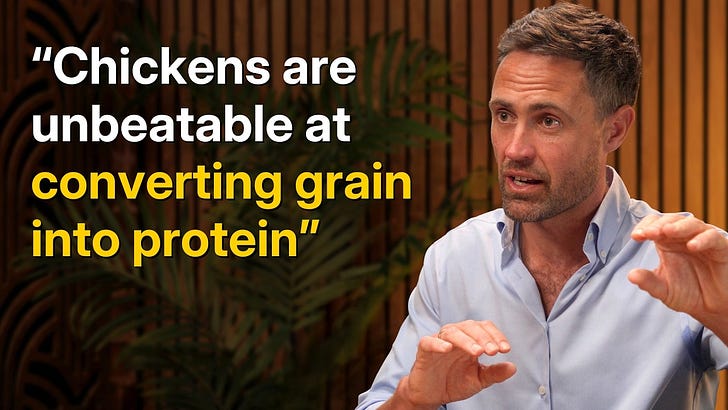
所以基本的效率在于动物,尤其是鸡,没错。
So the the basic efficiency is the the animal and the chicken in particular Yeah.
经过漫长的进化,它们能够摄入相对少量的谷物,并高效地将其转化为人们喜欢食用的蛋白质形式。
Has evolved over a very long time to be a being that can take in a relatively small amount of grain and convert it very efficiently into a form of protein that people like to eat.
因此,鸡的饲料转化率,即投入多少谷物能产出多少肉,大约是2比1。
So the feed conversion ratio for chickens, the amount of grain you put in to get meat out is like two two x.
而且这些谷物非常便宜。
And that grain is incredibly cheap.
对。
Right.
其余的生产过程非常便宜,因为他们已经去除了所有涉及成本的东西,比如善待动物、提供舒适环境等等。
And the rest of the production process is incredibly cheap because they've they've removed everything that costs money around, like, treating the animals well and providing comfort and all that stuff.
他们把这一切都删掉了。
They've just gotten rid of it all.
所以他们已经把成本压到了极其低廉的水平。
So they've gotten down to the point where it's insanely cheap.
所以你试图击败的是谷物价格的两倍再加上一些额外成本。
So you're trying to beat the price of grain times two plus a few extra costs.
这确实是一个非常难以达到的目标,这就是为什么如今工厂化养殖的鸡肉如此便宜的原因。
And that is that is actually a really hard, really hard target to meet, and and that's why factory farm chicken is so insanely cheap today.
也许这里可以举个直观的例子:我们每年花费数千亿美元来复制人类智能。
Maybe an intuition pump here is we've been spending on the order of hundreds of billions of dollars a year in order to replicate human intelligence.
而人类智能的发展——我不知道具体多久。
And human intelligence has been developed I don't know.
取决于你从什么时候开始计算,但智能的进化大约始于数亿到数千万年前,进化一直在优化这种智能能力。
It depends on when when you start counting intelligence has started evolving, but like on the order of hundreds to tens of millions of years ago, evolution has been trying to optimize for this intelligence thing.
而我们却不得不投入如此巨大的努力来复制它。
And we've had to spend all this effort in order to replicate it.
将热量转化为肉类,是进化数十亿年来一直在优化的事情,对吧?
Converting calories into meat has been something that evolution has been optimizing for billions of years, right?
所以从免疫系统到生长因子,再到营养输送、质地等等,这正是进化始终在努力的方向。
So everything from the immune system to growth factors, to delivering nutrition, etcetera, texture, whatever, this is this is what evolution is working on the entire time.
所以这解释了为什么这个问题实际上如此困难。
So it it makes sense why this is actually such a tough problem.
你准备好给你的朋友泼点冷水了吗?
Are you are you ready to throw some cold water on your friends?
培养肉到底还有多远?
How how far away is cultivated meat actually?
我认为这完全取决于我们从现在开始做什么。
I think it completely depends on what we do from here.
好的。
Okay.
而且这也取决于你所说的培养肉指的是什么。
So and it also depends on what you mean by cultivated meat.
目前有一些公司正在以极小的产量和极高的价格销售培养肉,这简直不可思议。
I mean, there are companies right now that are selling cultivated meat in very small volumes at very high price points, which is incredible.
从现在开始的挑战在于,如何扩大规模并将价格降至与工厂化养殖鸡肉极低的价格竞争的水平。
The challenge from here is how do you scale that and bring the price point down to compete with the incredibly low price point of factory farm chicken.
我认为,我们何时能实现这一目标,甚至能否实现,真的取决于从现在开始会发生什么。
And I think how long it takes to get there and indeed whether we get there really depends on what happens from here.
我们目前根本不在正确的道路上。
We are not we are not on a path right now.
就可用的风险投资金额和当前的初创公司而言,我们并没有走上一条能生产出比工厂养殖鸡肉更便宜的培养肉的道路。
When it comes to the amount of venture capital funding available, when it comes to the current startups available, we're not up on a path to reach cultivated meat that is cheaper than factory farmed chicken.
我认为我们可以走上这条道路。
I think we could get on that path.
抱歉。
Sorry.
永远。
Ever.
嗯,我的意思是,这要看情况。
Well, I mean, depends.
取决于通用人工智能的发展以及通用人工智能将带来什么。
Contingent on AGI and contingent on what happens with AGI.
对吧?
Right?
我的意思是,我不会完全排除这种可能性,但我不认为这是默认路径。
Like, I I wouldn't rule it out, but I don't think it's the default path.
我认为这并不是最可能的结果。
I don't think it's the most likely outcome.
但我的意思是,最终我们总会拥有纳米技术之类的玩意儿。
But, mean, eventually, we'll have, like, nanotech or whatever.
对吧?
Right?
到那时,养鸡肯定就不是该做的事了。
At that point, raising chickens can't be the thing to do.
你可能会这么想。
Well, you'd think.
比如纳米技术、机器人技术等等,但除非这些东西的成本降到接近零,否则鸡肉还是会便宜得离谱。
Like, nanotech and bringing robotics and all these things, but, like, unless the cost of all those things goes down to close to zero, chickens are just gonna be so insanely cheap.
嗯。
Mhmm.
所以是的。
And so yeah.
也许吧。
Maybe.
我觉得完全有可能这些AGI技术会带来一些全新的蛋白质,帮助我们解决这个问题。
Like, I think it is totally possible that these AGI technologies introduce incredible new proteins that that help solve this problem for us.
但我认为我们不应该依赖它。
But I don't think we should rely on it.
首先,因为它们可能无法将这些问题解决到鸡肉那样的低成本水平。
First, because they might not be able to solve some of these problems to the point that it is as cheap as chicken.
但其次,因为你仍然面临这些文化和政治障碍。
But second, because you still have these cultural and political barriers.
所以我认为这是一个非常有趣的例子,因为每当人们想到用技术改善动物福利时,他们想到的都是培养肉、实验室肉类。
So the reason I think this is a very interesting example is because whenever people think about the use of technology to improve animal welfare, they're thinking about cultivated meat, lab meats.
他们想到的都是这些极其遥远的解决方案。
They're thinking about these extremely far off solutions.
这就解释了为什么即使那些特别关注这个问题的人,第一反应也不是去寻找方法让现有的体系变得更可忍受,而是去提出一些能彻底改变整个范式的宏大构想。
And then it makes sense why even people who are especially concerned about the space, the first thought is not to just like find ways to make the existing regime more tolerable, but to come up with some moonshot that changes the whole paradigm.
如果你看看风投在培养肉上的投入有多少,我不知道你是否了解,大概知道吧。
If you look at how much VC investment is going towards cultivated meat, I don't know if you know, probably on the Yeah.
你有没有大致的概念,每年有多少资金投入到已有的养殖场,而不是去开发新的东西?
Do you have some sense of how much is goes into the year versus how much VC investment goes into, okay, we've already got the farms.
我们需要做些什么来提出更多这样的方案?
What is it that we need to do to make, come up with more things?
比如,让我们用核磁共振扫描鸡蛋。
Like, let's put the eggs through MRIs.
让我们在福利方面做一些其他的小改进。
Let's do these other small improvements in welfare.
是的。
Yeah.
这有很大的区别。
There's a huge difference.
我的意思是,人道技术领域的风险投资每年可能不到一千万美元。
So, I mean, it's it's probably the venture capital on the humane technology is is probably less than $10,000,000 a year.
一千万?
10,000,000?
这估计是我的猜测。
That would be my guess.
而替代蛋白领域的风险投资在过去几年里已经达到数十亿美元。
Whereas the venture capital on the alternative proteins has been in the billions over the last few
年。
years.
对。
Right.
这可能至少部分是出于我们能让事情变得更道德的这种认知。
Which has probably been motivated, at least partly, by the sense of we're gonna make things more ethical.
而且人们可能没有意识到,从短期来看,要让事情变得更道德,或许更好的做法是扩大这100亿美元的资金池。
And people might not realize that in the near term to actually make things more ethical, it might be just better to increase that 10,000,000,000 pool.
我认为两者都值得去做。
I think it's good to do both.
是的。
Yeah.
我觉得这两者都很重要。
Like, I I think both of these are important.
没错。
Right.
我认为我能理解为什么替代蛋白对投资者来说更具吸引力。
I think that I I can see why alternative proteins have a more promising allure to investors.
首先,它的利润率可能更高。
First, it could be higher margins.
但其次,它给人的感觉更像电动汽车或太阳能,能够彻底取代旧有的方式。
But but second, it feels more like the electric vehicle or the solar that just totally replaces the old practice.
对。
Right.
有一种全新的东西完全取代了它。
There's something totally new that that replaces that.
我认为它在某些市场领域具有这种潜力。
And I think it has that potential for some portion of the market.
但我看不到在不久的将来整个市场会全面转向这些替代蛋白。
But I what I don't see happening anytime soon is the entire market switching over to these alternative proteins.
因此,我认为我们需要替代蛋白来满足世界日益增长的蛋白质需求,以免我们只是不断加剧工厂化养殖。
And so I think we need alternative proteins to meet the world's growing demand for protein so that we don't just have ever more factory farming.
同时,我们也需要人道技术来减少现有工厂化养殖中的痛苦。
And we need humane technology to reduce the suffering within the factory farming that does exist.
所以,每当这种讨论出现时,通常都会从个人行为的角度来表述。
So, whenever a discussion like this comes up, it's often phrased in the context of personal behavior.
比如,人们可能会认为,我们最终会推动大家成为素食者。
Like, I think people will be assuming that where where we're gonna get up to is like this, push to make you vegetarian.
我恰好曾经是素食者。
And I, I happened to have been vegetarian.
我从小信奉印度教,所以从来没吃过肉。
I grew up a Hindu and so I've like never eaten meat.
即使后来我不再信印度教了,我还是继续当素食者。
And then I just stayed a vegetarian after, I was no longer a Hindu.
但当我开始准备采访你的时候,我心想:操。
But then I started prepping to interview you and I'm like, fuck.
我不知道这到底有多大的价值。
This might I don't know how valuable this is.
尤其是当我们看看一些在线慈善评估机构时,你会发现你捐出的一美元就能减少这么多肉类消费。
Especially if we look at some of these online charity evaluators and you're just like, a dollar of your donation will offset this much meat eating.
然后你就会想:我们到底在干什么?
And you're like, what are we doing here?
但不管怎样,素食主义被高估了。
But anyways, vegetarianism overrated.
我认为我们作为一个运动犯了一个错误,是的。
I think we made a mistake as a movement Yes.
把重点放在个人饮食上。
Making this about personal diet.
对。
Right.
我觉得当人们想要做出个人饮食决定时,无论是减少吃肉还是选择更人道的肉类来源,这很好。
I think it's it's great when folks wanna make a personal diet decision whether that is eating less meat or meat from more humane sources.
但重点不应该是个人。
But the focus should not be on the individual.
大规模的社会变革不是这样发生的。
This is not how large scale social change occurs.
我认为我们需要政府改革。
I think we need government reform.
我认为我们需要企业改革。
I think we need corporate reform.
无论人们吃什么,无论他们的饮食如何,都可以参与其中。
And people can be a part of that regardless of what they eat, regardless of what their diet is.
我认为我们需要人们成为这一事业的倡导者、资助者和支持者。
I think that we need people to be advocates and funders and supporters of this cause.
那么,我们是怎么陷入这种境地的呢?当人们想到动物福利时,他们想到的往往是PETA。
So how did we end up in this position where so much, I think when people think about animal welfare, they they think PETA.
他们想到的是鼓励个人放弃肉类消费的抗议活动。
They think of, like, protests which are encouraging individuals to give up meat consumption.
与此同时,这些慈善机构在推动企业或政策变革方面如此有效,却如此被忽视。
At the same time, these charities, are so effective at corporate or policy change, just so neglected.
动物福利倡导和资助的格局为什么会变成这样?
How did this end up being the landscape of animal welfare activism and funding?
是的。
Yeah.
我觉得这真是个谜。
I I think it's a puzzle.
我的意思是,政府层面和企业层面能带来更大规模的改变,这似乎显而易见。
I mean, it seems so obvious that you can have far larger scale change at the level of governmental change and and corporate change.
但我们却执着于某人是否完全素食或纯素食,我认为当人们最初了解这个问题时,只有少数人,他们觉得自己完全无力实现更大规模的改变。
And instead, we get fixated about whether someone is completely vegan or vegetarian or like and I think what happened is when people started learning about this issue initially, it was just a few people and they felt totally powerless to achieve larger scale change.
因此,他们很自然地把注意力放在了自己身上。
And so they understandably focused on themselves.
然后这开始变成一种自我实现的预言。
And then it started to become a self fulfilling prophecy.
它逐渐变成了一种终极目标,即个人的纯洁性与你对问题的实际影响同等重要。
It started to become an end in itself where it was about personal purity as much as about the impact you're having on the issue.
衡量你个人的纯洁性,远比衡量你对改革工厂化养殖的整体影响要容易得多。
And it's much easier to measure your own personal purity than it is to measure your total impact on reforming factory farming.
因此,我认为这逐渐变成了一种向内的关注。
And so I think it just became this kind of inward focus.
好消息是,我认为在过去十年中,这种情况已经发生了巨大变化。
And the good news is I think that has changed tremendously in the last decade.
我认为这个运动已经从过去痴迷于个人纯洁、痴迷于饮食选择,转变为更加关注实际影响。
I think the movement has gone from being one that was obsessed with personal purity, obsessed with dietary choices to one that is much more obsessed with impact.
好的。
Okay.
所以这正是我为什么特别想做这一集的原因——我认为人们会意识到这里存在一个普遍问题,但实际的政治、经济以及技术格局可能存在着一些极其有效的干预措施,却因为人们不了解这个领域正在发生什么而被忽视。
So this is why I really wanted to do this episode, which is I think people will be aware that there's a general problem here, but the actual politics and the actual economics, the actual state of the technology landscape here, There might be interventions which are stupendously effective, which would overlook just because people are not aware of what's actually happening in this space.
就这一点而言,借用全球健康与贫困领域的类比,反疟疾基金会估计它拯救了大约十八万条生命,这已经很多了。
So on that point, to use an analogy from global health and poverty, the Against Malaria Foundation estimates that it saved on the order of one hundred and eighty thousand lives or something, which is a lot.
但当你将其与中国改革开放使十亿人摆脱贫困相比时,
And but then you compare it to China liberalizing, brought a billion people out of poverty.
那影响要大上好几个数量级。
That that just like a many, many orders of magnitude bigger impact.
在动物福利领域,你有没有一些类似‘中国改革开放’那样的重大见解?
In animal welfare, do do you have some, like, big take about what the China liberalizing equivalent in this space is?
有的。
Yeah.
我认为到目前为止,推动进展的有三大主要驱动力。
I think there have been three large scale drivers of progress so far.
首先是政府政策。
So the first has been government policy.
倡导者促使欧盟制定了基本的动物福利标准。
So advocates got the European Union to set basic animal welfare standards.
这每年影响着数十亿动物。
That is billions of animals every year.
嗯。
Mhmm.
每年数十亿只。
Billions every year.
然后是企业改革,我们看到这些企业供应链上同样存在着巨大的规模效应。
Then there's corporate reforms, and we see the same thing that there's this incredible scale across these corporate supply chains.
我的意思是,麦当劳刚刚实施了其在美国实现无笼养的承诺。
I mean, McDonald's just implemented its pledge to go cage free in The US.
仅麦当劳供应链中,每年就有七千万只母鸡因此摆脱了笼养生活。
That alone is 7,000,000 hens every year out of cages just in the McDonald's supply chain.
第三大推动力是技术。
And then the third lever is technology.
一个例子是Innovosexing技术,它能消除蛋产业中杀害雄性小鸡的必要性。
One example would be Innovosexing as a new technology that can get rid of the need to kill male chicks in the egg industry.
那些不被需要的小鸡在出生时就被杀死。
The unwanted chicks are are killed at birth.
而Inovo性別鑑定技术已经让约两亿只小鸡免于这种命运。
And Inovo sexing has already spared about 200,000,000 chicks from that fate.
因此,这些是巨大的推动力,而好消息是我们才刚刚开始利用它们。
So there are these giant drivers, and the good news is we're just getting started with them.
我认为,通过这些推动力,我们有可能帮助数百亿只动物。
There is the potential, I think, to help tens of billions of animals through these drivers.
好的。
Okay.
我想聊聊Inovo sexing技术。
I wanna go into Inovo sexting.
嗯。
Yeah.
仅仅因为你可以拥有新技术,并且基本上实现帕累托改进——成本并没有上升。
Just the fact that you can have a new technology and you can have basically Pareto improvements where things aren't getting more expensive.
也许未来由于这项技术,成本实际上还会下降。
Maybe in the future they'll actually get cheaper because of this technology.
同时,动物福利也得到了改善。
At the same time, you're having improvements in animal welfare.
当然,这个行业过去的问题是,效率的提升总是伴随着残忍程度的增加。
The problem of course, with this industry has been that in the past increases in efficiency have been coupled with increases in cruelty.
所以我想了解,当趋势走向相反方向时,是什么导致了这种情况?
So I wanna understand whenever the trend goes in the opposite direction, what causes that to be the case?
那么这项技术的历史是怎样的?
So what is the history of this technology?
它是怎么运作的?
How does it work?
为什么它花了这么长时间才被广泛采用?
Why did it take so long for it to come into common practice?
当然。
Sure.
是的。
Yeah.
所以,从历史上看,这是一个技术造成伤害的故事:最初,蛋鸡产业和肉鸡产业是分开的。
So I mean, the the historical basis is a story of technology doing harm, which was we initially, the egg industry and the meat chicken industry separated
嗯。
Mhmm.
因为他们意识到可以将肉鸡培育成以增重为目标,而蛋鸡则以产蛋为目标。
Because they realized they could grow meat chickens to be optimized for weight gain and laying hens to be optimized for laying eggs.
这意味着蛋鸡产业不需要公鸡雏,因为它们既不能下蛋,也长不够快以成为肉鸡。
That meant that the laying egg industry had no need of the male chicks because they couldn't lay eggs and they couldn't grow fast enough to be meat chickens.
因此,他们决定在小鸡出生当天就将其杀死。
And so what they decided was to just kill them on the day they were born.
因此,全球每年约有80亿只小鸡在出生当天就被扔进大型绞肉机或装进袋子闷死。
And so the standard practice, and this is about 8,000,000,000 chicks globally every year, are just thrown in a giant meat grinder or suffocated in bags the day they're born.
太疯狂了。
Crazy.
这项新技术基本上是将现有技术应用于提前扫描鸡蛋,以判断其性别是雄性还是雌性。
This new technology is basically the application of existing technologies to scan the eggs in advance and work out whether they're gonna be male or female.
然后你可以在孵化早期就淘汰雄性鸡蛋。
And then you can just get rid of the male eggs very early in the incubation phase.
这项技术从十年前只是一个模糊的想法,发展到了今天。
And this technology went from ten years ago just being a vague idea to today.
它现在已经覆盖了欧洲蛋业的三分之一。
It's already a third of the European egg industry.
嗯。
Mhmm.
这项技术刚刚被引入美国。
It just got introduced to The United States.
我们现在在美国已经看到了首批鸡蛋产出。
We've got the first eggs coming out in The United States now.
这项技术正在迅速发展,我非常乐观地认为它最终能够在全球范围内解决这个问题。
So this is a technology that is growing rapidly, and I'm really optimistic can can ultimately end this problem globally.
这项技术的发展在多大程度上是由政策推动的,而不是因为技术已经成熟到足以经济可行?
And how much was this driven by policy versus the tech being mature enough for it to be economical?
我认为两者都有。
I think it was both.
首先,之前有一些政策推动,因为倡导者已经引起了人们对杀害雄性小鸡这一做法的关注。
So first, there was some policy upfront, which was because advocates had drawn attention to this practice of killing male chicks Right.
政府和慈善家们确实有动力支持这项技术的启动。
There was real impetus by governments and philanthropists to support kick starting this technology.
我估计,大约有一千万美元的公共和慈善资金启动了这项技术,使其达到初创公司能够开始实施的阶段。
And my estimate is it was about $10,000,000, very little amount of public and and philanthropic money that kick started this technology, got it to a point where startups could start to implement the technology.
我很想知道具体原因,因为核磁共振成像(MRI)已经存在很久了,PCR技术也已经存在很久了。
I'd be curious to understand exactly because MRIs have existed for a while, PCRs existed for a while.
那么,为什么这项技术花了这么长时间才变得经济可行呢?
So why it took this along for this to be economical?
那个成本曲线的性质是怎样的?
What what are the nature of that cost curve was?
我特别感兴趣的是,这似乎意味着我们并不需要发明某种全新的技术来实现这一点。
And I'm especially interested to understand this because it seems to imply that look, I mean, we didn't have to come up with some brand new tech in order to enable this.
那么,是否还有其他领域,那些对技术格局有一定了解的人,总是在寻找创业点子?
So are there other things where somebody who is somewhat familiar with the technological landscape, people are always looking for startup ideas.
对吧?
Right?
是的。
Yeah.
是的。
Yeah.
他们是不是应该花几天时间去大型家禽养殖场或养猪场看看,能不能改进一些做法?
Should they just spend a couple days at a big poultry farm or a pig farm or something and see if things can't be improved?
是的。
Yeah.
我认为这里对技术人员来说有着巨大的潜力。
I think there's huge potential for technologists here.
我的意思是,这里有很多低垂的果实,因为这本质上是一个商品行业,过去只关注降低成本或提高产量。
I mean, there is a lot of low hanging fruit because this is primarily a commodity business that has only done things that reduce the price or increase production levels.
是的。
Yeah.
它从未投资于动物福利。
It has not invested in animal welfare.
因此,你会看到一些做法显得非常原始。
And as a result, you find these things it's doing that just seem archaic.
比如,给小猪阉割时用的是钝刀,而且没有任何止痛措施。
Like, the way that it is castrating piglets is with a blunt knife and like no pain relief.
因此,在这种情况下,出现了一种新的免疫去势技术,通过注射就能达到相同的效果,而且非常容易开发。
And so in that case, there was a new technology of immunocastration, an injection that achieved the same effects, and and it was very easy to develop.
所以我认为,还有很多类似这样的做法。
And so I think there are a whole lot of other practices like that out there.
有很多这样的护理措施正在被实施,如果有人能以聪明的方式介入,真正关注动物福利,就有可能带来价值数十亿美元的解决方案。
There are a whole lot of these care practices being done where someone could come in and with a little bit of smart work around this and an actual focus on animal welfare, bring in solutions that could potentially help billions of dollars.
我认为你指出的这个行业的一个重要动态是:当我们不得不无情地优化某一领域的效率时,就会引发各种其他问题,而我们又不得不以更多的残忍手段来弥补。
I think one important dynamic to this industry that you pointed out is that we have to ruth whenever we have to ruthfully optimize for efficiency in one domain, it causes all kinds of other problems that we have to then make up for with even more cruelty.
想想我们对猪做了些什么。
I mean, think of think of what we've done to pigs.
是的。
Yeah.
所以当我们把猪从户外移到室内时。
So when we took pigs inside from from outdoors Yeah.
我们选择让它们长得更快,并且无意中导致了更大的行为退化,首先出现的问题就是它们感到无聊,开始咬彼此的尾巴。
And we selected them to grow faster and to have this inadvertent greater regression, the the first thing we started doing was getting bored and biting each other's tails.
对。
Right.
这成了一个问题。
And that was a problem.
所以我们说,把尾巴剪掉吧。
So then we said, we'll cut the tails off.
但这没用。
Well, that didn't work.
于是我们不得不开始磨牙,切掉部分牙齿。
So then we had to start clipping the teeth and cutting part of their teeth off.
当涉及到母猪时,这还不够,所以我们不得不把她们关进限位栏里,对吧。
And then that stool wasn't enough when it came to the sows, so then we had to put them in crates Right.
以保护她们不受其他动物伤害。
To protect them from from any other animal.
这还不够,所以我们给她们用了抗生素和其他药物。
That wasn't enough, so then we gave them antibiotics and other drugs.
在每一个步骤中,都会出现一个新的解决方案,但都无法解决这个问题的根本所在。
At each step, there is a new solution that that can't solve the fundamental underlying parts of the problem.
有时甚至让情况变得更糟。
And sometimes just makes it sometimes just makes it worse.
我们能不能培育出没有大脑的鸡或猪?
Could we make chickens or pigs with no brains?
对吧?
Right?
因为我们关心的是它们的痛苦。
Because there's a suffering we care about.
所以,从某种程度上说,它们的身体只是极其高效进化的生物反应器,用于将谷物转化为肉类,而这种优化在过去却导致了越来越多的残忍行为。
So to the extent that their bodies are just these incredibly well evolved bioreactors for converting grain into meat, whereas optimization has led to more and more cruelty in the past.
在这种情况下,这难道不是终极的优化吗?
In this case, like this is the ultimate optimization, right?
它们根本不会移动。
They're not moving around at all.
它们纯粹就是生产更多肉类的机器。
They are literally just a machine for producing more meat.
是的。
Yeah.
而痛苦在某种意义上是低效的,对吧?
And then the suffering is in some sense inefficient, right?
比如,这会让它们去啃咬其他动物,或者撕扯棉线等等。
Like it causes them to, you know, if they're pegging at other animals, if they're cutting cotton wires, etcetera.
这其实是一种即使从经济角度考虑也最好消除的现象。
This this is something that, like, it would be better even economically to eliminate.
我觉得你说得对。
I think you're right.
从单个动物的角度来看,痛苦是不经济的。
The suffering is uneconomical at the level of an individual animal.
因此,我们选择培育的动物以及对待它们的方式,导致了更多动物死亡,以及更多福利问题。
So, like, the animals that we have selected for and the way we have treated them result in more of those animals dying, more of them having all kinds of welfare problems.
问题是,从集体角度来看,这更有效率。
The problem is that it is collectively more efficient.
所以,如果你能把两倍数量的动物塞进一个畜棚里
So, like, if you can cram twice as many animals into a barn
对。
Right.
即使多死百分之十的动物也没关系。
It doesn't matter if ten percent more of them die.
是的。
Yeah.
因此,这一直是该行业的基本模式,是的。
And so that's been the underlying model of this industry Yeah.
福利被忽视的原因就在于,它确实有轻微的成本,但效率的提升要大得多。
Is that the reason welfare gets neglected is, yeah, it has like a slight cost, but the efficiency gains are so much greater.
所以,我同意我们应该努力寻找方法来扭转这种情况。
So I agree we should try and find things to reverse that.
我的意思是,我个人对这类渐进式改革更乐观。
I mean, I am personally more optimistic about these kind of incremental reforms.
比如,听这个节目的普通人并不会想:哦,没错。
Like, think the average person listening to this is not thinking like, oh, yeah.
我真的很期待那种无脑鸡的到来,能让我信服。
I'm really pumped for, like, the chicken the the brainless chickens to come along and, like, just just persuade me.
但他们对培养肉并不兴奋。
But but they're not pumped about the cultivated media.
对吧?
Right?
不。
No.
当然。
Sure.
而这正是你需要多种不同方法的原因。
And and, like, this but this is why you need a whole bunch of different approaches.
对吧?
Right?
这就是为什么,因为根本不存在一种能令所有人满意的解决方案。
Like, this is why because, like, there's no one solution that is gonna satisfy everyone.
至于遗传学,我认为在近期内更切实可行的是消除这些动物所遭受的遗传性生理问题。
And what I would say on the on genetics is what feels way more achievable to me in the near term is to get rid of the genetic physical problems that ail these animals.
比如,我们已经培育出这些鸡,让它们变成会因自身体重而崩溃的突变体。
So for instance, we've bred these chickens to be mutants that, like, collapse under their own weight.
我们知道,可以培育出福利更高但仍具商业可行性的禽类。
We know that we can breed for far higher welfare birds that are still commercially viable.
事实上,已经有公司,比如丹麦的一些地方,整个产业已经完全转向这些福利更高的禽类,它们的福利状况好得多。
And indeed, there are companies and there there are places like Denmark where the industry has already moved entirely toward these higher welfare birds they have way better welfare outcomes.
它们遭受的痛苦少得多。
They suffer way less.
它们有什么不同?
What what's different about them?
所以它们首先在整体上更加平衡。
So so the first thing about them is they are more balanced overall.
因此,行业只选择快速生长胸肉和高效饲料转化率,而这些鸟类则被培育得更具韧性。
So where the industry has just selected for rapid breast meat growth and for really efficient feed conversion, These birds have been bred to have robustness.
所以它们的腿更粗壮,不会塌陷。
So they have broader legs, so, like, their legs don't collapse.
它们的心血管系统更好,因此不会出现各种心血管问题。
They have better cardio systems, so they don't develop all these cardio problems.
总的来说,它们是被专门为了福利目标而培育的。
And in general, they've just been bred for welfare outcomes.
我们就只是培育一大批鸡,然后选出那些死亡率更低、总体状况更好的。
Like, we're just like, let's just breed a bunch of birds and find the ones that die less and, like, generally
它们是
And are they are
它们更不经济吗?
they less economical?
它们稍微不那么经济。
They're slightly less economical.
我的意思是,这正是原因,因为它们并没有被无情地选育以追求胸肉产量和饲料转化率这两个指标。
I mean, this is why because they have been they haven't been ruthlessly selected for those two two variables of breast meat yield and and feed conversion.
所以它们的成本略高一些,这就是为什么你需要倡导来推动人们采用它们。
So they cost a little bit more, and this is why you need advocacy to get people to adopt them.
对吧?
Right?
因此,法国、德国和丹麦已经开展了大规模的倡导活动来推广这种鸡。
And so there has been huge advocacy in France, in Germany, in Denmark to get this.
事实上,就在上个月,法国最大的鸡肉生产商LDC集团承诺将其两大品牌转向这些更高福利的品种。
And in fact, just last month, the largest French chicken producer, the LDC group, committed to moving its two main brands to these higher welfare genetics.
为什么不认为它们的福利影响最终会被吞噬呢?
Why not think that they will just be eaten up in terms of their welfare impact?
考虑到整个行业一个世纪以来的经济模式都是尽可能多地拥挤饲养,想办法沿着那些让动物变得极度不健康、长期遭受痛苦的维度进行优化。
To the extent that the economics of the industry for a century have been cram more things in, you know, figure out how to optimize along axes, which just make the animal incredibly unhealthy and immiserated for longer and in more extreme ways.
比如,我们会开发一种全新的性别鉴定方法,但接着又会出现另一种相当于妊娠栏的问题。
Like, okay, we'll come up with an de novo sexing, but then there'll be another thing which is the equivalent of gestation crates.
为什么认为即使在技术上,被青睐的也是无痛苦的优化方案呢?
Why think that even technologically, the thing that is favored is the, is the suffering free optimizations?
是的。
Yeah.
我的意思是,你说得对。
I mean, I I think you're right.
这正是行业改善动物福利的许多努力所呈现的故事。
This is the story of a lot of the industry's efforts to improve welfare.
例如,上世纪九十年代有一项研究,他们教会鸡选择含有止痛药的饲料,结果发现肉鸡都选择了含止痛药的饲料,表明它们都处于慢性疼痛中。
So for example, there was a study back in the nineties where they taught chickens how to select pain relief laced feed, and they found the broiler chickens were all selecting the pain relief laced feed, suggesting they're all in chronic pain.
是的。
Yeah.
而行业却说:别担心。
And the industry said, like, don't worry.
我们会解决这个问题。
We'll address it.
比如,我们会增强它们的腿力。
Like, we'll strengthen their legs.
于是他们去做了,稍微增强了它们的腿力。
So they went away, and they, like, strengthened their legs for a bit.
然后他们说:哇。
And then they were like, wow.
太棒了。
It's great.
鸡的腿现在更强壮了。
Like, the chickens have stronger legs now.
它们可以去吃更多东西,我们也能在它们腿上增加更多重量。
Like, they can, like, go and eat more stuff and we can put more weight on those legs.
于是他们让鸡长得更大,实际上抵消了那些改进。
And so then they made them, like, bigger and essentially undid those gains.
近年来,我们看到该行业的死亡率再次上升并恶化。
And in recent years, we've seen the mortality rate in the industry rising again and getting worse.
因此,他们显然又在这个方向上推进得太远了。
So presumably, they have just pushed so far again in that direction.
我认为这是一个主要风险。
So I think that's a major risk.
我认为这就是为什么需要政府或企业参与的原因。
I think this is why you need government or corporations involved.
这就是为什么需要政府制定一个基本标准,规定不能低于这个福利底线。
This is why you need government sending down a baseline standard saying, you can't go below this welfare floor.
例如,在丹麦,政府正在大力推动转向高福利品种,并计划全面禁止低福利结果的品种。
For instance, in Denmark, the government is strongly encouraging the move toward these high welfare breeds and looking to ban low welfare outcome breeds entirely.
你需要维持这些高福利成果。
And you need to maintain those you need to maintain those high welfare outcomes.
我认为企业供应链中也需要这样的措施。
And I think this is what you need in corporate supply chains too.
展开剩余字幕(还有 480 条)
因此,这也是你看到法国零售商正在远离这些低福利品种的原因。
So this is also what you see with, like, the French retailers moving away from these low welfare breeds.
你需要他们维持这些标准,因为你说得对。
You need them to maintain those standards because you're right.
如果任由行业自行其是,总会陷入竞相压低标准的恶性循环。
The industry left to its own on its own will always find a race to the bottom.
因此,我们或许可以通过未来生物技术的进步,让动物变得更大,正如我的一些嘉宾所讨论的那样。
So potentially, we could find ways to make animals even bigger with the future forms of biological progress that some of my guests talk about.
事实上,现在吃牛肉比吃鸡肉更好,因为牛每单位大脑对应的肉量要多得多。
It's already the case that it's better to eat beef than chicken because cows just have so much more meat per brain.
如果我们去除肌抑素抑制基因之类的,让每头牛的肉量更多,这会更好吗?因为每头牛的肉更多了,还是更糟?因为这可能导致动物过度生长,承受更多痛苦?
What if we just got rid of the myosin inhibitor genes or whatever, and then now that there's even more meat per cow, is that better because you have more meat per cow or is it worse because it's potentially going to lead to the same dynamic of these overgrown, more suffering animals?
这种趋势会朝哪个方向发展?
Which way does that tilt?
我认为这可能会导致更多的痛苦。
I think it probably tilts toward more suffering.
嗯。
Mhmm.
这就是你看到的鸡的育种历史,它们如今变成了这样的突变体。
This is what you see with the history of breeding these chickens to be the kind of mutants they are today Right.
自20世纪50年代以来,它们的生长速度提高了四倍。
Where they've achieved a four x gain in growth rates since the nineteen fifties.
这导致价格下降了一半,并使消费量增加了三倍。
That has led to a two x drop in price, and that has led to a three x increase in consumption.
由于消费量急剧上升,而每只鸟的痛苦也大幅增加,这已经超过了这些鸡体型变大所带来的好处。
And because consumption has gone up so dramatically and the suffering per bird has gone up so dramatically, that has outweighed the benefits of these birds being bigger.
但消费量可能无论如何都会上升。
But the consumption might have gone up regardless.
所以实际上,这一点并不明确。
So actually then it's not clear.
如果我们在消费量保持不变的前提下来看,也许我们不应该这么做。
They would have to be to the extent that we hold consumption constant, maybe maybe we shouldn't.
只有当它们的痛苦是二十世纪五十年代鸡的四倍时,这才不是净改善。
They would have to be suffering four x as much as a chicken in the nineteen fifties for it to be a not be a net improvement.
我不确定你是否不同意这个
I don't know if you disagree with the
不。
No.
不。
No.
所以我认为现在存在一个中间解决方案,即我们倡导生产者采用的高福利品种,并非回到二十世纪五十年代的生长水平。
So I think there's there there is a in between ground solution now, which is the higher welfare breeds that we are advocating for producers to adopt are not nineteen fifties growth levels.
它们的生长速度接近2025年的水平,但略有放缓,从而能实现更大的福利提升。
They grow almost at 2025 growth levels scaled back slightly in a way that enables much larger welfare improvements.
对。
Right.
因此,我认为你不必倒退到那些生长极其缓慢的动物的水平。
And so I think you don't have to go backwards to to the level of these incredibly slow breeding growing animals.
有些人会想要那种。
Some people will want that.
我的意思是,会有一个市场,比如对遗产鸡的需求,以及那些愿意为这些生长极其缓慢的动物支付高价的人。
Mean, there'll be a market for, like, heritage chickens and people who are willing to pay for these, like, extremely slow growing animals.
但在大规模情况下更现实的做法是,这些鸡仍然生长迅速、体型庞大,但方式不会彻底摧毁它们的身体,也不会让它们承受如此多的痛苦。
But the the more realistic thing at scale is gonna be these ones who still grow fast and still get big, but do so in a way that doesn't totally destroy their bodies and cause them to suffer so much.
我突然意识到,我们对这些动物所做的事情,与其说是从野外抓来动物然后关进笼子并施加可怕的折磨,不如说这已经极其不道德了。
It's just striking me now that the way to think about what what we're doing to these animals is not even and this is already be just incredibly immoral, is finding creatures in the wild and then caging them up and then putting them through awful tortures.
相反,我们实际上是在制造专门优化用于承受痛苦的生物。
Rather we are manufacturing creatures basically optimized for suffering.
对吧?
Right?
这甚至不是说我们找到了一只鸡,然后把它放进一个小笼子里。
It's not even that like we found this chicken and now we're gonna put this in this like little cage.
而是我们设计了这种鸡,让它几乎能承受最大程度的痛苦。
It's like we have designed this chicken to basically suffer as much as possible.
我们实际上已经利用当今可用的技术,以一种类似弗兰肯斯坦式的方式,尽可能地改变了它们的基因,使它们承受最大的痛苦。
We have like literally genetically changed it as much as we can plausibly change it given the technology available to us today in like this in this Frankensteinian way to suffer as much as possible.
我不知道。
I don't know.
这种说法让事情显得尤其残忍。
That framing just makes it like, yeah, especially gruesome.
我同意。
I agree.
我的意思是,
I mean,
鸡肉产业的故事就是,他们不断育种,让这些动物承受越来越多的痛苦。
this is the story of the chicken meat industry is they have just bred and bred so these animals suffer more and more.
我再给你举个例子,就是种禽。
I'll give you another example of that, which is the breeding birds.
那些被饲养用于肉用的禽类,其设计只允许它们存活到大约七到八周龄。
So the birds that they have have that are raised for meat are optimized to only survive until about seven or eight weeks of age.
即使到了那个年龄,很多鸡都会倒下、跛行、瘫倒。
And even by that age, a lot of them are keeling over, getting lame, collapsing.
但它们还没到青春期,所以他们需要让一些鸡活过青春期,以繁育下一代。
But they're not at puberty yet, so they need to raise some of these birds past puberty to raise the next generation of birds.
为了让这些鸟不因基因问题彻底崩溃,他们必须让它们挨饿。
For those birds to not totally collapse under their genetics, they have to starve them.
因此,他们给种鸟提供的饲料量只有它们自己正常食量的30%。
And so what they do is they give the breeding birds about 30% of the feed that the birds would eat on their own.
所以它们被饿了70%,因为这是阻止这些鸟因人类强加的基因而完全崩溃的唯一方法。
So they're like starving them 70% because that is the only way to stop these birds from completely collapsing under the genetics that they've inflicted on them.
在
In
只是读到关于猪在妊娠栏中的情况描述,比如肿胀的脚踝、骨折——显然是因为啃咬铁栏所致,还有各种淤伤、溃疡、肿瘤、癌症、化脓等等。
just reading about the accounts of, for example, pigs in gestation crates and the medical symptoms, like swollen ankles, broken bones, obviously from chewing the iron bars, all the bruises that causes, ulcers, tumors, cancers, pusses, etcetera.
这些并不是罕见的医疗突发事件,而是猪群中普遍预期的常态结果,单个农场通常会饲养成千上万头猪。
These not being rare medical emergencies, but the regular anticipated expected outcomes across populations of pigs, which individual farms will house like thousands of them.
当然,全世界有十亿只。
Of course, around the world, a billion.
我相信你自己也去过很多这样的地方,或者有朋友去过。
I'm sure you've visited many of these places yourself or have friends who've done so.
对吧?
Right?
是的。
Yeah.
我的意思是,我参观过一些工厂化农场,不得不说,实际情况和网上视频里看到的一模一样糟糕。
I mean, I've I've visited factory farms and I will say it is every bit as bad as it looks on the videos you can find online.
真的是一模一样,我的意思是,你首先听到的是这些动物痛苦的尖叫声。
It is every bit I mean, the the the addition you see is well, first, you you hear the noise, the the the distress yelps from these animals.
气味非常难闻。
You smell smells awful.
但另一点我注意到的是,我参观过一个蛋类工厂化农场,农民根本不可能为每一只鸟提供个体护理。
But the other thing I I noticed, I visited one egg factory farm, and it's impossible for farmers to provide individual care to each of these birds.
这是一家管理得相对不错的农场,但我还是发现很多母鸡被卡在铁丝网里。
This was a relatively well run farm, and yet I still found a whole lot of hens stuck in the wire.
这些母鸡只会慢慢饿死。
And those hens are just gonna slowly starve.
也就是说,根本没有,而且确实有很多母鸡都这样。
Like, there is no and and indeed, many had.
其他笼子里,死鸟和活鸟混在一起,数量很多。
There were a lot of dead birds in with the live birds in other cages.
这仅仅是因为规模太大了。
And that's just because of the scale.
一个农民要照顾大约二十万只母鸡。
It's like one farmer is trying to look after, like, 200,000 hens.
他们唯一能做的就是检查饲料线和水管,顺便清理一些死鸟。
It's like the only thing they can actually do is check the feed lines and check the water lines and, like, remove some of the dead birds.
是的。
Yeah.
事实上,工厂化农场主的大部分工作就是移除死去的动物。
And in in fact, that is the the work of a factory farmer is largely removing dead animals.
嗯。
Mhmm.
因此,这简直是一种反乌托邦的景象:行业却向人们展示出一种假象,仿佛我们对动物有着个体化的关怀。
And so it is just this dystopian thing where, like, the industry presents this picture of, like, oh, we have, individual care for our animals.
但你所进行的规模之大,完全杜绝了任何这种个体化关怀的可能性。
And it's like, the scale at which you were doing it has totally prohibited having any kind of individual care like that.
没错。
Right.
这是一个规模敏感性的问题,其严重程度简直令人发疯,对吧?
And this is an issue where a scope sensitivity is just is it is, like, so insane the magnitude, right?
如果世界上只有这一个笼养鸡场,会怎么样?
If this one battery cage farm was the only thing that existed in the world, right?
在印度有一个农场,养了十万只鸡,每只鸡一生中都经历了数周乃至数月的痛苦。
There was like this one farm in India that had a 100,000 chickens, which were each just experiencing weeks upon weeks of pain through their life.
这本身就已经是道德危机了,但人们很容易忘记,如果世界上任何时候都有100亿只鸡,那么整个问题的规模比这一个农场还要大五个数量级。
That would already be a moral emergency, but it just, it's so easy to forget that if there's 10,000,000,000 chickens that are alive at any point in the world, the whole problem is five orders of magnitude bigger than this one farm itself.
比这个农场大十万倍。
A 100,000 times bigger than this one farm.
要理解这个问题的规模,简直令人难以置信。
It's just like stupendous to comprehend the scale of the problem.
这太疯狂了。
It's crazy.
而且你能看到我们所通过的法律中这种彻底的混乱。
And and you see this total confusion in the laws we pass.
例如,斗狗——这确实是一种邪恶行为,非常可怕,但我们谈论的只是数千只动物。
So for instance, dogfighting, which is a real evil, it's horrific, but we're talking about thousands of animals.
而国会已经通过了多项法律。
And Congress has passed multiple laws.
每个州都将它定为重罪。
Every state's made it a felony.
它正被以正确的方式监管到消亡。
It is being regulated correctly out of existence.
与此同时,猪的工厂化养殖规模要大得多。
Meanwhile, the factory farming of pigs occurs on this far greater scale.
我的意思是,我们甚至对斗鸡也做了同样的事,而斗鸡本质上就是鸡。
I mean, we've even done the same thing with cockfighting, which is literally chickens.
而且这确实是成千上万只鸡,我们已经正确地禁止了它。
And it's literally, again, thousands of chickens, and we have rightly banned it.
我们正确地将其定为重罪动物虐待。
We've rightly made it felony animal cruelty.
然而,当工厂化农场对数量多得多的鸡实施更恶劣的对待时,我们却称之为商业。
And yet when factory farmers do far worse to far larger number of chickens, we call that commerce.
对。
Right.
没错。
Yep.
好的。
Okay.
所以,从积极的角度来看,正因为这个问题规模巨大且被严重忽视,任何一个人可能产生的巨大影响真的会让人震惊。
So the positive spin on that can be that because of how big the problem is and how neglected it is, the ability of any one person to have a big impact might genuinely shock them.
那我们来深入探讨一下。
So let's get into that.
你是这个领域最大的资助者,但综合你和其他人的投入,目前有多少‘明智的资金’被分配到这个问题上?
You are the biggest funder in this space, but cumulative between you and the others, what is the amount of smart money that is being allocated to this problem?
是的。
Yeah.
我们认为,全球范围内,所有可能解决工厂化养殖问题的举措加起来,获得的资金不到3亿美元。
So we think less than $300,000,000 is being devoted to all work globally around every possible solution to factory farming across every country.
而其中,你可能认为属于基于证据的有效干预措施的‘明智资金’还不到2亿美元。
And less than 200,000,000 of that is what you would probably consider smart money going to evidence based effective interventions.
为了便于理解,仅慈善领域的气候倡导资金就比这个数字大了50倍。
So to put that into perspective, philanthropic climate advocacy alone is 50 times bigger than that.
仅在美国,猫狗救助组织的工作投入就是这个数字的25倍。
The the work of cat and dog shoulders and rescue groups in The US alone, 25 times bigger than that.
有一些单独的保护和扶贫慈善机构,其规模是这个数字的五到十倍。
There are individual conservation and poverty charities that are five to 10 x bigger than that.
因此,对于社会改革而言,这笔资金非常少,但它已经取得了巨大成就,影响了数亿甚至数十亿的动物。
So this is a tiny amount of money for the purpose of social reform, and yet it has achieved a huge amount impacting hundreds of millions, billions of animals.
如果这个领域的资金从您提到的20.31亿美元的明智投入翻倍,会发生什么?
What would happen if the amount of funding in this space doubled from the $203,100,000,000 you mentioned that is being spent smartly?
我知道你会说,我们还有很多可以优化的地方。
I know you'll say there's a bunch of things we could optimize around.
对吧?
Right?
有这么多被忽视的问题,但有没有一个立即可行的方面,你认为再多一亿或一千万美元就能直接推动?
There's so many neglected issues, but is there an immediate thing where you're like, this is this is the thing that is directly at the margin, the next 100,000,000 or the next 10,000,000 would enable this?
我认为额外的资金将带来变革性的影响。
I think additional funding would be transformative.
我的意思是,我们在这些议题上已经有了行之有效的方案。
I mean, we have a playbook that works on a number of these issues.
所以,第一件事就是要求企业兑现它们已经做出的动物福利承诺。
So one of the first things would be holding companies to account for animal welfare policies they've already made.
嗯。
Mhmm.
我们有大量企业承诺要淘汰电池笼,但现在却试图反悔或置之不理。
We've got huge numbers of companies that make commitments to getting rid of battery cages and are now trying to back out of them or ignore them.
如果有更多的宣传资金,我们就能迫使它们履行承诺,从而立即改善数百万动物的生存条件。
With additional campaign funding, we could hold them to those, and as a result, immediately improve the conditions of millions of animals.
多年来,这个行业一直使用这种微波炉大小的电池笼。
For years, the industry used these battery cages that are these microwave oven sized cages.
它们把尽可能多的母鸡塞进笼子里,然后让它们在那里待上好几年。
They cram as many hens in as they can, and they they leave them there for years.
我们知道消费者认为这种做法不可接受,但行业却从不公开这些信息。
And we know consumers don't think this is acceptable, but the industry doesn't disclose.
它们已经习惯了。
They're used to them.
当你拿起一盒鸡蛋时,并不会看到醒目的标签写着‘来自笼养鸡’或展示它们的来源。
It's not like when you pick up a pack of eggs, it has a big thing saying from cage tens or like an image of where they came from.
于是倡导者们找到了最大的零售商和快餐连锁店,告诉他们:你们必须放弃这种做法,因为你们的消费者已经期待你们这么做。
And so advocates went to the largest retailers, the largest fast food chains, and said, you need to move away from this because your consumers already expect this of you.
这正是你们的消费者明确想要的,他们显然不能接受这种做法。
This is what your consumers clearly want and clearly don't accept this practice.
他们从几乎所有大型食品公司那里获得了承诺,不仅在美国,而且在全球范围内都是如此。
And they got pledges from almost all of the largest food companies, not just in The US, but globally Mhmm.
放弃这些做法。
To move away from these practices.
我们已经看到,这一转变每年已经让超过两亿只母鸡免于遭受这些电池笼的待遇。
And we're already seeing that this transition has already spared over 200,000,000 hens a year from these battery cages.
因此,美国的无笼饲养比例已从不到10%提升至47%。
So The US has gone from less than 10% cage free to 47% cage free.
欧盟目前有62%的鸡蛋来自非笼养鸡。
The European Union is now 62% cage free.
这是一次巨大的转变。
This is a huge transition.
他们是怎么做到的?
How do they do this?
我的意思是,他们抓住了消费者期望与实际情况之间的根本差异。
So, I mean, they they captured the this this basic divide between what consumers expected was already happening and what was actually happening.
我特别喜欢这个例子,它是一个非常可行的项目,只要有接下来几百万美元的资金支持,就能立即推进。
I I loved this specific example of like, there there's a super tractable thing that is, like, immediately available with the next millions of dollars in funding.
有没有哪家慈善机构专门从事这类宣传活动?
Is there a particular charity which works on these campaigns in particular?
我认为,支持它们的一个好方法是支持一个多元化的组织组合。
Well, I think that one great way to support them is to support a diversified portfolio of groups.
有一个叫PharmKind的组织,允许人们向多个团体捐款。
So there's a group, PharmKind, that allows people to donate to a variety of groups.
通过这个平台,你可以向两个组织捐款,即 humane league 和 synergy or animal,它们都在致力于这项工作。
And two of those groups that you can donate to through that platform, the Humane League and Synergy or Animal are both working on exactly this.
我认为人们可能并不了解在这个领域中,每美元所能避免的痛苦比例。
I think people just might not be aware of the ratio of dollars to suffering averted in this space.
是的。
Yeah.
如果你能大致说明一下我们所说的每美元对应的痛苦程度就好了。
If if if you can give some sense of what we're talking about, dollar to suffering here.
当然。
Sure.
让蛋鸡摆脱笼养的努力已经使超过两亿只母鸡免于笼养。
So the work to get hens out of cages has already spared over 200,000,000 hens from cages.
改善肉鸡生活条件的工作已经使超过十亿只动物受益。
The work to improve the lives of broiler chickens has already benefited over a billion animals.
这仅仅是每年的情况。
That's just every year.
等等。
And so Wait.
抱歉。
Sorry.
两年是每年两亿吗?
Two it's 200,000,000 a year?
每年两亿。
200,000,000 a year.
哦,抱歉。
Oh, sorry.
我没听到那部分。
I missed that.
我以为那是累计的总数。
I thought it was a cumulative across.
不是。
No.
不。
No.
不。
No.
所以累计数量,我们已经远远超过五亿只母鸡。
So the cumulative number, we're already well north of 500,000,000 hens.
我们已经达到了数十亿只肉鸡的规模。
We're into the billions of of broiler chickens.
如果你认为这些事情并不是近在咫尺,也不是迟早会发生的。
And if you assume these things weren't just around the corner, they weren't just gonna happen anyway.
如果你觉得你可能将进展提前了数年、数十年,甚至可能原本永远不会发生。
If you think you probably sped up progress by years, decades, maybe it would never have happened.
对。
Right.
那么在这些年来,这种累计影响是巨大的。
Then that's cumulative impact over those years and decades is giant.
我的意思是,我们谈论的是数十亿。
I mean, we're talking billions.
我们谈论的是上百亿。
We're talking tens of billions.
现在,仅在这些企业改革上的年支出,几年内每年还不到一亿美元。
Now the amount of money spent just on, like, those corporate reforms, that was less than a $100,000,000 a year over a couple years.
因此,我们谈论的是每年每改善一只动物福利所花费的不到十分之一美元的比例。
And so we're we're talking about a ratio that is far less than 1 to 10 of a dollar per year of animal well-being improved.
等等。
Wait.
所以你的意思是,一美元能带来十年以上更人道的生活?
So $1 you're saying $1 can do more than ten years of a better a more humane life.
这太惊人了,对吧?
That is stupendous, right?
比如,几个小时的痛苦就非常可怕和糟糕。
Like a couple hours of pain is just awful and terrible.
你说一美元能管十年。
You're saying ten years for a dollar.
这之所以如此令人震惊,是因为表面上看很惊人,但在其他领域,比如你试图改善全球健康时,首先,这个问题本身正在自行改善。
The reason why that's like so shocking is that on his face it's shocking, but in other areas where you're trying to like do global health or something, first, the problem is improving on its own.
其次,盖茨基金会等等。
Second, the Gates Foundation, etcetera.
已经有数百亿美元被投入到这个问题中,气候变化等问题也是如此。
There's tens of billions of dollars already being poured into the problem, same with climate change, etcetera.
所以,你竟然能找到一种干预措施,仅仅一美元就能产生如此巨大的效果,这简直太疯狂了。
So the the idea that you would find an intervention that like, a single dollar can go this far is just it it like, it is just genuinely crazy.
我认为这非常独特。
I think it's very unique.
我认为这种慈善机会之所以存在,是因为这个领域一直被系统性地忽视,也就是说,大多数人想到慈善时,根本不会想到农场动物。
And I think the reason this philanthropic opportunity exists is because this area has been systematically neglected, which is to say that most people, when they think of philanthropy, do not think of farmed animals.
你知道吗?
You know?
大多数人涌向教育、医疗和气候等热门领域。
It's most people pile into the popular areas like education and health care and climate.
因此,你就会遇到一些被忽视的巨大机会。
And as a result, you end up with these outsized opportunities that no one has taken advantage of.
就像,如果这个领域和其他慈善领域一样有数十亿美元的资金投入,你就不会看到这样的机会。
Like, it's like if the space had billions of dollars in it as other philanthropic areas do, you would not see opportunities like this.
所以,我不再绕弯子了。
So I won't bury the lead any longer.
我一直对这个问题感兴趣。
I've always been interested in this issue.
说实话,我一度忽略了它,但我在推特上遇到了你,开始更多地了解这个问题。
I lost track of it for a little while, to be honest, but I, encountered you on Twitter and I started learning more about the issue.
我们当面聊过几次,这促使我邀请你上播客,也让我自己进行了捐赠。
We chatted a few times in person and that motivated me to have you on the podcast and also to donate myself.
正如你提到的,PharmKind Giving 是一个再分配机构。
So as you mentioned, PharmKind Giving is this regranter.
他们自己不会保留任何资金。
They don't keep any of the money themselves.
他们只是将资金重新分配给这一领域最有效的慈善机构。
They just regrant it to the most effective charities in this area.
他们基本上就像是动物福利领域最有效慈善机构的指数基金。
They're basically like an index fund across the most effective charities in animal welfare.
这激励了我向他们捐款。
And it motivated me to donate to them.
所以我捐赠了25万美元,并且这是作为匹配捐赠。
So I'm giving $250,000 and I'm doing this as a donation match.
这意味着你,听众,如果你参与这个匹配捐赠,我们就能让彼此的影响翻倍。
So this is to say that you, the listener, if you contribute to this donation match, we can double each other's impacts.
如果我们充分实现这一目标,我们两人合计可以分配50万美元给这一领域最有效的慈善机构,我真的很希望充分实现这一目标。
And between the two of us, we can allocate $500,000 if we saturate this, and I really wanted to saturate this, dollars 500,000 to the most effective charities in this area.
请记住,这个领域是多么被忽视。
And remember how neglected this area is.
路易斯,正如你刚才提到的,在这个领域捐赠一美元,就能避免动物十年的痛苦,这简直令人难以置信。
Louis, as you were just mentioning, one that is donated in this area corresponds to ten years of animal suffering that is averted, which is stupendous to think about.
世界上没有任何其他领域有如此惊人的投入产出比。
There's no other cause area in the world which has such a crazy ratio.
而这正与这个领域被严重忽视有关。
And that has to do with how neglected this area is.
当然,这种被忽视的正面意义在于,任何收听这个播客的人所能产生的影响有多么巨大。
And of course the positive connotation of that neglectedness is just how big an impact any person listening to this podcast can have.
所以这是一个捐赠匹配计划。
So that's a donation match.
你可以通过访问 farmkind.givingdwarcash 来参与这个计划。
And the way you can contribute to it is to go to farmkind.givingdwarcash.
我也意识到,听众中有些人能够捐赠的金额远超这个数目,而考虑到这个问题被如此忽视,对吧?
Now I also recognize that there's people in the audience who can do much more than this amount and given how neglected this issue is, right?
请记住,目前每年明智地用于这个议题的资金只有大约一亿到两亿美元。
Like remember there's only the order of a 100,000,000 or 200,000,000 that are being spent wisely on this topic.
一位这样的听众可能会使该领域有效支出的资金翻倍。
One such person listening could double the amount of money that is being spent effectively in this area.
想想这简直不可思议,对吧?
That's crazy to think about, right?
如果你就是这样的人,请好好想想这一点。
And if you are one such person, just think about that.
即使你无法将该领域支出的资金翻倍,你也能使这些高效慈善项目获得的资金增加一位数以上。
And even if you can't double the amount of money that's being spent in the area, you could cause a double digit increase in the amount of funding that these effective causes are receiving.
因此,对于那些有能力做出更大贡献的人,至少可以先迈入门槛,考虑捐赠5万美元或更多,刘易斯,他们最好的联系你的方式是什么?
So for those people in a position to contribute much more, at least wanna get their foot in the door and explore contributions of 50 k or higher, Lewis, what's the best way they can reach you?
是的。
Yeah.
在这种情况下,我们非常希望收到您的消息。
In that case, we'd love to hear love to hear from you.
所以人们可以通过X平台给我发消息,或者联系我的同事安德烈亚斯。
So people can message me on x or they can reach out to my colleague, Andreas.
这是带一个a的Andreas。
That is Andreas with one a.
所以邮箱是andres@openphilanthropy.org。
So it is andres@openphilanthropy.org.
他非常乐意与你合作,我也非常乐意帮助你尽可能有效地使用这笔资金。
And he would love to work with you, and and I'd love to work with you to help you spend that money as effectively as possible.
好的。
Okay.
但如果你和我们其他人一样,需要从更谦逊的起点开始,我认为你的捐赠已经会因为这一领域被严重忽视而产生巨大影响。
But if you're like the rest of us and you need to start off on a more humble basis, I think your donation would already just have a huge impact given how neglected the space is.
所以,链接是farmkind。
So again, the link is farmkind.
Givingdwarcash。
Givingdwarcash.
好的。
Okay.
让我们谈谈其他国家,因为你不只是美国这个领域最大的资助者,而是全球最大的。
So let's talk about other countries because you are not only the biggest funder in this cause area in The United States, but globally.
显然,斯里兰卡或中国的一只动物所遭受的痛苦,和这里动物的痛苦一样严重。
And then obviously an animal suffering in Sri Lanka or China is just as bad as an animal suffering here.
那么,尤其令人期待的是,考虑到这些国家的人口将开始更多地食用肉类,而这个问题随着时间推移正在恶化——因为人们越来越富裕,吃肉也越来越多。
So what is especially promising, especially given that more people in these countries will start eating meat and this problem is getting worse over time and it's getting worse because people are getting wealthier and eating more meat.
对于这种情况,什么干预措施看起来最有用?或者我们最应该了解的是该怎么做?
What seems like the most useful intervention or the useful thing to understand about what to do about that?
是的。
Yeah.
我认为有几件事。
I think there are a couple of things.
首先是那些蛋白质消费快速增长、但尚未形成根深蒂固的畜牧业的国家,它们有能力采取不同的做法。
So the first is countries where their protein consumption is rapidly growing and there is not yet a deeply entrenched animal agricultural industry have the ability to do things differently.
特别是,它们可以支持替代蛋白研究,而不会引发政治上的抵触。
And in particular, they have the ability to support alternative protein work without that being politically toxic.
因此,例如我们看到中国在培养肉研究上投入了大量资金。
And so for example, we see China investing very heavily in cultivated meat research.
目前全球大部分关于培养肉的专利都来自中国的公立大学。
The majority of patents coming out globally on cultivated meat now are coming out from public universities in China.
所以这就像美国正被超越一样,因为我们有一个根深蒂固的产业在激烈游说。
So this is I mean, this is a case where just like The US is being overtaken because we have this entrenched industry that is that is ferociously lobbying.
我也认为,有可能在全球范围内推广动物福利政策。
I also think there's the potential to extend animal welfare policies globally.
我们看到联合利华、雀巢甚至汉堡王等跨国企业表示:我们的全球供应链中不应使用笼养系统。
So we're seeing multinationals like Unilever and Nestle and even Burger King saying, we shouldn't have cages in our supply chain globally.
这为传播最佳实践创造了可能,就像集约化养殖从美国向全球扩散一样。
And this creates the potential to spread best practices just in the same way that factory farming spread from The United States globally.
但集约化养殖之所以扩散,是因为它更便宜,对吧?
But factory farming spread because it was cheaper Right.
并不是因为有哪项法律通过,迫使其他国家觉得必须效仿。
Not because there was some law passed that everybody else felt felt the need to copy.
没错。
That's right.
没错。
That's right.
所以,我们基本上是通过经济效率的提升推动了集约化养殖的普及。
So so we had essentially the the economic efficiency spread factory farming.
对。
Right.
在某些情况下,这也能推动更高福利标准的传播。
And in some cases, that can spread higher welfare tax.
例如,性別鑒別技術一旦風險足夠降低、在歐洲和美國實現規模化後,我樂觀地認為它會變得更便宜,並基於多種原因在全球範圍內推廣。
So for example, in ovosexing technology, once that has been derisked enough, once it has has been scaled up in the Europe and The US, I'm optimistic it will become cheaper, and then it will just be scaled out globally for a number of reasons.
但我們也可以推動道德進步。
But there's also we can spread moral progress.
我的意思是,我們知道這些國家的人們也關心動物福利。
So, I mean, we know that people in these countries also care about animal welfare.
我有一次非常有趣的对话。
And I I had a fascinating conversation.
我去参加了一个贸易展,和一家生产笼具、妊娠笼的公司聊了聊。
I went to a trade show, and I talked with a company that manufactures crates, manufactures gestation crates.
我就问他们:你们觉得这些笼具未来的销量会怎样?
And I was like, you know, what do you think about the future sales of these crates?
他们说:我们已经停止在欧洲和美国销售这些产品了。
They're like, well, we already have stopped selling them in Europe and The US.
我就问:那你们觉得能在亚洲永远卖下去吗?
And I was like, yeah, do think you'll able sell them in Asia forever?
他们说:绝对不可能。
And they're like, no way.
随着亚洲变得越来越富裕,人们通过社交媒体看到这些图片和信息后,也不会再接受这些东西了。
Like, as Asia gets, like, richer and is, like, on social media and sees the images and things, like, they're not gonna be cool with us either.
我们知道,这种产品能卖多久是有限的,这让我感到一些乐观。
Like, we know there is a a limit to how long we're gonna be able to sell these things for, and I think that gives me some optimism.
但我认为,随着国家变得富裕,它们通常会更加关注这个问题,从而像我们在西方看到的那样,推动动物福利改革。
But I think as countries get richer, they generally get more concerned about this issue, and that then enables them to adopt animal welfare reforms as we've seen in the West.
总体而言,这里是否存在一个库兹涅茨曲线:最初它们变得富裕,有足够的钱负担最经济的肉类生产方式,比如笼养等。
On net, is there a Kudznets curve here where initially they get wealthier, wealthy enough to have afford the most economical forms of meat, which are battery cages, etcetera.
然后它们变得更加富裕,能够负担得起可能稍微贵一点的肉类,这些肉类更人道?还是说总体上,整个过程中人们只是持续吃更多的肉?
And then they get even wealthier so that they can afford the potentially slightly more expensive versions of meat, which are more humane Or on net is just like you keep eating more meat through this whole process.
所以即使肉的生产变得稍微更人道了,肉类消费总量也可能增加两倍或三倍。
So even if it gets slightly more ethical, the amount of meat consumption will have like two x or three x.
因此,财富总是与更多的痛苦相关联。
So wealth always correlates with more suffering basically.
是的。
Yeah.
情况比较复杂。
It's mixed.
所以,是的。
So Yeah.
到目前为止,全球范围内,财富与更多的痛苦密切相关。
So far globally, wealth has heavily correlated with more suffering.
我的意思是,人们变得更富裕的驱动力导致他们食用了更多的肉类,而且这些肉类大部分来自工厂化养殖。
I mean, the the the drive of people getting richer has led to them eating far more meat and and far more of that coming from factory farming.
我们在所有国家都 overwhelmingly 看到了这一趋势。
And we have overwhelmingly seen that trend across all countries.
在一些欧洲国家,我们开始看到一种动态:一旦国家达到一定的富裕程度,就能够推动改革,真正减少总的动物痛苦。
In a few European countries, we are starting to see the dynamic where once countries have reached a certain degree of wealth, they are able to impact to to bring about reforms that actually reduce the total amount of suffering.
我认为,德国很可能已经越过这一曲线的顶点,现在正处在动物痛苦总量减少的另一侧。
Like, I think it is quite likely that Germany has passed the top of that curve and is now on the other side of of diminishing total animal suffering.
嗯。
Mhmm.
需要牢记的关键是,这种变化不会自动发生。
The critical thing to bear in mind is this does not happen on its own.
比如在德国,这种情况的发生是因为有非常有才华的倡导者,他们利用公众的意见和关切,推动了零售商的企业改革和政府政策改革。
Like, in Germany, this happened because there are very talented advocates who harnessed that public opinion and concern to drive corporate reforms to the retailers and to drive government policy reforms.
对。
Right.
我认为我们需要这样做。
And I think we need to do that.
我觉得不能仅仅指望人们达到一定富裕程度后,这种变化就会自然发生。
Like, I don't think you can just count that people are gonna get to a certain degree of wealth, and this is gonna happen.
我认为,只有通过倡导来动员公众意见,这种情况才会发生。
I think it only happens if there is advocacy to mobilize that public opinion.
这些动物福利政策面临的一个困难是,即使你在国内禁止某种做法,只要以这种方式生产肉类更便宜,人们就会进口其他国家生产的这类肉类。
So a difficulty that these animal welfare policies have had is even if you outlaw a practice domestically, to the extent that it's cheaper to produce meat that way, people will just import meat produced that way that is made elsewhere.
因此,美国一些试图这样做州遇到了这个问题。
And so states in The US who have tried to do this have had this problem.
欧洲一些试图这样做国家也遇到了这个问题。
Countries in Europe that have tried to do this have had this problem.
你如何解决动物福利标准中的‘最低共同标准’问题?
How do you solve the lowest common denominator problem in in animal welfare standards?
是的。
Yeah.
这是一个巨大的问题。
It's a huge problem.
因此,美国的倡导者在佛罗里达州和亚利桑那州通过了公投措施,禁止使用妊娠栏,但猪肉产业随后从其他州进口了使用妊娠栏生产的猪肉进入这些州。
So advocates in The US passed ballot measures in Florida and Arizona to ban gestation crates, and then the pork industry just imported crated pork from other states into those states.
于是,倡导者又前往加利福尼亚州和马萨诸塞州,通过了将相同标准扩展至州内猪肉销售的公投措施。
So advocates then went to California and Massachusetts and passed ballot measures that extended the same standards to the sale of pork within the states.
规定禁止销售来自使用妊娠栏饲养的猪的猪肉。
Said you can't sell pork from crated pigs anywhere.
我认为这是一个关键举措,我们现在看到欧盟也在考虑采取类似做法,对进口产品实施同等的动物福利标准。
I think that is a critical move, and we're seeing the European Union now considering doing the same thing, imposing animal welfare standards equally on imports.
我认为这项政策至关重要,不仅能防止这些法律被削弱,还能改变政治格局。
I think that policy is is critical to not just ensuring that you're not getting these these laws undercut, but also to changing the political dynamic.
因为国内农民,本地农民如果意识到他们只是会被其他州的低价生产所压垮,当然会强烈反对任何此类法律。
Because domestic farmers, local farmers are gonna be very opposed to any law if they realize they're just gonna get undercut by understate condition, rightly so.
因此,我认为这是一个改变这种政治动态的机会,让他们在知道不会处于相对劣势的情况下真正支持这项法律。
And so I think this is a chance to also change that political dynamic so they can actually support the law knowing that they are not at a relative disadvantage.
对。
Right.
而且可能被即将通过的法案推翻。
And potentially reversed by an upcoming bill.
对吧?
Right?
没错。
This is right.
因此,猪肉产业不幸地看到了加利福尼亚州和马萨诸塞州的这些法律,并想尽一切办法来削弱它们。
So the the pork industry, unfortunately, has looked at these laws in California and Massachusetts and wants to do everything it can to undermine them.
我的意思是,它知道这是在无法有效监管的情况下唯一可行的方式,因为它在猪肉生产的主要州——爱荷华州和北卡罗来纳州——对立法机构拥有绝对控制权。
I mean, it knows this is the only way it can be effectively regulated given it has an absolute hold on the legislature in Iowa and North Carolina, which are the main states for for pork production.
它明白必须阻止其他州制定生产标准或销售标准。
It knows that it needs to stop any other state from setting production standards or or sales standards.
因此,它首先上诉到了最高法院。
And so it first went to the Supreme Court.
它最初声称这违反了宪法。
It first said this is unconstitutional.
各州无权这样做。
The states can't do this.
但最高法院持不同意见。
And the Supreme Court disagreed.
我们在最高法院赢了。
We won at the Supreme Court.
因此,现在它转向了国会。
And so now it has gone to Congress.
它对国会表示:你们必须废除这些州级法律。
And it's saying to Congress, you need to wipe out these state laws.
你们必须阻止它们这样做,不幸的是,参议院和众议院都正朝着这个方向推进。
You need to stop them from doing And the unfortunate thing is the the senate and the house are both on track to do that.
因此,在即将出台的农业法案中,有一项条款将禁止各州就动物福利销售标准制定相关法律。
So in the upcoming farm bill, there is language that would ban states from passing laws on the sales standard on on animal welfare sales standards on goods.
目前,预计这项条款将在未来几个月内作为农业法案的一部分获得通过。
And right now, the default path is that that will pass as part of the farm bill in the next few months.
好的。
Okay.
所以,如果这些倡导者能够在州一级通过这些法律或公投,而且这些措施足够受欢迎得以通过,为什么他们在国家层面不能大声反对,阻止这些内容被加入到完整的农业法案中呢?
So if these advocates are able to pass these laws or ballots at the state level and it's popular enough that they're passing, why is it at the national level they can't make a ruckus about this and prevent this from getting added to the full farm bill?
第一个问题是结构性的。
The first problem is structural.
在州一级,他们不得不使用公投措施来绕过根深蒂固的游说团体。
So at the state level, they've had to use ballot measures to get around entrenched lobbies.
在这种情况下,法案最初是在众议院和参议院的农业委员会中启动的,而这些委员会被农业利益集团严重主导。
In this case, things start out in the House and Senate Ag committees, which are heavily dominated by agricultural interests.
是的。
Yeah.
我认为,众议院的大多数议员在上一届国会中签署了一封反对我们的信,但他们中的绝大多数并不在农业委员会中。
The majority of House members, I think, signed a letter against us in the last congress, but the vast majority of them are not on the on the Ag committee.
因此,农业委员会决定这项法案的内容,而农业委员会的成员——众议院农业委员会刚刚就此事举行了一次听证会。
And so the ag committee gets to decide what's in this bill, and the people on the ag committee mean, they just the house ag committee just hosted a hearing on this.
他们只邀请了行业内的游说者。
They only invited lobbyists for the industry.
他们根本没邀请任何反对意见的证人参加听证会。
They didn't bother to invite a single opposing witness to their hearing.
我们还发现,这个行业在这项努力中比倡导者组织得更严密、资金更充足。
We're also seeing that the the industry is much better organized and funded on this effort than advocates are.
因此,行业不断派出大量大型工业化养猪户,声称自己代表整个行业,告诉立法者这是他们的首要任务,必须立即执行。
So the industry is constantly flying out a bunch of big industrial pork farmers claiming they speak for the entire industry, telling the legislators this is their number one priority and absolutely has to be done.
相比之下,动物福利团体却没有得到同样的重视。
By contrast, animal welfare groups are not getting the same hearing.
因此,立法者对他们的重视程度远不如对这些农业利益集团的重视。
So legislators are not taking them as seriously as they take these as they take these agro.
但难道不应该形成一个由采用更道德标准的猪肉生产商组成的政治群体吗?他们自己正被这些爱荷华州的农场主压低价格。
But shouldn't there be some political constituency that's formed by the pork producers who are using more ethical standards and who are themselves being undercut by these Iowa farm farmers.
为什么他们没有被邀请参加这些国会听证会?
Why aren't they getting flown out to these congressional hearings?
你说得对。
That's exactly right.
确实有一大批家庭农场主支持这些法律,因为这为他们创造了新的市场机会,对吧?
There is a large constituency of family farmers who support these laws because it has created a new market opportunity for them Right.
他们可以销售自己已经符合更高福利标准的肉类,而不被工业化的猪肉产品压价。
Where they can sell their already higher welfare meat and not be undercut by the industrial stuff.
他们的问题在于,他们远不如工业猪肉利益集团富有和有组织。
The problem they have is that they are far less wealthy and organized than the industrial pork interests.
所以,他们没有足够的钱可以飞到华盛顿去。
And so, like, they don't have the money to, like, just fly themselves to DC.
他们不能停止耕作。
They can't stop farming.
像那些真正从事家庭养殖的人,不可能随便去华盛顿待上一周,因为他们得留在农场照看猪只。
Like, the people who are actually doing family farming can't just, like, go to DC and, like, hang out for a week because they need to be farming and, like, looking after the pigs on their farm.
但肉类游说团体既然做的是大宗商品生意,你可能会以为他们并没有太多余钱用于政治游说。
But the the meat lobbyist also, given that it's a commodity business, you would think that there wouldn't be that much surplus that they can dedicate to political lobbying.
所以在这里的每个人,其实都没多少钱。
So everybody here is, like, not doused in cash.
我们不可能为这些家庭农场主补贴几张机票。
We can't subsidize a couple plane tickets for these family farmers.
到底发生了什么?
Like, what's going on?
我的意思是,确实有人在资助一些家庭农场主去华盛顿,但我们本可以看到更大规模的努力。
I mean, there there are people who are who are funding some of these family farmers to go to Washington DC, but we could see a far bigger effort.
我认为,在这场辩论中,这种声音被严重忽视了。
I think that that voice is being hugely neglected in debate.
关于猪肉产业所拥有的资金,我还想说一点:是的,这是一项大宗商品生意,但也是一个寡头垄断行业。
The other thing I'll say on on the the money the pork industry has is, yes, it's a commodity business, but it's also an oligopoly.
因此,只有极少数公司处理了绝大多数生猪,而且它们似乎获得了超额利润。
And so you've got a very small number of firms that process the vast majority of pigs, and they do seem to make outsized profits.
所以它们赚取的利润并没有你预期的那么高。
So they don't make the kind of profits you would expect.
在这些行业中,我们不断看到价格操纵丑闻和其他反垄断丑闻,因为只有少数几家公司,它们只需极少的协调就能获得比预期高得多的利润。
And across these industries, we constantly see price fixing scandals and other antitrust scandals because it's a very small number of companies and only requires minimal coordination for them to make to make greater profits than you would think they could.
从动物福利的角度来看,这可能是好事,因为如果它们能获取更多剩余价值,就更有可能投资于动物福利。
That might be good for animal welfare in the sense that if they can extract greater surplus, it makes it more possible for them to potentially invest in animal welfare.
并不是说它们真的在这么做,但至少这会让它成为可能。
Not that they're necessarily doing it, but it would, like, it would make it possible.
这完全使其成为可能。
Completely makes it possible.
没错。
That's right.
我觉得,荒谬的是,鸡蛋行业一直声称:我们根本负担不起向无笼养蛋转型。
Like, I I think I mean, this is the the absurdity of this is that the egg industry has been saying, like, we we can't possibly afford this transition to cage free eggs.
在过去的几年里,鸡蛋价格高涨,他们赚取了惊人的利润,因为像Cal-Maine这样的最大鸡蛋生产商,其股价在过去几年里几乎翻了一番。
They, over the last few years of high egg prices, they've made insane profits because this is a good well, so, like, cal main, which is the biggest egg producer, I think its share prices, like, doubled over the last few years.
这是因为鸡蛋的价格弹性非常低。
And it it's because the the price elasticity for eggs, it's very inelastic.
所以,即使供应量稍微减少,你也能不断提价,从而攫取全部的剩余价值。
So, like, you can just keep cranking up the price on even a very small reduction in supply, and you can then take all that surplus.
没错。
Yeah.
因此,他们一直在这么做。
And so they they've been doing that.
结果,你看到这些行业中的许多公司都现金充裕。
And as a result, you see a whole lot of these industries, They are actually flushed with cash.
问题是
The problem is
但这是以数亿还是数十亿美元计的?
But is it on the order of hundreds of millions, billions?
这取决于具体的公司。
Depends on the depends on the on the company.
对吧?
Right?
所以很多蛋类生产商实际上规模相对较小。
So a lot of the egg producers are actually relatively smaller.
像泰森食品这样的公司才达到数十亿美元的规模。
It's the Tyson Foods and things that are on the billion on the billions.
但他们有资金来实施这些改革。
But, no, they have the money to do these reforms.
我的意思是,资金并不是限制因素。
I mean, that is not the that is not the constraint.
限制在于他们是否愿意进行改革。
The constraint is the willingness to do the reforms.
所以,如果大多数众议员已经写了这封信,表示应该把他们从农业法案中剔除,为什么他们仍然能影响投票结果呢?
So if the majority of house members have written this letter apparently saying that they should be taken out of the farm bill, why is it still like, they're the people who are gonna vote on this.
对吧?
Right?
那为什么它还是会通过?
So why is it still gonna pass?
问题是,这项禁止各州监管农场动物福利的法案,本身是无法通过的。
Well, the the problem is so this bill, stopping states from regulating farm animal welfare immediately, this bill could not pass on its own.
所以如果把它直接提交到众议院和参议院表决的话
So if it was put on the floor of the house and the senate
是的。
Yeah.
它会失败的。
It would lose.
这就是为什么他们要把这项内容放进农业法案里。
This is why they're putting it in the farm bill.
农业法案是一项庞大的立法,包含所有农业补贴和食品券援助,而这项法案被视为必须通过的立法,其通过与否取决于大多数政客认为远比废除州法律更重要的议题。
So the farm bill is this huge piece of legislation that includes all the farm subsidies, it includes all the food stamp assistance, And so this is a bill that is considered a must pass piece of legislation and is decided based on issues that most politicians consider far bigger than the issue of where the state laws are wiped out.
因此,产业界寄希望于一旦这项条款被写入法案,人们就不会因为这一项规定而阻止法案通过,即使这项政策极不受欢迎,它仍会顺利通过。
And so what the industry is banking on is that once they've got this in the text of the bill, people aren't gonna sink the bill over this one provision, and it will sail through even though it's a deeply unpopular policy.
好的。
Okay.
我想请你告诉我,如何以相反的方式影响政治进程。
I want your guide on how to corrupt the political process in the opposite direction.
你有什么见解,能告诉我们如何真正影响国会议员或州议员的投票?
What what insights do you have on how to actually have an impact on how congresspeople or state legislatures vote?
是的。
Yeah.
我的意思是,好消息是我们有压倒性的公众舆论支持我们。
I mean, I think the good news here is we have public opinion overwhelmingly on our side.
对。
Right.
所以,这很好。
So like That that's that's good.
缓解我说了‘腐败’这个词造成的尴尬。
Ease the ease the foot in the mouth I caused by saying the word corrupt.
没错。
That's right.
没错。
That's right.
其实我们不需要腐败。
Well, that's we don't need to be corrupt.
对吧?
Right?
就像这个行业需要腐败,因为他们试图让政客们做些选民强烈反对的事情。
It's like the the industry needs to be corrupt because they are trying to get politicians to do something that their voters strongly disapprove
了。
of.
对。
Right.
所以我认为我们需要动员这一支持基础,展示它的真实性。
And so I think what we need to do is mobilize that base of support and show how real it is.
因此,我认为我们需要,例如,动员动物福利倡导者。
And so I think we need, for instance, to mobilize animal welfare advocates.
我们需要动员那些从更高福利标准中受益的农民,并为他们提供与行业赋予少数依赖该系统的集约化养殖户同等的平台。
We need to mobilize farmers who benefit from higher welfare standards, and we need to provide them with an equal footing to the footing that the industry has provided to the very small number of factory farmers who have a stake in the system.
而这需要效仿行业所采取的手段。
And that requires the same things the industry doing.
我的意思是,这需要把人们飞到华盛顿特区。
So I mean, it it requires flying people to DC.
需要让人们去和他们选区的政客交谈。
It requires getting people to go and talk to their politicians in their local district.
是的,这也需要资金,因为行业正在投入大量资金。
And, yes, it also requires money because the the industry is putting up so much money.
政客们需要看到,在这个问题的另一方也有资金支持。
Politicians need to see that there's also money on the other side of this issue.
那到底需要做些什么呢,我不知道。
And what would it actually take to I don't know.
我听到这些,就觉得不太清楚,如果你真的想让这个信息被广泛知晓,具体该怎么做?理论上你可以捐钱之类的,但这些怎么才能真正转化为政治影响力呢?
I I hear this, and I'm like, it's not clear what exactly you would do if you if you wanted to get this message in front of like, could abstractly, can give money or whatever, but, like, how does that actually transfer to political influence?
我觉得这个行业的做法是,让一大批高管向政客们捐出最大限额的款项。
My sense of what the industry does is they get a whole bunch of their executives to max out on donations to politicians.
然后政客们就会给他们安排会面。
The politicians then give them meetings.
对。
Right.
我希望这个体系不是这样的。
And I wish this wasn't the way the system worked.
我希望政客们真正能回应选民的意愿。
Like, I wish instead that politicians were actually just responsive to what the voters want.
但既然这个体系就是这样运作的,我认为人们需要做的,是和几个同样关心这个问题的朋友联合起来,向政客捐出最大限额的款项,然后约见政客,告诉他们:我非常关心这个问题,我会关注你在这方面的作为。
But given this is how the system works, I think that what people need to do is to bind together with a couple of other friends who care about this issue, max out on your donations to a politician, and then meet with the politician and say, I really care about this, and I'm watching what you do on this issue.
我认为,如果足够多的人这样做,事实上,你甚至不需要一开始就捐款。
And I think that if enough people did that and frankly, you don't even need to just start donating.
有很多听这个节目的人,可能已经向政治家捐赠了相当多的钱。
There are a lot of people listening to this who probably already donate significant amounts to politicians.
如果他们开始对这些政治家说:顺便提一下,这是我非常关心的问题,我会关注你们在这方面的行动,我认为你会开始看到政治格局发生变化。
And if they started saying to those politicians, by the way, this is something I really care about, and I'm watching what you do on this issue, I think you'll start to see the political dynamic change.
嗯。
Mhmm.
你在最近的一篇博客文章中写道,肉类游说团体在任何一次选举周期中的支出约为4500万美元,他们似乎能够影响自己关心的议题,这令人惊叹,让包括我们在内的科技行业人士都羡慕不已。
You wrote in one of your recent blog posts that the meat lobby spends on the order of $45,000,000 at any given election cycle, and they seem to be able to have influence on the topics they care about, which would be astounding and make jealous all of us in tech.
可能有一些听这个播客的人,有能力在政治上投入类似数额的资金,但科技行业在影响他们关心的问题上的影响力,与肉类产业相比却微乎其微。
There are probably people listening to this podcast who could spend on the order of that kind of money on politics, but the ability of tech to have an impact on the kinds of issues that they care about is quite minuscule compared to the meat industry.
这里发生了什么?
What's going on here?
肉类产业的政治经济机制究竟是怎样的?
What's the political economy of meat here?
嗯。
Yeah.
这真是个谜。
It's a real puzzle.
我的意思是,这个产业只占美国人口的不到1%,却在试图捍卫极其不受欢迎的做法,而且投入的资金也不多。
I mean, this is an industry that accounts for less than 1% of Americans, is trying to defend wildly unpopular practices and doesn't even get that much money.
但不知为何,他们完全掌控了立法进程,能够阻止任何动物福利法案通过。
And yet somehow they have this total lock on the legislative process where they can stop any animal welfare legislation from passing.
嗯。
Mhmm.
我认为有几件事在同时发生。
I think there are couple of things going on.
所以我认为第一点是,这不仅仅是他们的问题。
So I think the first thing is it's not just them.
他们正在与整个农业产业并肩作战。
They are fighting alongside of the entire agriculture industry.
还有像保险业、制药业这样的关联产业,它们在工厂化养殖中有着重大利益。
There are allied industries like the insurance industry, the pharma industry that have a big stake in factory farming.
这也不仅仅是钱的问题。
They also it's it's not just the money.
因此,他们诉诸于美国农民的这种神话形象。
So they appeal to this myth mythos of the American farmer.
人们认为美国农民是善良、勤劳、与大地紧密相连的人。
People think the American farmer is the good, hardworking, soul to the earth person.
他们看到的是这样一个人在田间照料鸡和猪的形象。
They saw the image of this person out in the fields tending to their chickens and their pigs.
他们没有意识到这些其实是工厂化农场主。
They don't realize these are factory farmers.
嗯。
Mhmm.
而且他们组织得非常严密。
And they're extremely well organized.
我的意思是,他们在华盛顿特区和各州首府都有非常强大的游说力量,并有效利用这一点来阻止任何形式的监管。
I mean, they have a very formidable lobbying presence in Washington DC and across state capitals, and they have effectively used that to block any kind of regulation.
你是说科技圈的人在政治上对攻击其他农民并不像对农民那样有同情心?
You're telling me that tech bros aren't as politically sympathetic as with assaulting the other farmer?
你知道,政治中有一条儿童读物的规则,就是永远不要去打扰儿童读物里的角色。
You know, there's there's this children's kid's book rule of politics, which is you should never mess with a character in a children's book.
嗯。
Uh-huh.
而警察、医生、农民,都是这样的角色。
And, you know, that's the the police, that's the doctors, that's the farmers.
我不认为科技界人士
And I don't think there are any tech pros
还在儿童读物里。
in the kids'
还没出现。
books yet.
前端开发人员还从未登上过封面。
The front end developers have yet to grace the covers.
没错。
That's right.
所以你应该描述一下这些肉类公司的特许经营层级结构。
So you you should describe the sort of franchise hierarchy type structure of a lot of these meat companies.
但你可以预期,像普渡和泰森这样的公司会希望在政治进程中发生某种特定的变化。
But you would anticipate that, yes, the Purdue's and Tysons of the world would want a particular thing to happen in terms of political processes.
但那些欠这些公司债务的农民往往与它们关系对立。
But the farmers who are indebted to these companies often have an adversarial relationship.
那他们为什么能与这些公司形成有效的政治联盟呢?
Why are they able to form an effective political coalition with them?
是的。
Yeah.
这是个很好的观点。
This is a great point.
我认为大多数人没有意识到,这些工厂化农场的运作模式是像泰森食品或史密斯菲尔德这样的大型企业。
I think most people don't realize that the way these factory farms are structured is you have these giant corporations like Tyson Foods or Smithfield.
它们大多并不拥有自己的农场。
They mostly don't own their own farms.
相反,它们拥有大量合同农民,这些农民本质上是契约劳工。
Instead, they have these contract farmers who are essentially indentured laborers.
我的意思是,他们背负着巨额贷款,却仍在从事养殖。
I mean, they they have a huge loan hanging over their head, and they're farming.
那么,这些人为什么会支持这种体系呢?
And so why why would those people support this?
答案是:他们通常并不支持。
The answer is they often don't.
我认为农业综合企业游说团体非常成功地伪装成他们支持这种体系。
And I think the agribusiness lobbying associations have done a very good job of pretending they do.
因此,他们声称自己代表了农民的利益。
So they present themselves as representing the farmers.
但如果你看看它们的董事会,看看真正领导这些组织的人,就会发现他们都是来自大型农业企业和最大工业农场的人。
But if you look at their boards, if you look at the people who are actually leading these organizations, it's made up of people from the giant agribusinesses and the very largest industrial farmers.
这些组织的董事会中并没有小型合同农场主的身影。
They do not have small contract farmers on the boards of these organizations.
因此,我认为这实际上是一种诱饵换开关的手段——他们声称代表这些家庭农场主,但实际上并没有。
And so I I think it really is a bit of a bait and switch where they claim to be representing those family farmers, but they're not.
那么,这些合同农场主为什么愿意与这些大企业合作呢?
And what is the reason that these contract farmers are willing to work with these large businesses?
因为人们常常会说,比如,优步对优步司机不利。
Because people will often say things like, oh, Uber is bad for Uber drivers.
而我只是想说,我相信优步司机知道什么对他们最有利。
And I'm just like, I trust Uber drivers to know what's best for them.
如果这对他们来说毫无经济利益,这些小农场主为什么一开始就会与这些公司合作呢?
Why would these small farmers be working with these companies in the first place if it's uneconomical for them?
是的。
Yeah.
所以这要看情况。
So it it depends.
我的意思是,对某些人来说,这仅仅是他们所能拥有的最不坏的选择。
I mean, for some people, it is just their the the the least bad option they have.
对吧?
Right?
尤其是当一个人只有很少的一点土地,又想保住那块地,却没有其他技能可以依靠的时候。
And especially if someone just has a little wee bit of land and they wanna preserve that land and they don't have other skills they can use.
嗯。
Mhmm.
但我曾和一个叫克雷格·沃茨的人聊天,他是普渡大学的鸡肉合同养殖户。
But, you know, I mean, I I was chatting with this guy, Craig Watts, who was a chicken contract farmer for Purdue.
他告诉我,当他刚进入这个行业时,对方向他做出了种种过分的承诺。
And he told me that when he got into the business, they made all these exorbitant claims to him.
我的意思是,他们说你几年内就能赚到十万多美元。
I mean, they said you're gonna be making over a $100,000 within years.
他们说,只要贷这笔款,一切都会变得不可思议。
They they said just get out this loan, and it's gonna be incredible.
告诉他所有可能顺利的事情。
Told him all the things that could go right.
等他进入这个行业后,他们就开始逐渐削减对他的付款。
And then he got into the business, and they slowly started eroding the payments to him.
所以他们慢慢开始付给他越来越少的钱。
So they slowly started paying him less and less.
他们逐渐把他推到一个收入越来越少的境地,而他也想退出。
They slowly got to a point where he was making less and less money, and he wanted out.
但到那时,他已无法脱身,因为他背上了一笔巨额贷款。
But by that point, he couldn't get out because he had this giant loan hanging over his head.
嗯。
Mhmm.
所以我认为,确实有一大批人被困在这种境况中。
And so I do think you've got a bunch of these people who are stuck in the situation.
而且没有简单的替代方案,因为通常在一个地区,只会有一家拥有屠宰场的加工企业。
And there aren't easy alternatives because normally in one area, there will only be one processor that has a slaughterhouse in that area.
嗯。
Mhmm.
所以这里不存在有效的竞争。
So there's not effective competition going on.
而且,你们常常被锁定在长期合同中。
Also, often, you're locked in these long term contracts as well.
因此,一方面人们被束缚在这里,另一方面人们也没有更好的选择。
So there there is an element of people being locked in this, and then there's an element of people just not having better choices.
对。
Right.
那这块土地的其他用途是什么?
And what is the alternative use of that land?
所以,如果你不与某个集中式加工商合作,这块土地的其他用途是农业吗?
So if you didn't work with some centralized processor, is the alternative use of that land for farming?
比如,如果你继承了一块地,想弄清楚能拿它做什么,你能做什么呢
Like, if you've inherited some land and you, like, wanna figure out what to do with it, what can you do with
我的意思是,理想情况下,我们会在这些地方看到以放牧为基础的农业。
I I mean, I think, ideally, we would see pasture based farming in those places.
比如,建立一个以放牧为基础的养鸡场并不需要太多土地。
And, you know, it doesn't require that much land, for instance, to have a pasture based chicken farm.
但问题是,你需要找到一个能合作的加工厂。
The problem is you would need to find a processor that you could work with.
但通常,这样的加工厂根本不存在。
And normally, that just doesn't exist.
所以通常一个地区只有大型企业,他们说:我们只想要大宗商品生产。
So normally, you've only got the giant players in an area, and they say, we just want commodity production.
我们不想资助你做这种放养式养殖。
We don't wanna fund you to do this pasture raised stuff.
因此你就被锁定了这份合同。
And so you get locked into that contract.
因此,从事放养生产的人往往不得不自己建立整个供应链。
And so oftentimes, people who are doing pasture raised production have to create their entire supply chain by themselves.
比如,他们真的必须自己建造屠宰场,并围绕它建立整个供应链,这会大幅推高成本。
Like, they they literally have to build their own slaughterhouse and create their entire supply chain around that, which drives up costs massively.
为什么会这样?
Why is that?
因为一定有足够的消费者——即使他们不是大多数消费者——也足够多到能产生经济激励,从而促成规模经济和供应链的形成,让建立这样的农场更容易。
Because there must be enough consumers who even if it's not a majority of consumers, there must be enough that there's some economic incentive to set off the economies of scale and supply chains that would make it easier to set up such a farm.
对吧?
Right?
那为什么这种情况不存在呢?
So why doesn't that exist?
确实有人在尝试。
So there are people who are trying.
比如,尼曼牧场就与独立养猪户合作实现了这一点。
So Nyman Ranch, for instance, has done this with independent pork farmers.
关于 Bayt 播客
Bayt 提供中文+原文双语音频和字幕,帮助你打破语言障碍,轻松听懂全球优质播客。