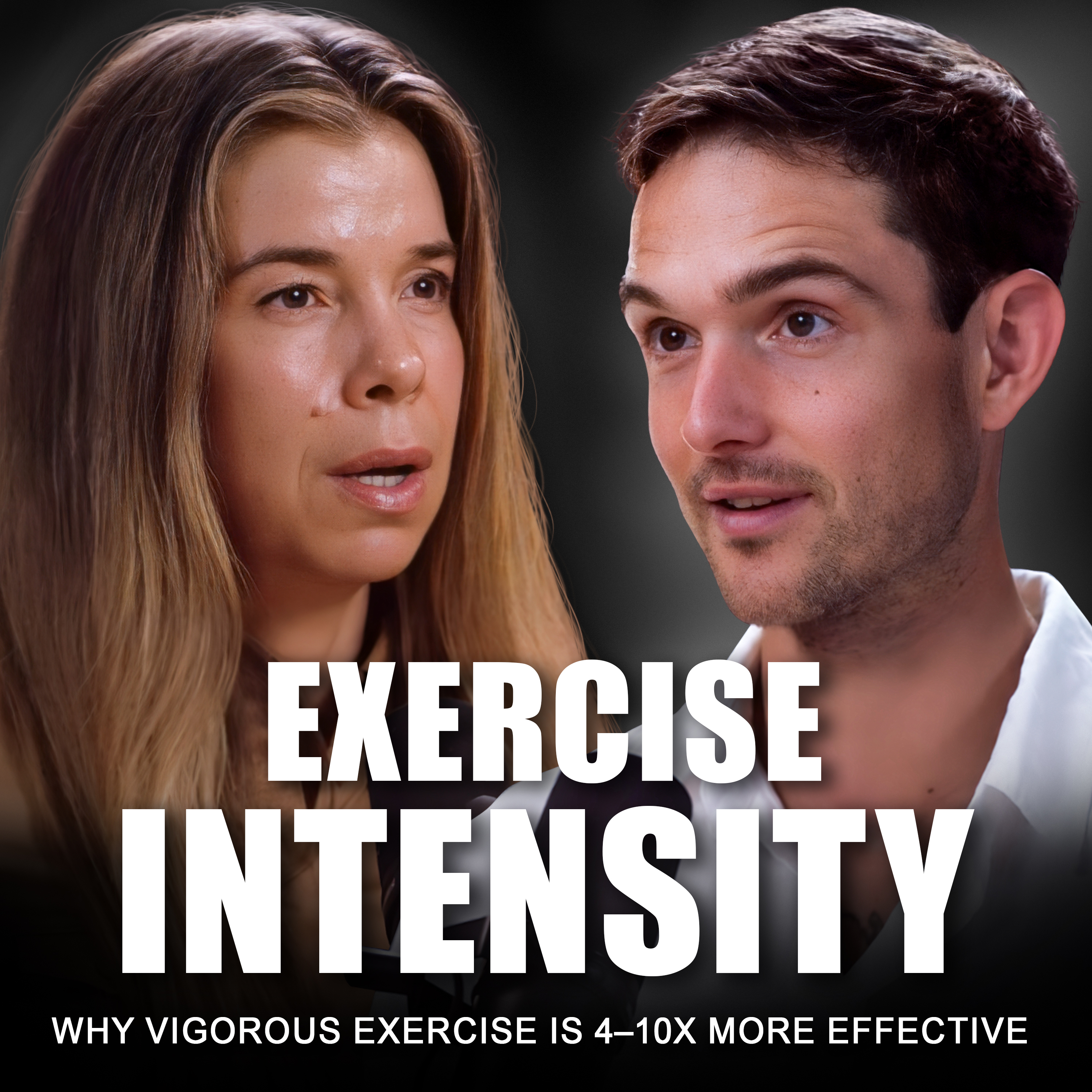
本集简介
双语字幕
仅展示文本字幕,不包含中文音频;想边听边看,请使用 Bayt 播客 App。
朋友们,大家好。
Hello, friends.
今天,我们将深入探讨一个关于运动强度的有趣话题。
Today, we're diving into a fascinating discussion about exercise intensity.
我们大多数人长期以来都接受一个简单的准则:1分钟剧烈运动等同于2分钟中等强度运动。
Most of us have long accepted the simple guideline that one minute of vigorous exercise equals two minutes of moderate exercise.
这个准则直观、简洁、方便。
It's intuitive, neat, convenient.
但如果它从根本上就是不准确的呢?
But what if it's fundamentally inaccurate?
这一规则几十年来塑造了全球体育活动指南,但它主要基于卡路里消耗,而非死亡率、心血管事件、糖尿病或癌症等硬性终点指标。
That rule has shaped global physical activity guidelines for decades, yet it was largely based on calorie burn, not hard endpoints like mortality, cardiovascular events, diabetes, or cancer.
与我共同探讨这一重要话题的是耐力运动员布雷迪·霍默,他拥有人体表现硕士学位,并曾与我合作完成《Found My Fitness综合训练指南》。
Joining me to explore this important topic is endurance athlete, Brady Homer, who has a master's in human performance and has collaborated with me before on the Found My Fitness comprehensive training guide.
今天,我们将解析发表在《自然·通讯》上的一项突破性新研究,该研究使用客观设备数据挑战了数十年来传统的运动智慧和指南。
Today, we're breaking down a groundbreaking new study published in Nature Communications that used objective device based data to challenge decades of conventional exercise wisdom and guidelines.
我们将剖析研究方法、局限性以及数据实际支持的观点。
We break down the methods, the limitations, and what the data actually supports.
这是一期期刊俱乐部风格的节目。
This is a Journal Club style episode.
在本期节目中,布雷迪和我讨论了可穿戴加速度计如何比传统自报方法更准确地反映身体活动情况。
In this episode, Brady and I discuss how wearable accelerometers offer a more accurate picture of physical activity than traditional self reported methods.
令人惊讶的新发现:一分钟剧烈运动可能带来相当于四到九分钟中等运动带来的健康效益,这将彻底改变我们对运动效率的理解。
The surprising new finding that one minute of vigorous exercise could offer health benefits equivalent to four to nine minutes of moderate exercise, dramatically altering our understanding of exercise efficiency.
具体数据显示,剧烈运动对心血管健康的效力高达中等运动的八倍,在糖尿病预防方面效果更是近十倍。
Specific outcomes showing vigorous activity is up to eight times more potent for cardiovascular health and nearly 10 times as effective in diabetes prevention.
为何剧烈运动能独特地触发强大的生理适应机制——包括改善心血管功能、胰岛素敏感性、线粒体健康,甚至通过靶向细胞机制降低癌症风险。
Why vigorous exercise uniquely triggers potent physiological adaptations like improved cardiovascular function, insulin sensitivity, mitochondrial health, and even reduced cancer risk through targeted cellular mechanisms.
我们讨论了这对日常生活的实际影响,包括剧烈间歇性生活方式运动这一强大的健康习惯。
We talk about the practical implications for everyday life, including the powerful health habits of vigorous intermittent lifestyle, physical activity.
这些就是Vilpas(高强度间歇生活方式运动)。
These are Vilpas.
这些都是快速、有时无组织的日常生活方式,能让我们的心率加快。
They're quick, sometimes unstructured everyday lifestyle ways that we're getting our heart rate up.
但我们也会讨论结构化的'运动零食'。
But we also talk about the structured exercise snacks.
这项新研究确实可能彻底重写现有的运动指南。
This new research really could rewrite the existing exercise guidelines entirely.
它挑战了健身追踪器、运动应用程序和公共卫生信息,要求我们完全重新校准评估和测量体育活动的方式。
It challenges fitness trackers, challenges exercise apps and public health messaging to completely recalibrate the way we value and measure physical activity.
在深入今天的内容之前,先快速提醒大家关注我们免费的循证资源《如何按专家建议训练》。
Before we dive into today's episode, a quick reminder about our free evidence based resource, How to Train According to the Experts.
如果你还没下载这份免费指南,或者已经下载过,我们刚发布了重大更新,你绝对会想看看。
If you haven't downloaded this free guide yet, or even if you have, we just released major updates you'll definitely want to check out.
你可以在howtotrainguide.com找到它。
You can find that at howtotrainguide.com.
我们扩展了关于肌酸补充的内容,并更新了剂量方案。
We've expanded our coverage on creatine supplementation with updated dosing protocols.
我们还获得了关于它如何影响大脑健康和认知功能的新见解。
We also have fresh insights into how it impacts brain health and cognitive function.
我们还完善了关于需要多少运动才能最大化延长寿命的建议,以及运动零食和Vilpas如何对我们的健身目标做出有意义的贡献。
We've also refined our recommendations on exactly how much exercise is needed to maximize longevity and also how exercise snacks and even Vilpas can contribute meaningfully to our fitness goals.
因此这份指南真正浓缩了我们播客中顶尖科学家的最佳循证策略,整合成一个真正可操作的工具包。
So this guide really condenses the best evidence based strategies from our leading scientists that have been on this podcast into a real single actionable toolkit.
您会在其中找到精确的方案,用于增加肌肉质量、增强肌肉力量,以及经过验证能提升心肺功能的有针对性的训练方法。
You'll find precise protocols in there for building muscle mass, building muscle strength, targeted training methods that are proven to enhance cardiorespiratory fitness.
这是衡量长寿的一个非常重要的指标。
This is a really important marker for longevity.
我们更新了科学驱动的策略,以支持代谢健康和认知表现。
We have updated science driven strategies to support both metabolic health, cognitive performance.
此外,我们还为时间紧张的人群精心设计了一些实用的运动方案。
And then we also have some practical exercise routines that are really crafted for people with time constrained schedules.
再次强调,它完全免费,现在就可以在howtotrainguide.com上获取。
Again, it's entirely free and it's available right now at howtotrainguide.com.
再次提醒,网址是howtotrainguide.com。
Again, howtotrainguide.com.
此外,如果你对肌酸特别感兴趣想深入了解,我们在FoundMyFitness专题页面也准备了完整的资源合集。
And also if you're intrigued a little bit more about the creatine and you want to explore it more deeply, we also have a comprehensive collection of resources on the FoundMyFitness topic pages.
请访问foundmyfitness.com/topics。
So foundmyfitness.com/topics.
你可以找到C字母分类下的肌酸专题,在那里阅读所有关于肌酸的资料。
You can go to the creatine section, which is under the C, and you can find and read all about creatine there.
一如既往,我们所有的成果都完全依靠听众朋友们的支持才得以实现。
As always, everything we produce is made possible entirely through the support of you, our listeners.
我们的使命是提供严谨、客观、可操作的科研成果,并确保这些知识对所有人开放。
Our mission here really is to deliver rigorous, unbiased, actionable science that is really accessible to everyone.
你可能已经注意到,这个播客没有任何广告植入。
You may have noticed that this podcast is free from advertising.
也没有任何知名绿色补剂公司赞助这档节目。
I don't have any popular green supplement companies that are paying for this podcast.
我需要你们的支持来实现这一目标。
I need your support to do this.
如果你认同我们的使命和内容的深度,请考虑成为FoundMyFitness的付费会员。
If you value this mission and the depth of our content, please consider becoming a FoundMyFitness premium member.
你不仅将支持我们的播客、YouTube频道、精心整理的主题页面、每周发送的优质通讯,实际上是我们所做的一切。
Not only will you support the podcast, our YouTube channel, our topic pages that we put together, our great newsletters that we send out every week, literally everything we do.
同时你还能获得附带超值福利的付费会员资格。
But you also get a premium membership with really great perks.
你将获得《Aliquot》的访问权限。
You get access to the Aliquot.
这是我们仅限会员收听的专属播客。
This is our members only podcast.
每月可参与由我主持的实时问答环节(含录制回放)。
You get a monthly live and recorded Q and A session with me.
还能收到我们每月两次精心筛选的科学文摘,汇集最前沿的健康科研资讯。
You get a curated science digest where we deliver this to you twice a month, all the best science and health information.
这真的只是为了支持我们在FoundMyFitness所做的工作。
And it's really just to help support what we're doing here at FoundMyFitness.
所以若想直接加入并支持我们的工作,请访问foundmyfitness.com/premium。
So to join and support our work directly, please go to foundmyfitness.com/premium.
再次提醒,网址是foundmyfitness.com/premium。
Again, that's foundmyfitness.com/premium.
非常感谢您支持基于证据的健康与健身教育。
Thank you so much for supporting evidence based health and fitness education.
现在让我们进入今天的节目内容。
Now let's jump into today's episode.
欢迎回到播客节目。
Welcome back to the podcast.
今天,我们将讨论这个几乎被普遍接受的规则:每分钟剧烈强度运动相当于两分钟中等强度运动。
Today, we're gonna be discussing this almost universally accepted rule that for every one minute of vigorous intensity exercise, that's equivalent to two minutes of moderate intensity exercise.
我们将探讨这一说法的准确性及其来源。
And we're gonna talk about whether or not that's accurate and where it came from.
所以今天的播客更像是一期期刊俱乐部类型的节目,我们将讨论一项颠覆这一观念的新研究。
So today's podcast is more of a journal club type of episode where we're gonna be discussing a new study that really kind of overturns that idea.
今天和我一起的是耐力运动员布雷迪·霍默,他拥有人体表现学硕士学位。
So I'm joined by endurance athlete Brady Homer who has a master's in human performance.
他还是《最大摄氧量要点》一书的作者,也是我们播客的往期嘉宾。
He's also an author of the book, b o two max essentials, and he's a former podcast guest.
几个月前他参加了'如何按专家建议训练'的播客节目,当时我们讨论了他也参与编写的《训练指南》。
He was on the podcast a few months ago on the how to train according to the experts podcast where we were talking about our how to train guide, which Brady also was a collaborator on.
所以能坐在这里主持Family Fitness的首期期刊俱乐部节目,我真的很兴奋。
So I'm pretty pumped to sit here and have this first episode of a journal club for Family Fitness.
希望我们以后能做更多这样的节目。
So, you know, hopefully, we'll do more of these.
你觉得怎么样?
So let's, what do you think?
我们开始吧。
Let's get started.
当然。
For sure.
是的。
Yeah.
我认为这种新形式对播客来说会很有趣,对我们的一些节目来说也是新的尝试,我很期待看看效果如何。
I think this will be a interesting new structure kind of for the podcast, new for, you know, some of our episodes, and I'm excited to see how it goes.
很期待讨论这项研究。
Excited to talk about this study.
我觉得这确实是一个让我大开眼界的研究。
I think it was really a eye opening one in my mind.
那么,我们开始吧。
So, yeah, let's get into it.
大开眼界,但并不意外。
Eye opening, but not surprising.
对吧?
Right?
完全同意。
Totally.
那好吧。
So okay.
那么我先来解释一下这个'一比二规则',因为听众可能不太明白我在说什么。
Well, let's I'm gonna start off by just talking about what this, you know, one to two rule is for people because they might be, like, not exactly understanding what I'm talking about.
简单来说,几十年来世界卫生组织等机构发布的体育活动指南指出,为了达到最佳健康状态——虽然这个概念有点模糊——每周应进行150到300分钟的中等强度体育活动。
So essentially, you know, for decades now, we have these physical activity guidelines that's put out by the World Health Organization and, you know, other organizations that essentially state these physical activity guidelines, which essentially are for optimal health, which is sort of vague, but for optimal health, you wanna be engaging in about a hundred and fifty minutes to three hundred minutes of moderate intensity physical activity per week.
如果是高强度运动,则建议75到150分钟。
Or if you're gonna be doing more vigorous intense, vigorous type of physical activity, that would be more like seventy five to a hundred and fifty minutes.
所以本质上这就是'一比二规则':每分钟高强度运动相当于两分钟中等强度运动。
So that's essentially your your you have this one to two rule, right, where it's like, okay, for every one minute of vigorous intensity physical activity, you're gonna be doing two minutes of the moderate intensity activity.
这个规则就是这么来的。
And that's kind of where this rule came from.
我不确定这是否最佳方案。
And I don't know that it's necessarily it's not necessarily telling you if you're trying to reduce, you know, different disease risks.
比如心血管疾病或癌症,你知道的,随便举什么病都行。
So cardiovascular disease or cancer, you know, fill in the blank, whatever disease.
它并没有真正告诉你这些。
It's not really telling you that.
它更像是给出了一个指导原则。
It's just kind of like this is the guidelines.
对吧?
Right?
那么我们来谈谈这个1:2规则的起源。
So let's talk about the origin of this one to two rule.
它实际上并非来自对健康结果的直接测量。
It really didn't come from direct measurements of health outcomes.
本质上,是研究人员计算出,你知道的,高强度运动消耗的热量大约是中等强度运动的两倍。
Essentially, it's researchers that calculated, you know, for vigorous intensity exercise, you're burning about twice as many calories as you do for moderate intensity exercise.
所以这实际上归结于能量消耗,而非健康结果。
So it's really comes down to energy expenditure, not health outcomes.
是的。
Yeah.
而且那有点
And that was kind
对我来说并不意外,因为我早就了解这些事了。
of like the biggest not surprise to me because I've, you know, known about this stuff for a long time.
但当你深入研究时,就会发现这些建议的基础到底是什么?
But when you really dig into it, it's like, what what's the foundation of these recommendations?
它是基于一个叫做代谢当量或任务代谢当量的概念。
It is based on the idea of this thing called metabolic equivalent or metabolic equivalent of task.
可能有人听说过它被简称为Mets或M.E.T.S。
People maybe will have heard that referred to as mets or m e t s.
本质上,它就是衡量各种不同活动的热量消耗。
And basically, it is just what's the caloric expenditure of these various different activities.
比如,进行轻度活动可能在0到3个代谢当量之间,中度活动3到6个代谢当量,剧烈活动则超过6个代谢当量。
If, you know, you're doing a light activity that might be somewhere between, you know, like zero to three Mets, moderate activity three to six Mets, vigorous activity over six Mets.
这基本上是在问,你在这些活动中的耗氧量或卡路里消耗是多少?
And it's basically saying, what's your oxygen consumption or your, you know, calorie burn during these activities?
按照这个逻辑,中等强度活动确实会消耗大约3到6个代谢当量。
And so by that logic, yes, moderate activity, you burn, you know, that might be three to six mets.
如果你运动强度更大,代谢当量和卡路里消耗就会翻倍。
Well, if you're going harder than that, that's double the mets, double the caloric expenditure.
因此要达到与中等强度运动相同的健康效益,你只需要一半的运动量。
So you need half as much physical activity to get the same health benefit as the more moderate intensity activity.
这就形成了建议的基础:75到150分钟的剧烈运动,或150到300分钟的中等强度运动。
So that kind of formed the foundation of that either seventy five to one fifty minutes of vigorous, one fifty to three hundred minutes of moderate.
逻辑上说得通,但就像你刚才说的,这到底是为了什么?
And it makes sense logically, but as you just said, you know, well, for for what?
我们关注的是哪些健康指标?
What health outcomes are we looking at?
我们仅仅是在关注卡路里消耗吗?
Are we just focused on calorie burn?
所以,是的,如果仅仅关注卡路里消耗,那么两者确实是等效的。
So, yes, if if it's just focused on calorie burn, yes, the two are equivalent.
但健康远不止于此,你知道的,不仅仅是燃烧卡路里。
But health is a lot more, as you know, than just burning calories.
人们关注不同的健康目标,比如提升体能、改善心血管健康或降低糖尿病风险。
People are focused on different health outcomes, like improving their fitness or improving their cardiovascular health, improving their diabetes risk.
当你从这个角度看待问题时,它确实改变了你的思考方式——也许并不全是关于代谢当量。
So when you look at it from that perspective, it really changes the way that you think of, well, maybe it's not all just about metabolic equivalence.
也许重点在于其他方面,我们应该以不同方式评估体育活动的价值。
Maybe it's about something different, and we should be looking at the value of physical activity in different ways.
没错。
Right.
我认为这个观点非常到位,因为那些更关注减肥的人未必会关注体育活动指南。
I think that's a really good point because I think people that are more focused on weight loss aren't necessarily the people that are looking at the physical activity guidelines.
对吧?
Right?
这些人正在计算卡路里,他们试图弄清楚需要进行多少运动才能实现身体重组。
Those are the people that are counting calories and they're you know, it's a very different they're trying to figure out how much exercise they need to do to trim down body recomposition.
而那些真正关注体育活动健康指南的人,通常心里想的是:我需要做多少运动才能更好地延缓衰老。
Whereas people that are actually looking at the physical activity health guidelines generally in their mind have this concept of how much exercise do I need to, like, age better.
嗯哼。
Mhmm.
对吧?
Right?
通常人们在看这些指南时都是这么想的。
Like, that's generally what people are thinking when they're looking at these guidelines.
我需要做多少运动才能真正延缓衰老?
How much exercise do I need to do to really age better?
所以这有点不公平,因为这些指南如果没有明确指出我们需要做多少运动或做什么类型的运动才能真正延缓衰老,那么是时候修改这些指南了。
And so it's it's kind of unfair because, you know, these guidelines, if they aren't necessarily indicating how much exercise we need to do or what type of exercise we need to do to to really age better, then it's time to change these guidelines.
我想我们会深入讨论这个话题。
And I think we're gonna talk a lot about that.
但我也想提一下,你谈到这些关于轻度、中度或剧烈强度的体力活动的代谢当量。
But I also wanted to mention, you know, you're talking about these metabolic equivalents with respect to light, moderate, or vigorous, you know, intensity physical activity.
指南中给出的一些例子,并不完全符合我对中度或剧烈活动的理解。
There's some examples for the guidelines that are given, which aren't necessarily what I would think of as moderate or or vigorous.
例如,他们说轻度活动是悠闲散步,或者站着不坐,比如洗碗的时候。
So for example, they say light activity is a casual stroll or maybe, like, you're standing, so just not sitting or you're maybe you're washing dishes.
而中度活动则是快走这样的运动。
And then the moderate activity is, like, brisk walking.
就是说你走得比较快,或者悠闲地骑自行车,又或者做些庭院劳动。
So you're walking more briskly or you're you're maybe doing a leisurely cycle or you're doing some yard work.
这些被认为是中等强度的体力活动。
That's considered considered moderate intensity physical activity.
剧烈活动则包括跑步、游泳、更多休闲运动,或者像在外面和孩子玩耍、追逐奔跑、和小狗嬉戏这类。
And then vigorous activity is running, swimming, more recreational sports, or if you're, like, you know, playing with your kids outside, sprinting around, playing with your puppy or your dog.
所以这些大致就是关于如何定义轻度、中度和剧烈体力活动的一些指导原则。
So those those are sort of some of the guidelines, you know, in terms of how you define light, moderate, or vigorous physical activity.
是的。
Yeah.
我认为这很重要,可以为我们今天讨论这项研究时提供框架。
And I do think that's important just for framing kind of when we start to talk about this study for framing our discussion today.
因为当人们听到'剧烈运动'时,尤其是你通常在播客中提到的,剧烈强度往往指的是高强度间歇训练那种程度。
Because when people hear vigorous, especially, you know, as you usually talk about on your podcast, it's vigorous intensity is kind of this high intensity interval training.
但根据指南标准,'剧烈'的门槛其实低得多——大家可能更熟悉'二区训练'这个概念。
But when it comes to the guidelines, vigorous is a lot less vigorous, and people were probably familiar with zone two training.
我想强调的是,在这次讨论或体育活动指南中提到的'剧烈',基本上相当于二区强度或更高。
I would just consider, like, when you hear vigorous in the context of this discussion or the physical activity guidelines, that's like zone two intensity or above, basically.
所以它既包括高强度间歇训练,也包含一些比典型高强度间歇训练强度稍低的运动。
So it includes high intensity interval training, but it also includes things that are a little less intense than one might consider high intensity interval training to be.
没错。
Right.
对。
Yeah.
所以通常来说,特别是在这个播客里,我经常讨论高强度运动以及心率测量相关的话题。
So typically, you know, especially in this podcast, I've talked a lot about vigorous intensity exercise and with regards to, like, heart rate measurements.
对吧?
Right?
比如人们佩戴这些可穿戴设备,测量他们的心率。
Like, people are wearing these wearable devices, and they're measuring their heart rate.
通常来说,当你达到最大心率的80%或以上时。
And usually, it's like you're getting into the 80% max heart rate or above.
明白吗?
You know?
而且就像你说的,其实这并不完全包含高强度运动。
And and I it like you said, you know, it's it's really not that includes vigorous.
是的。
Yes.
但特别是当我们讨论今天要谈的这项研究,以及总体来看体育活动指南时,'高强度'的标准其实比那要低一些。
But, like, especially when we get into this study that we're gonna talk about today and looking at the physical activity guidelines in general, vigorous is a little bit less than that.
所以它确实包含了更多那种第二区间的训练类型。
So it does include more of that zone two type of training.
但你在跑步。
But you are running.
你或许还能断断续续地说上几句话。
You are able to maybe have you know, say a few sentences while they may be breathy.
你依然能把话说清楚。
You can still state them.
如果严格按照体育活动指南的标准,这实际上已经算剧烈运动了。
That's actually considered vigorous if we're actually just talking about the physical activity guidelines.
是的。
Yeah.
非常重要。
Very important.
另外,我想我们之前已经提到过这点,但还是要再强调一下:讨论体育活动指南的潜在缺陷时,长期健康影响是一个需要考量的方面。
And then also just, you know, I think we sort of already stated this, but just to kinda reiterate, talking about the potential flaws of the physical activity guidelines is one potential, like, looking at long term, like, health outcomes.
对吧?
Right?
第二点是依赖自我报告的数据。
Two would be, like, relying on self reported data.
这正是我们今天要深入探讨的,当你试图让人们回忆他们的体育活动情况时,这个问题会变得更加明显,稍后我们会详细讨论。
And that's something that we're gonna get into today, you know, when you're trying to ask people to remember their physical activity, and you're gonna talk about this a little bit more.
这根本不准确。
It's just not accurate.
第三点是它实际上无法捕捉到某些活动,比如你和孩子玩耍,或者和小狗一起奔跑。
And then the third one would be that it's not it's not actually able to capture, some of these, like, you know, you're playing with your kids or you're you're sprinting around with your puppy.
对吧?
Right?
这些短暂的体力活动确实很重要。
These short bursts of physical activity that do matter.
对吧?
Right?
所以你也没有把那些情况包括进去。
So you're not you're not including that as well.
那我们不如来看看这项新研究吧?
So why don't we get into this new study?
这项研究发表在《自然·通讯》上,题目是《基于可穿戴设备的不同强度体力活动对死亡率、心血管代谢疾病和癌症影响的健康等效值》。
It was published in Nature Communications, wearable device based wearable device based health equivalents of different physical activity intensities against mortality, cardiometabolic disease, and cancer.
非常棒的研究。
Very good study.
或许我们可以先从研究方法开始讨论,比如实验设计之类的。
Maybe we can kinda start off with, you know, the how the study was set up, like some of the methods.
好的。
Yeah.
没问题。
Sure.
这项研究是由斯坦·梅塔基斯领导的团队完成的,他是论文的第一作者。
So this was by it was by a group led by Stan Metakis as the first kind of author on it.
重要的是,他们正是你所经常谈论的Vilpa研究(高强度间歇性生活方式体力活动研究)背后的团队,Rhonda。
And importantly, they're the they're the group behind a lot of these Vilpa studies, Rhonda, that you've talked about a lot, the vigorous intermittent lifestyle physical activity studies.
因此,他们撰写了这项研究,并从英国生物银行挖掘数据。
So they authored this study, and they mined data from the UK Biobank.
这类似于美国的NHANES,但规模更大——追踪了数万个体数十年甚至更长时间。
That's just a huge it's kinda similar to, like, the NHANES in The United States where just but lot cohort of a ton of individuals looked at for, you know, decades or more.
他们拥有这些人的全部健康数据,包括客观数据和主观数据。
They have all this health data on them, objective data, subjective data.
本研究中,他们聚焦于英国生物银行中73,000多名40至79岁的成年人。
So for this study, they focused on 73,000 more than 73,000 adults from the UK Biobank who were aged 40 to 79.
我认为这一点也很关键。
So that's kind of important, I think, as well.
这些研究对象涵盖中老年群体,并对其进行了长达八年的追踪。
They were, you know, middle aged to to older aged adults, and they tracked them over eight years.
因此,该研究的平均随访期为八年。
So the follow-up period in the study was eight years on average.
这项研究的重要部分在于他们如何测量参与者的身体活动。
And the important part of the study is how they measured their physical activity.
测量是通过这些可穿戴设备完成的,即手腕佩戴的加速度计。
It was measured using these wearable devices, these wrist worn accelerometers.
参与者在研究基线阶段佩戴了一周,然后研究人员收集了那一周的所有身体活动数据,用于确定这些个体的活动水平。
They wore it for a week at the baseline of the study, and so then they took all their physical activity from that one week, and then, you know, that was used to establish these physical activity levels for these individuals.
这显然存在一定局限性。
Kind of a limitation there, obviously.
身体活动仅通过加速度计测量了一周时间。
Physical activity was only measured for a week using these accelerometers.
不过我们稍后可能会讨论到,虽然看似局限,但从某种角度来说这反而是优势——因为与健康结果的强关联性几乎暗示着,他们在那周进行的活动可能在后续八年或更长时间里保持着一致性。
But, you know, as we'll maybe discuss later, it seems like a limitation, but in a way, I almost feel like it's a strength because the strong association with these health outcomes almost assumes that this activity that they were doing during that one week may have been consistent over, you know, the next eight years or or something like that.
嗯,其实这也意味着——它测量了所有活动。
So Well, it's also I mean, you we it's measuring everything.
对吧?
Right?
它能测量那些你根本不会注意到的短暂运动爆发。
It's measuring these short bursts of exercise that you would never think about.
比如,如果有人问我每周锻炼多少分钟,我只会计算那些专门安排的结构化锻炼。
Like, if someone were to ask me how many minutes I exercise a week, I would only include my structured, defined workouts that I set aside to work out.
我不会把每天三次在院子里和小狗追逐打闹,或者每天一次和儿子踢足球算进去。
I wouldn't include, you know, the three times a day I'm sprinting around my yard with my puppy or, you know, once a day that I'm playing soccer with my son.
对吧?
Right?
我不会计算这些活动,但它们确实让我的心率明显上升了。
I don't include those, but I'm absolutely getting my heart rate up.
没错。
Right.
我认为这正是这项研究的主要优势所在。
And that was, I think, the major strength of this study.
与之前很多指南研究采用自我报告不同,这项研究采用的是客观数据。
So instead of self report, which a lot of the previous studies for the guidelines did, this one was objective data.
而且,是的,它捕捉到了他们进行的各种身体活动和锻炼,我猜包括他们结构化的训练,但正如你提到的,也包括他们一天中做的所有事情。
And, yes, it captured it captured what physical activity they were doing, what exercise they were doing, I guess, so their structured workouts, but also, as you mentioned, just everything they did throughout the day.
这个设备以每十秒一次的频率测量他们全天的每一个活动。
This device was measuring every single activity in ten second bursts throughout the day.
每十秒钟,它就会测量他们活动的强度如何。
Every ten seconds, it measured, you know, what is the intensity that their activity is.
我不想深入讨论Can
I don't wanna get into Can
当你提到他们活动的强度和加速度计时,我们能暂停一下吗?
we pause for a minute when you say what the intensity their activity is and their accelerometer?
对吧?
Right?
是的。
Yeah.
所以人们可能会感到困惑,他们可能又会联想到心率上去。
So people might be confused, and they, again, might be going back to heart rate.
比如,当他们听到可穿戴设备时,想到运动强度,我知道我的大脑会直接联想到心率。
Like, when they hear wearable device, and they're thinking intensity, I know my brain goes right there, my heart rate.
你能解释一下他们是如何通过加速度计数据来定义轻度、中度和剧烈运动的吗?
Can you kind of explain, like, how they were able to define light, moderate, and, you know, vigorous with this accelerometer data.
我会尽量在不涉及加速度计测量身体活动原理的复杂细节的情况下,尽我所能解释清楚。
I'll do it the best I can without getting, like, way too complicated on how the accelerometers measure physical activity.
是的,这项研究中的强度并非基于心率——这通常是常规做法,可能你现在用的可穿戴设备(比如苹果手表)就是通过心率来测量的。
So, yes, not intensity not based on heart rate in this study, which would be the common convention, and maybe your wearables measure that using, you know, heart rate, the wearables we have today, like your, you know, Apple Watch.
加速度计本质上就是戴在手腕上的设备,它能测量运动方向和运动时的物理强度。
So an accelerometer is literally a device that you wear on your wrist, and it is measuring the direction of movement and the physical intensity of movement.
比如如果我缓慢移动手腕,这可能属于低强度活动。
So if I move my wrist, say slowly, that might be light activity intensity light intensity activity.
如果动作更剧烈些,就可能属于高强度运动。
If I move it more vigorously, that might be vigorous intensity.
所以这个加速度计设备就是通过内置的物理传感器,全天候测量人们运动的强度和方向——它正是通过监测身体活动的方向和强度来实现的。
So this accelerometer device is measuring, you know, the intensity of people's movements throughout the day, the direction of that intensity because it just has this physical, you know, an accelerometer in it, which just measures the direction and the intensity of physical activity.
所以它全天每隔十秒就会测量一次人们的运动强度。
And so every ten seconds throughout the day, it's measuring their intensity of physical activity.
然后根据运动强度的特定阈值,将其归类为轻度、中度或剧烈强度的活动。
And then based on a certain threshold of how intense their movement is, that would get bucketed into being a light intensity activity, a moderate intensity activity, or a vigorous intensity activity.
因此每隔十秒,这个设备就会测量你正在进行的活动类型。
So every ten seconds, this thing is measuring, you know, what type of activity you're doing.
数据会被归类到这三种强度之一,然后全天累加,再整周汇总,就能得出你做了多少剧烈运动、中度运动和轻度运动。
It gets bucketed into one of those three intensities, and then summed throughout the day, and then throughout the week to say you did this much vigorous, this much moderate, and this much light activity.
所以这有点困难,因为我们现在的设备大多不是基于加速度计的。
So it's a little bit difficult because most of the devices we have these days are not accelerometer based.
它们要么是基于心率的,要么是使用GPS的,就像大多数这类设备一样,但我觉得这是最好的解释方式了。
They're either heart rate based or they're, you know, you're actually using a GPS like most of these devices, but I think that's the best way of describing it.
但重要的是,这项研究中的强度测量方式就是如此,没有使用像心率这样的指标。
But the important thing there is that this is how the intensity was measured in this study, not using, say, something like a heart rate.
我在阅读论文和与你讨论时想到的是,比如有人在做二头肌弯举时,它会如何分类。
What I what I was thinking about when when kind of reading the paper and, like, talking about it with you is how it would categorize like, let's say someone was, like, doing bicep curls.
对吧?
Right?
因为你的手腕在动,但你并没有真正在走路。
Because your wrist is moving, but you're not really walking.
从距离上来说,你并没有真正移动。
You're not really moving distance wise.
那么这种动作会被这个设备捕捉并考虑进去吗?
So is that something that would be picked up by this device and considered?
它会被归入哪一类呢?
And what bucket would it be?
因为有些人可能动作很快。
Because like, some people can be like moving fast.
对吧?
Right?
会的。
It would.
我认为无论你以多快的速度移动那个哑铃,那很可能都会被归类为高强度活动。
And that would be I think even regardless of the speed at which you were moving that dumbbell, that would probably be categorized as like a vigorous intensity activity.
因为这是有目的性的动作,而且你知道,你在测量手臂时所施加的力和扭矩。
Because it's purposeful movement and, you know, it's, you know, the force and the torque at which you're measuring your arms.
所以这很可能会被归类为高强度活动。
So that would be probably categorized as a vigorous intensity activity.
你在空间中实际向前或向后移动并不重要。
It doesn't necessarily matter whether you're moving physically forward or backward in space.
关键在于你的身体移动的速度或强度。
It's just like what is the speed or the intensity at which your body is is kind of moving.
好的。
Okay.
所以,是的,有点复杂,但你知道,在不考虑的情况下这是最好的描述方式。
So, yeah, a little bit complicated, but, you know, that's the best way to describe it without Considering
那个。
that.
是的。
Yeah.
我是说,考虑到因为,你知道,很多人听到'高强度'这个词时,通常不会联想到抗阻训练。
I mean, considering that because, you know, the a lot of times when people hear the word vigorous intensity, know, activity, they're not really thinking of resistance training.
对吧。
Right.
所以也许至少可以举些例子。
So maybe, like, you can give some examples at least.
我知道研究里列出了一些例子,说明什么算高强度、中度和轻度活动。
I know the study laid out some examples with respect to what's actually considered, you know, vigorous versus moderate versus light.
然后我们当然也讨论过健康指南中的相关例子,它们其实很相似。
And then, obviously, we talked about what what examples are considered that for the health guidelines, but they're pretty similar.
它们确实相似。
They are similar.
研究中提到轻度活动时,他们给出了一些例子。
The study, they said, you know, light activity, they gave some examples of it.
那只是一些轻微的家务劳动。
That would be just light household chores.
比如清空洗碗机、扫地、吸尘之类的活动。
So even maybe you're, you know, emptying the dishwasher or sweeping or vacuuming or something like that.
根据这项研究,这些都算轻度活动。
That would be considered, like, light activity based on this study.
中等强度的活动则像是主动通勤。
Moderate activity would be something like actively commuting.
比如悠闲地骑车上班,或者步行从公交站到办公室,上下楼梯,做些稍费力的家务。
So say you were riding your bike leisurely to work, or you were commuting to work, walking from the bus to work, going up some stairs, doing maybe some more moderate household chores.
剧烈活动的例子包括陪孩子户外玩耍、跑步、骑自行车或健身运动。
And then vigorous, they gave some examples like, you know, outside playing with your kids, or you're you're running, or you're riding a bike, or exercise.
健身运动会被归类为剧烈活动,所有这类高强度运动都算。
Exercise would be categorized in that vigorous bout, but all or that vigorous type of activity.
不过说真的,任何有目的性的身体活动——我们私下聊过这个话题。
But really anything, you know, purposeful movement, I think, is you know, we're chatting offline.
在这项研究中,任何有目的性的运动都会被归为剧烈活动,无论是为了锻炼还是为了到达某个地方。
It's anything that would be purposeful movement, you're doing this for a reason of, either to exercise or to get somewhere, that would kind of be considered vigorous in this study.
所以再次强调,这些标准可能比人们想象中的剧烈活动强度要低一些,我觉得这很酷,因为当我们开始讨论剧烈活动带来的益处时,它证明了即使不是高强度间歇训练,有目的性的运动也能产生显著效果。
So, again, like the guidelines, maybe a little bit less intense than what people imagine when they think of vigorous, which I think is kind of cool because when we start to discuss the benefits that vigorous activity had, it goes to show just the power that even kind of purposeful movement, even if it's not high intensity interval training can have.
是的。
Yeah.
我认为有必要指出,身体活动和锻炼是不同的,因为人们通常听到身体活动时,就会想到有组织的锻炼。
And I think it is important to point out, like, physical activity versus exercise because people do typically when they think when they hear even physical activity, they think, you know, structured exercise.
我觉得这是一个非常普遍的认知误区,认为有组织的锻炼就等于身体活动。
It's a very I think a very common, you know, thought is structured exercise is physical activity.
但它不一定非得是有组织的锻炼。
But it's not necessarily structured exercise.
它包括锻炼,但也涵盖了你提到的所有活动,比如和孩子玩耍、遛狗、跑上楼梯、步行上班等等。
It includes it, but it can also include all the things that you mentioned where you're, you know, playing with your kids or you're playing with your dog or you're sprinting up the stairs or you're walking to work or things like that.
这些都是身体活动。
Like, this is all physical activity.
是的。
Yeah.
而这正是这项研究所要捕捉的内容。
And that's what this is all capturing.
确实如此。
For sure.
当你深入思考时也很有意思,因为当我们讨论运动指南时,很多人听到每周需要150到300分钟的体育活动,
It's And kind of interesting when you think about that too because when we talk about the guidelines, I think a lot of people hear that and say, hundred and fifty to three hundred minutes of physical activity a week.
他们会认为这意味着需要在健身房锻炼150到300分钟。
That means I need to be in the gym for a hundred fifty minutes to three hundred minutes.
但再次强调,体育活动与锻炼是不同的概念。
But, again, physical activity is different than exercise.
体育活动是指你全天进行的任何身体动作。
Physical activity is any physical activity you're doing throughout the day.
而锻炼则是指有规划、有结构的训练方案,比如专门抽时间去健身房进行的系统训练。
Exercise is defined, structured, a workout, like a training regimen that you, you know, go to the gym and you set aside time for.
但身体活动可以是日常生活中的各种动作,自然而然地融入日常生活。
But physical activity can be things done throughout the day, just integrated into your daily life as well.
对。
Right.
对。
Right.
好的。
Okay.
那么这项研究追踪了哪些健康指标呢?
So health outcomes that were tracked in this study.
你想提一下这些健康指标吗?
We have do you wanna mention the health outcomes?
他们基本上追踪了人们关心的所有健康相关指标。
They pretty much tracked anything people are interested in in terms of health.
比如全因死亡率(任何原因导致的死亡),大多数人都知道这个概念。
So all cause mortality, death from any cause, most people are aware of what that is.
心血管疾病死亡率,即与心血管疾病相关的任何死亡,特别是心脏病发作、中风等主要不良心血管事件(MACE)。
Cardiovascular disease mortality, so deaths from anything related to cardiovascular disease, heart attack, stroke specifically, major adverse cardiovascular events or MACE.
这包括心脏病发作、中风、心血管死亡、二型糖尿病发病率,以及癌症发病率,其中也包含与体力活动相关的癌症。
So that's heart attack, stroke, cardiovascular death, type two diabetes incidents, and then cancer incidents, and that included physical activity related cancers as well.
关于这些健康结果的一个重要观点是,许多先前研究的问题在于存在所谓的‘健康用户偏差’概念。
And one of the important points too about these health outcomes is that a lot of the problems with some of the previous studies were it's this idea of the healthy user bias.
也就是说,更积极锻炼的人是否患病风险更低,还是患病较少的人更倾向于多活动?
So, oh, people who are more physically active, do they have lower disease risk, or do people who have less disease do more activity?
他们在本研究中通过排除那些在研究前12个月内出现任何这些疾病的人来控制这一偏差。
Well, they controlled for that in this study by excluding people who if you developed any of these diseases within the first twelve months of the study, they were excluded.
此外,基线时已患病的任何人也被排除在外。
And additionally, anybody with a disease at baseline was excluded.
因此他们尽力消除了这种病患用户或健康用户偏差,我认为这大大增强了研究结果的可信度。
So they tried their best to sort of take care of this sick user or healthy user bias, which I think strengthens a lot of the the outcomes in the study.
这一点确实非常关键。
That's a really important point.
好的。
Okay.
那么我要开始深入探讨这项研究中的一些主要发现。
So I'm gonna I'm gonna kinda get into some of these major findings in the study.
在讨论之前,我想先说明一点:当我们谈到降低全因死亡率、心血管相关死亡率或癌症相关死亡率所需的运动时长时,通常指的是能将风险降低5%到35%的范围,也就是降低这些死亡率或疾病发生率(比如二型糖尿病)。
And I think before getting into that, I just wanna talk about that when we're when we're talking about the minutes to reduce all cause mortality or cardiovascular related mortality or cancer related mortality, generally, were talking about this range between five to thirty five percent risk reduction in in, you know, reducing those mortality rates or disease incidents in the case of type two diabetes.
当然这个比例还可以更高,我们会在讨论剂量反应关系时详细展开。
You could go above that, and we'll get into that when we talk about dose response.
但我只是想让大家明白,我们这里讨论的风险降低范围大约在5%到35%之间。
But I just want people to kinda be aware of that's kind of like the range that we're talking about here is like anywhere anywhere between five to thirty five percent, like, risk reduction.
是的。
Yeah.
我认为在讨论风险降低之前还需要提到的主要一点是,这项研究最独特之处在于他们计算了一个叫做健康当量比的东西。
And I think the main thing too then to also mention before you get into the risk reduction was and this was, I think, the most unique aspect of the study is they calculated something called the health equivalence ratio.
简单来说,他们在这项研究中想知道,你需要进行多少分钟的轻度活动或剧烈活动,才能获得相当于一分钟高强度活动所带来的风险降低效果。
So basically, what they wanted to know in this study was how many minutes of light activity or vigorous activity do you need to do to get the equivalent amount of risk reduction to a minute of vigorous intensity activity?
所以他们在研究中称之为健康等效比。
So it was this they called it the health equivalence ratio in this study.
他们基本上是在研究,还记得我们之前讨论过的1:2比例吗?
They they were basically looking at, you know, does this one to two going back to the one to two rule that we talked about.
这个1:2比例是否成立?
Does this one to two rule hold up?
如果你进行两倍的中等强度活动,是否能获得与一分钟高强度活动相同的疾病风险降低效果?还是说存在某种偏斜比例?
Do you need if you do twice as much moderate activity, does it give you the same disease reduction as a moderate a minute of vigorous, or is there, like, the skewed ratio?
是否有更多的高强度活动?
Is there more vigorous activity?
你知道,与一分钟的低强度或中等强度活动相比,这能带来更多的风险降低吗?
You know, does that give you more risk reduction compared to a minute of, you know, light or moderate activity?
所以当我们讨论时,你知道,很多这类研究只关注在某种体力活动水平下的风险降低。
So when we're talking about it, you know, a lot of these studies just look at risk reduction at x level of physical activity.
这项研究我最喜欢的部分之一就是这个健康等效比的概念,我们即将讨论它,因为它确实揭示了高强度活动的影响。
One of my favorite parts of this study was this health equivalence ratio thing that we're gonna talk about because it really shed some light on the impact of vigorous activity.
太好了。
That's great.
很喜欢。
Love it.
好的。
Okay.
所以我认为这项研究最重要的发现是,高强度体力活动并非只是中等强度的两倍效果。
So I think the biggest headline from this study was that vigorous intensity physical activity was it wasn't a two to you know, it wasn't twice as better than moderate intensity.
对吧?
Right?
我们说的是比中等强度运动效果高出4倍到近10倍,这相当显著。
We're talking anywhere between four times better to almost 10 times better than moderate intensity exercise, which is pretty big.
首先,在降低全因死亡率方面,1分钟高强度体力活动大约相当于4分钟中等强度活动。
So first of all, when it comes to all cause mortality, it seems as though one minute of vigorous intensity physical activity was equivalent to about four minutes of moderate intensity activity.
所以基本上,在降低全因死亡率方面。
So basically, in terms of reducing all cause mortality.
对吧?
Right?
所以这是所有非意外原因导致的死亡。
So this is the death from all non nonaccidental causes.
对吧?
Right?
想想看,剧烈运动的效果是中等强度的四倍——用更少时间获得更大效益,在降低全因死亡率风险上效果是中等强度的四倍。
And if you think about that, you know, vigorous intensity physical activity is four times as potent in terms of, you know, you can get the bigger bang for your buck, four times as potent at reducing the risk of all cause mortality than moderate intensity physical activity.
这相当显著。
That's pretty big.
但当我们观察心血管相关死亡率时,差异实际上更大。
But it actually gets even bigger when we look at cardiovascular related mortality.
而这正是关键所在,因为心血管疾病是美国和许多发达国家(包括许多欧洲国家)的头号死因。
And this is a really, really important point because, you know, cardiovascular disease is the number one cause of death in The United States in many developed nations, including many European nations.
所以这是极其重要的。
So it's something that's really, really important.
我接下来要说的内容会让人大吃一惊。
And what I'm about to say will blow people's minds.
我知道这让我很震惊,那就是高强度体力活动。
I know it blew mine, and that is that vigorous intensity physical activity.
每进行一分钟的高强度体力活动,你需要进行七点八分钟——几乎是八分钟的中等强度体力活动,才能获得相同的心血管相关死亡率降低效果。
And for every one minute of vigorous intensity physical activity, you had to perform seven point eight minutes, almost eight minutes of moderate intensity physical activity to get the same reduction risk reduction in cardiovascular related mortality.
我是说,这太疯狂了。
I mean, that is insane.
嗯。
Mhmm.
你知道吗?
You know?
所以这有点像...如果你在想我要花75分钟做中等...抱歉。
So it it kind of like you know, if you're thinking about I'm spending seventy five minutes doing mod sorry.
做更剧烈的运动类型,比如跑步或骑车之类的。
Doing intense, like, more vigorous types of exercise, you're running or cycling or whatever.
展开剩余字幕(还有 480 条)
你在思考这个问题时就会想,要达到同样的健康效益——降低心血管疾病死亡风险,我需要花多少时间进行中等强度的体育活动?
And you're thinking about that and go, how much time will I have to spend doing moderate intensity physical activity to get that same benefit health benefit on reducing my cardiovascular disease mortality risk?
你必须把时间基本上乘以八。
You'd have to you'd have to multiply it by essentially eight.
这个数字非常惊人。
And that's huge.
对吧?
Right?
另一个重要因素是二型糖尿病。
Another big one is type two diabetes.
这个结果对我来说并不意外,可能对你来说也是。
So this one isn't so surprising to me either and probably not to you as well.
每进行1分钟高强度体育活动,你需要花费约9.4分钟进行中等强度体育活动。
Vigorous for every one minute of vigorous intensity physical activity, you had to spend about nine point four minutes doing moderate intensity physical activity.
也就是说,在降低患二型糖尿病风险方面,高强度运动的效果几乎是中等强度的十倍。
So it's almost 10 times as powerful at reducing the risk of developing type two diabetes.
这其实并不那么令人惊讶,因为我们确实知道运动强度在很大程度上驱动了代谢适应和运动带来的益处,特别是在改善胰岛素敏感性和血糖调节等方面。
And it's really not it's it's that surprising because we do know that exercise intensity really does drive a lot of the metabolic adaptations and benefits that occur from exercise with respect to improving insulin sensitivity and blood glucose regulation and whatnot.
但是,我的意思是,10倍,将近10倍啊。
But, I mean, 10 times, nearly 10 times.
对吧?
Right?
这太疯狂了。
That's nuts.
然后我要说的最后一个重要对比点是关于癌症死亡率的高强度与中等强度运动比较。
And then the last big, I would say, headline here with respect to comparing vigorous to moderate is cancer mortality.
因此,每分钟的高强度运动,你需要进行约3.4到3.5分钟的中等强度运动,才能获得相同的癌症死亡率降低效果。
So for every one minute of vigorous intensity physical activity, you had to spend about three point four or three point five minutes, doing moderate intensity physical activity to get the same reduction in cancer mortality.
所以如果你参考体育活动指南,仍然低估了高强度运动对每一项健康结果的积极影响。
So still underestimating, you know, if you're looking at the physical activity guidelines, underestimating the effect that vigorous intensity physical activity has on every single health outcome.
明白吗?
You know?
我是说,我觉得如果人们这样想,他们会从更剧烈的锻炼中获得更多的多巴胺
I mean, it's just I feel like if people were to think about it like this, they would get so much more dopamine from their, like, more vigorous workouts
确实如此。
For sure.
他们会觉得,这真的在起作用。
Where they would just be like, this is really doing something.
你知道吗?
You know?
这确实对我的整体健康和衰老方式有益。
This is really doing something beneficial for my overall health and for, like, the way I age.
所以我觉得这个话题应该改变可穿戴设备公司编程算法的方式,以及他们游戏化体育活动的方式,以增强活动的奖励性。
So And I think maybe that's something we talk about later, but I just think that this could and probably should change the way, like, these wearable device companies program their algorithms and program their the the way they, like, gamify physical activity almost to enhance the, you know, the rewarding aspects of the activity that you're doing.
莫,是的。
Moe, yeah.
绝对。
Definitely.
确实如此。
Definitely.
我们应该讨论这个话题,我百分之百同意。
We should talk about that, and I 100% agree.
但在深入之前,他们还会多谈谈剧烈运动和轻度运动之间的惊人差异。
But before we get there, let's they're gonna talk a little bit more about the insane difference between vigorous physical activity and light physical activity.
我是说,这两者的效率差异简直令人难以置信,你根本无法忽视。
I mean, it's it's so crazy to think about, the difference between those that the time efficiency is like you just you can't you can't ignore.
你无法忽视剧烈运动的高效性。
You can't ignore how efficient vigorous physical activity is.
是啊。
Yeah.
这项研究中的一些数据相当惊人。
Some of these numbers were kind of incredible in the study.
有时候看着这些数字,你会怀疑它们真的合理吗?
And like sometimes you look at them, you're like, does this like make any sense?
但这项研究中轻度活动的健康等效比率数据简直令人难以置信。
But the numbers were insane for the health equivalence ratio of this light activity.
现在从你刚才讨论的中等强度活动转向轻度活动与剧烈活动的等效关系。
Now moving from what you were just talking about moderate to what's the equivalence of light activity to vigorous activity.
在所有主要结果指标中(包括癌症),1分钟剧烈活动相当于53到94分钟的轻度活动。
So for all of the main outcomes, including cancer, light activity, one minute of vigorous activity was equal to fifty three to ninety four minutes of light activity.
也就是说,要达到与1分钟跑步相同的死亡风险降低效果,你可能需要进行约1小时的轻松步行——这里只是举个实际例子。
So to get the same mortality risk reduction as one minute of running, you might need, say, an hour or so of gentle walking, just kind of using a practical example there.
等等。
Wait.
先暂停一分钟。
Just pause for a minute.
1分钟的剧烈体育活动。
One minute of vigorous physical activity.
让我们...大家先好好听听这个结论。
So let's, you know, let's just listen to this.
相当于一小时的轻量运动,是的。
An hour equivalent to an hour of Yeah.
比如散步这种轻度运动。
Like gentle walking.
时间效率立竿见影。
Time efficient right there.
确实如此。
For sure.
在预防糖尿病方面,需要近一个半小时。
For diabetes prevention, it was nearly an hour and a half.
因此94分钟的轻度运动等同于1分钟的高强度运动。
So ninety four minutes of light activity was equal to one minute of vigorous intensity activity.
针对心血管疾病的结果显示:心血管疾病死亡率需73分钟,重大心血管不良事件需86分钟。
For the cardiovascular disease outcomes, seventy three minutes for cardiovascular disease disease mortality, eighty six minutes for major adverse cardiovascular events.
而癌症死亡率方面,这个数值是最大的。
And then for cancer mortality, this one was the largest one.
1分钟的剧烈活动相当于156分钟,也就是近两个半小时的低强度活动。
One minute of vigorous activity was equal to a hundred and fifty six minutes, so nearly two and a half hours of light intensity activity.
所以我觉得所有这些数字,再说一遍,看起来有点极端,但这就是数据显示的结果。
So I think all those numbers, again, they seem a little bit extreme, but, you know, that's what the data we're showing.
这恰恰说明,就像我们刚才讨论的,甚至不需要高强度间歇训练,只要是有目的的剧烈运动(达到第二区或以上),对健康结果的益处就远超低强度活动。
And I just think it goes to show that even, like, as we just talked about, not even high intensity interval training, just vigorous purposeful kind of efforts zone two or above, have this massively outsized benefit on health outcomes compared to light intensity activity.
我想强调的是,虽然我之前谈过高强度运动,但这并不是说低强度活动毫无用处。
And I think, you know, this I think, you know, you know, I've talked about high intensity before, and this isn't to say that the light intensity activity is useless.
显然我们都同意任何运动都比久坐好,但研究确实发现了一些益处。
Obviously, any we both agree any movement is better than just sitting around, but the study did find some benefits.
在全因死亡率和糖尿病预防方面,增加低强度活动确实有些益处,但对于心血管疾病死亡率、中风和心脏病发作等结果,七十三分钟对心血管疾病死亡率,八十六分钟对主要不良心血管事件。
So for all cause mortality and diabetes prevention, there were some benefits to doing more light intensity activity, but there were some outcomes, so say for cardiovascular disease, mortality, stroke, heart attacks.
实际上似乎并没有太大益处。
It actually didn't really seem to have much of a benefit.
增加低强度体育活动并没有显著降低风险,只有5%到10%的风险降低,这在研究中被认为是不显著的。
Doing more light intensity physical activity didn't significantly reduce, so there were, you know, five to ten percent risk reductions, which the authors actually didn't consider to be meaningful in the context of this study.
因此增加低强度运动量,除了对降低糖尿病和全因死亡率有些效果外,似乎并未对多数其他健康指标带来额外的风险降低,这一点我认为很值得指出。
So doing more physical activity, if it were light, didn't seem to produce an extra risk reduction for a lot of these outcomes other than diabetes and all cause mortality reduction, which I think is kind of important to point out.
研究中引用了作者的一段话。
There was a quote in the study from the authors.
他们表示,即便是最大量的日常低强度体育活动(LPA),也无法达到中等或高强度运动带来的健康效益。
They said, not even the largest amounts of daily LPA or low intensity physical activity can elicit the health benefits of moderate or vigorous intensity.
所以我认为这基本概括了我们从这项研究中需要了解的核心结论。
So I think that tells us kinda all we need to know about this study.
这个总结非常精辟。
That was kind of a very apt conclusion.
嗯。
Yeah.
我同意。
I I agree.
我是说,我记得论文中提到,低强度运动的效果上限大约在15%左右。
I mean, I think I think I was reading in the paper that, you know, it was the for light physical activity, it was capped at like fifteen percent.
你知道,心血管相关死亡率之类的大约能降低15%
You got like a fifteen percent reduction in, you know, cardiovascular related mortality and some of these things.
但也就这样了,不会再进一步降低
But like, you know, it just it didn't go beyond that.
即使你花上好几个小时运动,上限也就是这样了,癌症方面大概是10%左右
Even if you did hours and hours and hours, that's like that's what you were capped at or like ten percent for cancer, something like that.
所以你看,就算花几个小时做轻度运动,最多也只能获得10%的效果
So it's like, again, you're just like, you know, you just you could for hours be doing light physical activity, and you're only gonna get that like 10% cap.
对
Right.
研究中确实没有观察到明显的剂量反应关系
There wasn't really a there wasn't really response, a potent dose response observed Yeah.
在这项研究中
In the study.
而高强度运动则确实存在这种关系
Whereas with the vigorous intensity physical activity, there was.
但在讨论这个之前,我确实忘了提心脏病发作或中风的风险。
But, like, before I get to that, I do wanna did forget to mention the risk of having a heart attack or having a stroke.
这些都是你刚才提到的高强度体力活动可能带来的不良事件。
So So these are these adverse events you were talking about with vigorous intensity physical activity.
每进行1分钟的高强度活动,你需要约5.4分钟的中等强度活动来达到同等效果。
For every one minute of that vigorous activity, you needed about five point four minutes of moderate intensity activity.
重申一下,心脏病发作、中风这类重大事件都是我们要尽量避免的。
So, again, you know, heart attacks, strokes, like, those are major events that you want to avoid.
所以你看,相比中等强度活动,更不用说低强度活动了,高强度运动能让你在时间效率上获得巨大优势。
And so, you know, you could you could you could be so much more time efficient if you're doing vigorous physical activity versus the moderate even, and certainly light.
就像你说的,久坐本身就是一种病症。
I mean, that's like, again, I don't wanna like you said, being sedentary is a disease.
嗯。
Mhmm.
我们知道久坐是独立的危险因素,尤其是对癌症而言。
We know that being sedentary is an independent risk factor, particularly for cancer.
我想那就是你之前说实际上更多的地方,对吧。
And I think that was where you were saying there was actually more was it Yeah.
癌症更好吗?
Cancer better?
让我们看看。
Act it was let's see.
我认为那只是针对全因死亡率和?
I think it was just for all cause mortality and diabetes was for light activity.
对于轻度活动。
For light activity.
癌症在轻度与剧烈活动对比时确实存在巨大的等效性。
Cancer cancer did have that huge equivalence when it came to the light versus vigorous.
我记得大概是需要256分钟的轻度活动才能达到剧烈活动的风险降低效果。
So it was like two hundred hundred and fifty six minutes, I think, of minimal light activity you needed for the risk reduction of vigorous.
但是,没错,轻度活动对癌症也没有剂量反应关系。
But, yeah, no dose response for cancer for light activity either.
对。
Right.
不过确实。
But yeah.
所以久坐确实有害。
So be so being sedentary is bad.
因此任何能让你避免久坐的行为都更好。
So anything that makes you not sedentary is better.
但说实话,如果我们真要讨论身体活动的话。
But, I mean, if we really if we're talking about being physically active, I'm gonna be I'm gonna be honest.
我认为我们至少需要讨论中等强度,最好是剧烈运动。
I think we need to be talking about at least moderate, at least preferably vigorous.
实际上,剧烈运动甚至不需要像我们节目中常说的那么剧烈。
And in fact, vigorous, it doesn't even have to be as vigorous as we usually talk about on this podcast.
我是说,我经常谈论高强度运动对大脑的种种益处——它依然很省时。
I mean, we're talking I talk about a lot about the the benefits of going high intensity for the brain and all the you know, it is still time efficient.
但现在我们讨论的是剧烈运动,它的范围其实更广一些。
But but right now, we're talking about vigorous, and it has a little bit of a wider range.
对吧?
Right?
所以有更多的弹性空间。
So a little more room.
是的。
Yeah.
我觉得这某种程度上也是一种解放,因为我们并不是在说'天哪,你必须做300分钟高强度间歇训练'。
Which I think is a I think is kind of liberating as well because we're not saying, oh my god.
你必须完成挪威4×4训练法。
You need to do three hundred minutes of high intensity interval training.
就是那种挪威四乘四训练法。
The Norwegian four by four.
没错。
Yeah.
确实如此。
Exactly.
挪威4×4训练法。
The Norwegian four by four.
我是说,只要你达到那个量的zone2运动就已经很有益了。
It's you just I mean, if you get that amount of zone two just exercise is is beneficial.
所以并不是...我们稍后也会讨论这个,但你并不需要持续进行高强度间歇训练。
So it's not it will maybe you know, we'll talk about this later too, but it doesn't you don't need to be doing constantly hit.
这种有目的的zone2中等强度运动就能带来惊人的益处。
It's just these crazy benefits with this purposeful zone two even intensity movement is Yeah.
相当相当不可思议。
Pretty pretty incredible.
我们其实严重低估了运动的力量,你知道,就是让心率提升的效果。
It's that we're really just dramatically underestimating the power of doing exercise, you know, and and getting our heart rate up.
虽然我们现在不测量心率,但本质上它们是相关的。
I know we're not measuring heart rate, but essentially, they do correlate.
对吧?
Right?
关于剧烈运动的剂量反应曲线,我们确实看到了线性效应,无论是剧烈还是中等强度运动。
With the dose response curves with vigorous exercise, we did see a linear effect, both vigorous and moderate intensity both.
但就剧烈运动而言,我知道你每天可以花大约三十到四十分钟进行这类剧烈运动,这与健康结果中许多类别的风险降低50%或更多相关。
But with the vigorous, I know that you could spend about thirty to forty minutes per day doing this vigorous type of exercise, and that was associated with 50% or more greater reduction in, like, many of these categories for health outcomes.
你知道的,心血管相关死亡率、全因死亡率。
You know, cardiovascular related mortality, all cause mortality.
还有二型糖尿病发病率。
So type two diabetes incidents.
对吧?
Right?
降低50%甚至更多。
Fifty percent or more, like, reduction.
这效果相当显著。
That's pretty robust.
再次强调,这是在高强度体力活动的较高区间。
And again, that was at the higher end of the vigorous intensity physical activity.
但确实观察到了明显的剂量反应关系。
But there's definitely a dose response that that was seen there.
是的。
Yep.
中等强度运动也是如此,每天约五十分钟内,你能看到这种线性的剂量反应——风险降低效果随着每天中等强度活动时间增加而提升,但超过五十分钟后,基本不会因更多中等强度活动带来额外风险降低。
And with moderate too, so up to about fifty minutes per day, you kind of saw this linear dose response, this risk reduction up to about fifty minutes per day of moderate activity, and then after that, you didn't see more risk reduction basically from getting more moderate activity.
至于轻度活动,正如我们刚才提到的,几乎没有或根本不存在剂量反应关系。
And then moving on to light activity, as we sort of already just mentioned, not much of or zero dose response relationship.
做些轻度活动时,
So you do some light activity.
能获得约10%到15%的风险降低,但即便每天增加两到三小时的额外轻度活动,似乎也不会进一步显著降低风险。
You get about a ten to fifteen percent risk reduction, but doing more of that up to, say, even two to three hours a day of that extra light activity didn't really seem to reduce risk much more.
没错。
Right.
好的。
Okay.
所以我认为很明显,我们严重低估了高强度体力活动在降低多种不良健康结果风险方面的价值。
So let's I think that's pretty clear that we are dramatically underestimating the value of vigorous intensity, physical activity in in terms of reducing the risk of a variety of different, you know, negative health outcomes.
对吧?
Right?
这一点非常清楚。
And so that's pretty clear.
但问题是为什么会这样?
But the question is why is that?
对吧?
Right?
我想说,这是我们之前在播客中讨论过的话题。
And this is something that I would say we've sort of talked about on the podcast before.
我邀请过许多不同的运动生理学家,比如本·莱文博士、马丁·卡巴拉博士上播客,我们深入探讨过身体活动带来的适应性变化。
I've had a lot of different exercise physiologists, Ben doctor Ben Levine, doctor Martin Kabbalah on the podcast, and we've talked a lot about the adaptations to physical activity.
那么我想先从对心血管健康的影响以及心血管系统发生的适应性变化开始讲起,因为我认为这可能是这里最重要的概念之一。
So I wanna kind of start off with the effects on cardiovascular health and the adaptations that occur in the cardiovascular system because I think it's probably one of the most important concepts here.
而且,这确实归结为一个理念:刺激越强,适应变化就越大。
And, it does really come down to this idea of the stronger the stimulus is, the greater the adaptation.
对吧?
Right?
显然,你总是可以把事情推向极端情况。
Now, obviously, you can always take something to the extreme case.
对吧?
Right?
如果你不停地一直运动,那当然不好,但我们不是在讨论这种情况。
If you were to exercise all the time nonstop, like, that's not good, but we're not talking about that.
所以刺激越强,适应变化就越好。
So the stronger the stimulus, the better better the adaptation.
在讨论这些适应性变化之前,我想先向听众们重申一下这一点。
And one of, just to kind of reiterate to people before we talk about the adaptations.
你知道吗?
You know?
记住,一分钟剧烈体育活动相当于近八倍的效果。
Remember, one minute of vigorous physical activity was equivalent to almost eight times.
对吧?
Right?
也就是八分钟中等强度的体育活动。
So eight minutes of moderate intensity physical activity.
这是个很大的差异。
That's a big difference.
因此这里一个重要的适应性变化就是血流量增加。
And so one of the big adaptations here really comes down to increased blood flow.
就是让你的血液加速循环流动。
It's just getting your blood pumping, moving.
因为这会在你的血管系统内部、动脉内壁上产生所谓的剪切应力。
Because what happens is there this causes what's called shear stress on your vascular system, on the interior lining of the arteries.
而剪切应力本质上就是血液在血管系统动脉内壁上流动时产生的摩擦力。
And what shear stress is is essentially just the friction of the blood flow against this interior lining of the arteries in the vascular system.
对吧?
Right?
那里存在摩擦力。
There's a friction there.
所以运动强度越大、越剧烈,心脏泵血速度就越快——这就是心率之所以重要的原因——你的血液流动也就越活跃。
And so the stronger the exercise, the more vigorous the exercise, the faster your heart is pumping, and that's why heart rate does come into this, the the more your blood flow is moving.
对吧?
Right?
所以你会受到更强的剪切应力
So you're getting a stronger sheer stress.
这其实是一种有益的应力
And that is actually not a bad type of stress.
这是一种好的应力
It's a good type of stress.
剪切应力会使动脉内壁的内皮细胞发生适应性改变,从而改善血管功能。
The sheer stress causes your endothelial cells lining your arteries to adapt in a way where it improves vascular function.
它能改善内皮功能,并促使这些内皮细胞分泌有益健康的分子。
It improves endothelial function, and it causes these endothelial cells to secrete beneficial molecules.
其中一种就是一氧化氮。
So one of those would be nitric oxide.
很多人都听说过这种物质。
Many people have heard of that.
另一种则是前列环素。
And the other one would be prostacyclin.
这两种化合物都能引起血管舒张。
And both of these compounds are causing vasodilation.
它们能改善血液流动。
You know, they're improving blood flow.
但随着时间的推移,当你不断重复这种剪切应力时,你的动脉弹性会逐渐增强。
But over time and as you continue to repeat this sheer stress, what happens is you're improving the flexibility of your arteries.
你让它们更具韧性。
You're making them more resilient.
它们能更好地应对压力。
They're able to handle stress better.
你提升了它们的整体功能,使它们更具韧性,更能抵抗动脉粥样硬化。
You're improving their overall functioning, and you're making them more resilient and resistant to atherosclerosis.
对吧?
Right?
我认为这本质上就是为什么高强度运动对心血管健康如此有益的核心原因。
And that is essentially, I think, at the crux of what's going on here with respect to why vigorous intensity exercise is so beneficial for cardiovascular health.
我们知道莱文医生曾在播客中谈到过进行更多高强度运动的一些益处,以及如何获得更强的心血管适应能力。
We know doctor Levine has come on the podcast and talked about, you know, some of the benefits of doing more vigorous intensity exercise and how you get more stronger cardiovascular adaptations.
如果我们看看他对中年人的那项研究,他让50岁左右的人参加了一个相当高强度的运动计划——按照这个定义来看,所有运动都属于高强度。
And if we look at even that study he did in middle aged adults where he took, you know, 50 year olds and put them on a pretty, you know I would say the exercise program, if you if you look at look at it, it was like all all vigorous according to this definition of vigorous.
那是什么?
And it was what?
每周五小时吗?
Five hours a week?
嗯。
Mhmm.
大约每周五小时。
About About five hours a week.
每周五到六小时。
Five to six hours a week.
所以如果按照这项研究中的定义,基本上都是高强度运动,因为他们要么在跑步,进行类似二区强度的跑步,要么在做挪威4×4训练,一些高强度间歇训练,还包含一些抗阻训练。
And and so if we're if we're talking about the definition in this study, it was pretty much all vigorous because they were either running, doing like a zone two type of run, or they were doing Norwegian four by four, some high intensity interval training, some resistance training in there.
两年后,他们逆转了心脏结构老化约二十年。
And after two years, they reversed the structural aging of the heart by about twenty years.
明白吗?
You know?
这相当了不起。
And that's pretty profound.
所以心血管的适应性变化是真实存在的。
So the cardiovascular adaptations are real.
它们确实存在。
They are real.
是的。
Yeah.
而且,我的意思是,如果你阅读过任何比较中等强度训练与高强度间歇训练的随机对照试验,观察它们对内皮功能的影响,比如你提到的动脉硬化程度,就会发现两者根本不在一个量级上。
And, I mean, a lot of the if you read any of the randomized controlled trials to just comparing moderate intensity training to high intensity interval training, if you look at the effects on endothelial function, like you mentioned, in artery stiffness, it's it's not it doesn't even come close.
即使当训练量相匹配时,也就是说进行相同运动量的中等强度训练和高强度间歇训练,在改善血管功能方面,高强度间歇训练总是更胜一筹。
Like, when even when they're volume matched, so you say you do the same amount of volume of moderate intensity and high intensity interval training, it's high intensity interval training always wins in terms of improving vascular function.
归根结底,这都源于你提到的那个切应力原理。
And it's just it all comes down really that sheer stress that you mentioned.
强度越高,切应力就越大。
It's so higher intensity, more sheer stress.
这样更好。
It's bet it's good.
这很糟糕。
It's bad.
‘剪切应力’这个名字听起来不太好,就像你说的,感觉有点负面。
Sheer stress is almost like a bad name for it because like you said, it's kinda sounds bad.
你虽然不想承受剪切应力,但实际上承受得越多越好。
You don't want sheer stress, but like you do, the more sheer stress you get, the better.
而且这不仅仅是简单的剂量反应关系。
And it's not just a simple dose response.
我觉得这不像是个简单的曲线下面积问题。
It's just not like an area under the curve, I guess, type of thing.
你不能单纯通过增加低强度训练来弥补,因为关键在于剪切应力的强度而非持续时间——这才是影响内皮细胞适应的关键因素。
It's you can't just do more low intensity because you're not getting the it's the intensity of the sheer stress, not the amount over time that actually matters for those endothelial adaptations.
所以从这个角度来说,进行高强度间歇训练确实非常重要。
So it's really important to do HIT in that respect for sure.
这个观点很棒,因为这有点像思考微风的作用
That's a really good point because it's kind of like thinking of a light breeze
嗯。
Mhmm.
轻拂过脸庞的微风与强风之间的区别。
Blowing across your face versus a strong wind.
对。
Yeah.
对吧?
Right?
就像,微风吹拂可以持续很久,但不可能吹倒树木。
Like, there's a difference between the light like, can't have a you could have a light breeze last for a really long time, but ain't gonna knock over some trees.
对吧?
Right?
你需要的是那种更强的风。
Like, it's not gonna like you need that you need that stronger wind.
而这正是你血管系统所需的剪切应力。
And that's what you need with the sheer stress in your vascular system.
它需要足够强烈,才能向你的身体发出信号,嘿。
It needs to be stronger to to cause you know, to basically signal to your body, hey.
这很有压力。
This is stressful.
让我们来应对这种压力。
Let's respond to that stress.
但压力也没那么大。
But it's not so stressful.
这不是心脏病发作那种级别的压力。
It's not a heart attack kind of stress.
对吧?
Right?
那种压力就太大了。
Like, that's too much stress.
对不对?
Right?
它刚好足以让你产生这些适应性,这样当你遇到真正有压力的情况时,你的动脉和血管系统能更好地应对。
It's just enough to, like, give you these adaptations so that when you have really stressful situations happening, your your your arteries and your vascular system respond better.
对吧?
Right?
所以,我真的很喜欢你指出这一点。
So, I really like that you pointed that out.
我们来谈谈心脏和肺是如何协同工作的。
Let's let's talk about, you know, how heart and lung function together.
对吧?
Right?
比如心肺系统,以及高强度活动在其中扮演的重要角色。
Like the cardiorespiratory, you know, system and how vigorous intensity activity really plays a role there as well.
是的。
Yeah.
所以我认为类似于心血管压力和内皮压力,更高强度的运动将会增加代谢需求,增加肌肉的氧气需求,这会迫使你的身体需要向工作肌肉输送更多氧气。
So I think similar to kind of the cardiovascular stress, the endothelial stress, higher intensities of exercise are going to increase, you know, metabolic demand, increase your oxygen demand in your muscles, which is going to force your body to it needs to deliver more oxygen to your working muscles.
这意味着你的心脏需要更努力工作,每搏输出量会增加。
That means your heart is gonna work harder, Your stroke volume is gonna go up.
对于可能不太熟悉的人解释一下,每搏输出量是指心脏每次跳动泵出的血液量。
So stroke volume, for people who may not be familiar, it's the amount of blood that your heart is pumping out per beat.
心脏会充满血液然后泵出,通常以每分钟多少升来表示。
So it fills with blood, and it pumps it out, and and usually expressed in something like liters per minute.
这就是所谓的每搏输出量。
That would be your your stroke volume.
这会迫使你的每搏输出量增加。
It forces your stroke volume to go up.
在剧烈运动时心率明显会上升,同时肺部也会更充分地充气,承受更大压力以向身体输送更多氧气。
Your heart rate obviously goes up during more vigorous exercise, but also your lungs are gonna fill and, you know, be stressed more to deliver more of that oxygen to your body.
这就是为什么剧烈运动,甚至在一定程度内的二区强度运动,会给心血管系统、心脏和肺部带来更大压力的另一个原因。
And so that's another one of these reasons why vigorous and, you know, even zone two intensity of exercise up to a point, they're gonna stress the cardio the cardiac system, the heart, and the lungs more.
这将迫使你的身体适应,使心脏变得更强大,肺部功能也会增强。
That's gonna force your body to adapt, and your heart is gonna get stronger, your lungs are gonna get stronger.
我认为其中一个关键的适应机制显然是——再次强调——你获得的心搏量提升。
And I think one of the key adaptations there is obviously, again, the the increase in in stroke volume that you get.
这是最好的预测指标之一,或者说这是最大摄氧量提升时最主要的增长指标。
That's one of the best predictors or that's the main thing that increases when v o two max increases.
如果你查看这些研究就会发现,提升最大摄氧量的主要适应机制就是更高的心搏量,因为这能带来更大的心输出量。
So if you look at these studies showing, you know, what's the main adaptation that gives you a better v o two max, it's higher stroke volume because that gives you a greater cardiac output.
你的心脏可以向身体泵送更多血液。
Your heart can pump more blood to your body.
你在运动时能利用更多氧气。
You can use more oxygen during exercise.
这就是为什么高强度间歇训练如此有效的原因之一——它能更大程度地提高你的需氧量。
And so that's one of the reasons why HIIT is so effective because it increases your oxygen demand more.
它迫使心脏更努力工作,从而提升心搏量。
It forces your heart to work harder, and you're improving that that stroke volume.
肺部也是同样的道理。
And then same thing with the lungs.
我认为肺部并非适应性较差,而是确实适应能力稍弱,因为对大多数人来说,除非患有哮喘等疾病,肺部的构造可能已经超出了运动所需。
I think the lungs are a little bit not less adaptable, but they do adapt less because in a lot of people, unless you have asthma or something like that, the lungs are a little overbuilt maybe for exercise.
比如,我们大多数人的肺功能都很充足,但真正会适应的是心脏。
Like, most of us have plenty of lung function, but the heart is really what's gonna adapt there.
因此我认为,这正是我们在这项研究和其他研究中看到高强度运动高效性的原因——因为心脏正在承受压力训练。
And so I think that, you know, again, that's why we see this efficiency with his vigorous intensity exercise in this study and in others because you're just the heart is being stress worn.
如果你参与更多迫使心脏适应的高强度活动,你的心脏会变得更加强健。
You're gonna have a stronger heart if you're engaging in more higher intensity activities that are forcing the heart to adapt.
回到本·莱文的研究,他引用了类似的研究,特别提到在50、60、70岁之后,人们确实需要这些高强度训练。
Going back to Ben Levine, I think he cited, you know, that similar study, but he talked about how, especially after, say, age 50, 60, 70, you need these higher intensities.
再次强调,不一定是HIIT,但必须足够剧烈才能迫使心脏适应,预防心肌纤维化和心脏僵化。
Again, it doesn't have to be hit, but it has to be pretty vigorous to force the heart to adapt and prevent cardiac fibrosis, cardiac stiffening of the heart.
如果没有高强度训练,低强度运动真的无法达到效果。
If you don't get that high intensity training, know, like low intensity really just doesn't cut it.
所以这项研究中40-79岁的人群数据可以解释,为什么剧烈运动对心血管结果产生了不成比例的益处——出现你提到的8:1比例,这个效果远超其他健康指标。
And so, you know, in this study, the cohort that we're talking about, they were aged 40 to 79, so that might be why vigorous exercise had this outsized benefit on specifically cardiovascular outcomes, that eight to one ratio, like you mentioned, that incredible like, higher than some of these other outcomes.
所以我认为这就是为什么会有如此显著的好处。
So I think that's why there was that outsized benefit as well.
嗯。
Yeah.
我认为对于人们来说,关于为什么要提高你的最大摄氧量(VO2 max),也就是心肺适能,这一点非常重要,因为它是长寿的一个关键指标,同时也能降低全因死亡率的风险。
I think for people, with respect to, like, why is it important to improve your v o two max, you know, your cardiorespiratory fitness, that being a pretty important marker for longevity and, you know, for lowering your your risk of death from all causes of mortality.
对吧?
Right?
基本上,就像我们之前在上次一起做的播客中讨论过的那样。
So, essentially, like, we've talked about this before last podcast we did together.
对吧?
Right?
那些通过最大摄氧量测量显示心肺适能最高的人群。
People with the highest cardiorespiratory fitness as measured by v o two max.
他们的预期寿命比心肺适能较低或最低的人群要长五年。
They had a five year increased life expectancy compared to the lowest people with the lower or lowest cardiorespiratory fitness.
或者说他们全因死亡率降低了百分之八十。
Or the eight they had a eighty percent lower all cause mortality.
对吧?
Right?
所以无论从哪个角度看,如果你处于较高心肺适能水平,就意味着你的预期寿命会显著延长,
So any way you look at it, you know, if you are in that higher cardiorespiratory fitness range, you are talking about, you know, a a lifespan life expectancy, you know,
相较于不在这个范围内的人群。
extension if you compared to if you were not in that in that range.
确实如此。
For sure.
大约在30到40岁进入50岁后,你的最大摄氧量每十年会下降约10%。
And after about talking age 30 to 40 into your fifties, your VO two max starts to decline about 10% per decade.
所以如果你不做些努力来维持它,是的,你可以在30到40多岁时尽可能提升它。
So if you're not doing something to maintain that, yes, you can build it up as much as you can into your thirties and forties.
但如果你在40、50、60、70岁时不进行中等强度到剧烈强度的锻炼,你的最大摄氧量只会继续每十年下降10%。
But if you aren't engaging in moderate to vigorous intensity exercises at age 40, 50, 60, 70, your VO two max is just gonna continue to drop 10% per decade.
维持甚至提升心肺功能的唯一方法就是进行这些更高强度的运动。
The only way to maintain that or even build that is to do these more vigorous types of exercise.
是的。
Yeah.
而且我觉得这一点再次显得尤为重要。
And I I think this is kind of important again.
我知道人们可能会感到困惑,因为我们讨论高强度运动时的语境与这项研究不同,也与身体健康指南的标准不同。
You know, I know people are gonna be confused because we've talked about vigorous intensity exercise in such a different context than this study, and also than the physical health guidelines.
我想回到Marty Gabala几年前在播客中引用的这项研究,他提到约40%的人达到了中等强度体力活动的指导标准。
And, you know, I just going back to this study that Marty Gabala cited on the podcast a few years ago where he talked about, you know, forty percent of people that are meeting the guidelines for moderate intensity physical activity.
也就是每周进行150到300分钟被定义为中等强度的活动。
So that would be a hundred and fifty minutes to three hundred minutes a week doing this what is defined as moderate intensity activity.
对吧?
Right?
这些人若想继续提升心肺功能和最大摄氧量,就必须参与更高强度的运动。
They are unable to continue to to improve their their cardiorespiratory fitness, their b o two max, unless they're engaging in more vigorous types of exercise.
因此,在这方面,高强度运动似乎并不像曾经认为的那样剧烈。
So, again, in this regard, it seems as though the vigorous intensity exercise is is not as vigorous as perhaps once thought.
没错。
Right.
对此你有什么看法?
What are your what are your thoughts on that?
是的。
Yeah.
我同意这个观点。
I I would agree.
我认为我们能看到这个信号的原因之一在于,当我们讨论研究方法时,这些设备记录了全天所有的活动数据。
And I think one of the reasons maybe why we're seeing that signal there is because when we talked about the methodology of the study, these devices were capturing all the activity that they were doing throughout the day.
我们稍后会讨论运动零食和Vilpa概念,但我认为这就是我们看到这种中高强度活动额外益处的原因——设备记录了所有活动,而不仅仅是人们记得的那些高强度训练时段。
And you and I are gonna talk about, I think, exercise snacks and Vilpa a little bit later, but and I think that's why we're seeing this extra added benefit of this vigorous and moderate activity is because this device was capturing everything, not just those intense those sessions that people remembered.
所以它真正获取的是全天活动的完整频谱,从而观察到这种大幅度的风险降低。
So it was really getting, like, the full spectrum of activity throughout the day and seeing this massive risk reduction.
不过,关于无反应者的问题,我认为这可能特指在日程中增加一些刻意的高强度间歇训练。
But, yes, I mean, with regard to the non responders thing, I think that specifically might refer to, you know, adding some deliberate high intensity interval training into your, you know, schedule during the day.
但我觉得这再次说明低强度运动在指南中是不够的。
But, yeah, I think it's another illustration of how just, like, the low intensity kind of doesn't cut it in the guidelines.
有些人对这些指南反应不佳,我们需要更新指南,或者你需要做更多运动,或者两者兼而有之。
You know, some people don't respond well to the guidelines, and we either need an update or you need to do more or probably some combination of the both.
是的。
Yeah.
我认为还需要更加强调剧烈运动。
More emphasis on on vigorous, I think, too as well.
好的。
Okay.
那么其他一些适应性变化,我们来谈谈二型糖尿病。
So some of the other adaptations, let's talk about, you know, the type two diabetes.
降低新发二型糖尿病诊断率的效果非常显著。
Lowering the new diagnosis of type two diabetes was very profound.
对吧?
Right?
这里我们讨论的是,高强度运动的效果几乎是普通强度的10倍。
Here, we're talking about almost vigorous intensity was almost 10 times as effective.
对吧?
Right?
这很了不起。
That's big.
那么为什么会这样呢?
So why is that?
这其实是我经常讨论的话题,我还专门做过一期关于高强度运动的播客,详细解释了为什么高强度运动对改善代谢健康如此关键。
And, again, that is something that I've talked about a lot, and I did a podcast like a solo cast on vigorous intensity exercise and talked about, you know, why vigorous intensity seems to be really key for improving metabolic health.
当你更用力运动时,当你的肌肉更努力工作时,当你迫使肌肉更快产生能量时,实际上你并不是时刻都在使用线粒体。
When, you know, when you are working harder, when you're working your muscles harder, when you're when you're basically forcing your muscles to produce energy quicker, what ends up happening is you're not using your mitochondria all the time.
有时你会使用线粒体,但有时你也会不依赖它们来产生能量。
You're sometime you're gonna be using your mitochondria, but you're sometimes gonna be making energy without them as well.
因此你会产生一种名为乳酸盐的物质,姑且称之为'副产品',但它实际上并不一定是副产品。
And so you're gonna be making something called lactate as a quote unquote byproduct, which is not necessarily a byproduct.
它是一种活性代谢物。
It's an active metabolite.
为什么这很重要?
And why is that important?
因为乳酸盐不仅仅是一种代谢物。
Because lactate is not only a metabolite.
在某些方面,它实际上发挥着类似激素的作用。
In some in some ways, it actually acts as a hormone.
它是一种信号分子,能够向其他蛋白质、其他器官传递信号,促使它们更努力地工作,以应对当前的高强度运动。
It is a signaling molecule that's signaling to, you know, other proteins, to other organs to to basically work harder and, like, respond to this hard work that is going on.
对吧?
Right?
所以,在改善胰岛素敏感性方面,我们确实知道高强度运动首先会促使肌肉收缩。
So, with improved insulin sensitivity, we do know that vigorous intensity exercise, for one, it does cause your muscles to contract.
对吧?
Right?
所以单就这一点本身而言。
So you can actually just in and of that of itself.
如果你的肌肉在收缩,其收缩次数可能比静息时多出50到100倍。
If your muscles are, you know, contracting, can basically cause 50 to a 100 times more contractions than at rest.
这相当多。
That's a lot.
对吧?
Right?
这实际上会迫使葡萄糖进入你的肌肉。
And that actually forces glucose to come into your muscle.
因此肌肉是葡萄糖的主要储存场所。
So your muscle is a big sink for glucose.
但肌肉还需要将这些葡萄糖转运进去。
But your muscle also has to transport that glucose across it.
这就是乳酸的作用机制——当你高强度运动时,你的肌肉会产生乳酸。
And that's where lactate comes in because when you're working hard, you are your muscles are producing lactate.
乳酸实际上是一种信号分子,它能增加肌肉中GLUT4转运蛋白的数量。
And that lactate essentially signals to your muscle to increase these GLUT four transporters.
这些转运蛋白负责将葡萄糖从血液循环中转运至肌肉细胞内。
These are the transporters that are responsible for bringing glucose out of your circulation and pulling it into the muscle.
因此乳酸实际上是促进GLUT4转运蛋白数量增加的关键信号分子,它能促使这些转运蛋白向肌细胞膜表面转移。
And so lactate's actually what is responsible for that for that, you know, signaling to increase the GLUT four number or translocation to the cell surface, muscle cell surface.
运动强度越大,通过这种机制转运的葡萄糖就越多,因为此时细胞膜上的转运蛋白数量更多,而且这些转运蛋白能在膜上维持相当一段时间。
And so what happens is that you're basically with the more intense or the more vigorous intensity of the activity, the more glucose you're gonna bring in because you're having more of those transporters there, and the transporters actually last around for a while.
所以这个效应具有持久性。
So there's a lasting effect.
这些情况是这些 where 转运蛋白并不会在运动结束后立即消失。
It's not like they just they're there when you're working out and then they go back.
不
No.
它们会保持活跃相当长一段时间,对吧,持续吸收更多葡萄糖。
They stay active for quite a while, right, bringing more glucose in.
所以,当你想到高强度运动的益处时——比如效率提升十倍——这简直令人难以置信。
And so it's it's it's unbelievable to to actually think about how beneficial vigorous intensity activity is if you're thinking about, you know, a 10 times efficient.
我见过并知道有几项研究表明,15分钟的高强度运动在血糖调节效果上相当于45分钟的中等强度运动。
I've seen, and I know that there's been a couple of studies showing that vigorous intensity activity, you can do, like, fifteen minutes of vigorous intensity activity, and that's equivalent to, like, forty five minutes of moderate intensity in terms of glucose regulation.
我甚至看到其他研究显示比例达到1:5。
I would say there's even other studies out there showing like a one to five ratio as well.
但这项研究本身,如果我们讨论的是实际结果而不仅是生物标志物数据——
But this study itself, if we're talking about outcome, not just biomarker data, we're talking about outcomes.
我们讨论的是糖尿病新发病例——
We're talking about new diagnosis of diabetes.
研究显示比例接近1:10。
It suggested a one to ten ratio, almost.
实际数据是9.4倍,但几乎就是1:10的比例。
It was nine point four, but almost one to ten.
因此我确实认为这证实了,显然我们已经通过随机对照试验研究了许多生物标志物数据。
So I really do think that this confirms that, you know, obviously, we've looked at a lot of biomarker data with these randomized controlled trials.
我们曾邀请马蒂·卡巴拉上播客讨论过大量这类试验,表明如果进行高强度间歇训练与时长匹配的中等强度持续运动相比,能改善胰岛素敏感性、血糖调节以及多种代谢指标。
We've had Marty Kabala on the podcast talking about, you know, tons of these, you know, trials showing that if you do high intensity interval training for volume matched moderate intensity continuous exercise, you will get improvements in insulin sensitivity and blood glucose regulation and a lot of different metabolic markers.
再次强调,是时长匹配的情况。
Again, volume matched.
并不一定是1:10的比例。
It wasn't necessarily one to 10.
是的。
Yeah.
但确实存在改善效果,无论是1:3、1:5还是其他比例,只要是时长匹配的情况下。
But it was there there were improvements whether it was like a one to three, one to five, you know, whatever it was, it was definitely for volume matched.
效果确实更好。
It was better.
但我们现在讨论的是,如果看实际的2型糖尿病诊断数据,效果甚至远超这个比例。
But but we're talking about, again, even more than that if we're looking at the actual type two diabetes diagnosis.
是的。
Yeah.
我是说,我觉得这与他的许多研究结果一致,因为我知道他的团队进行过一些关于冲刺间歇训练的研究,每次训练时间不到十分钟,然后与四十五到六十分钟的训练进行比较。
I mean, I feel like it aligns with a lot of his studies that he's done because I mean, I know his group has done some of these sprint interval training studies where they're doing less than ten minutes of exercise per workout, and then you compare that to a forty five to sixty minutes.
所以这几乎与我们在这项研究中看到的情况吻合,尽管在他的一些实际随机对照试验中,冲刺间歇训练与中等强度训练的比例大约是1:10。
So it's it almost kind of lines up with what we're seeing in this study, though, one to 10 ratio with in, you know, in some of his actual randomized controlled trials, that one to 10 sort of ratio between the sprint interval training and the moderate training too.
我想提到的一点是,我认为这项研究中关于糖尿病风险的信号可能是最显著的,即中等强度与高强度运动1:10的比例。
And one of the things that I wanted to mention, think I think the signal here for diabetes risk was probably the most drastic, that one to 10 ratio of moderate to vigorous.
当然,运动对此很重要,但我认为这项研究中出现这个信号的关键原因在于,我认为全天的活动对血糖控制至关重要。
And, obviously, you know, exercise is important for it, but I think what's important, probably why this signal is showing up in this study, is because the movement throughout the day is what I think is so important for glucose control.
对。
Yeah.
如果你早上锻炼后整天都不活动,那么你全天的胰岛素敏感性可能会相当好。
If you do a workout in the morning and don't do anything the rest of the day, you're gonna be probably pretty insulin sensitive throughout the day.
但如果你真的想改善血糖控制,更好的做法是全天进行多次十到十五分钟的短时运动。
But what really is better is doing, you know, ten, fifteen minute kind of bouts of movement throughout the day if you're really trying to improve your glucose control.
因此我认为这就是为什么在这项研究中,通过客观测量人们进行的每一种体育活动,剧烈运动被证明如此有益——因为如果你整天都在多活动,就能获得更好的血糖控制,这无疑会对降低糖尿病风险等长期结果更有利。
And so I think that's one of the reasons why in this study that objectively measured every single type of physical activity people were doing, the vigorous exercise was shown to be so beneficial because you're if you're just moving more throughout your day, have you better glucose control, you're definitely gonna have better long term outcomes than for diabetes risk and things like that.
你的糖化血红蛋白会降低,胰岛素敏感性会提高,空腹血糖也会下降。
You're gonna have lower h b a one c, better insulin sensitivity, lower fasting glucose.
所以我认为这就是为什么这些结果会在这里显现,正如你所说,对大多数人而言,这些实际结果可能比生物标志物数据更重要。
And so I think that's sort of why that that's showing up here in in the actual outcomes, like you said, which for most people are more important than the biomarker data, probably.
对。
Right.
是的。
Yeah.
我还想补充几点。
And I also just wanna add on to that, like, couple of things.
首先,全天分散运动确实很有道理。
One, you know, that makes a lot of sense too, by the way, you know, doing the exercise throughout the day.
而这项发表在《自然·通讯》上的研究能通过加速度计数据捕捉到这一点,也说明其重要性。
And and the fact that matters, this specific study that was published in Nature Communications did pick that up because of the accelerometer data.
但我想强调这里的乳酸信号传导,要知道当你进行高强度运动时,这不仅仅是肌肉收缩和葡萄糖摄入那么简单。
But I do wanna emphasize the the the lactate signaling here and just knowing that as you are getting that vigorous intensity exercise, that is really like, it's not just a muscle contractions glucose in thing.
这是GLUT4转运蛋白在发挥作用,让你在一天中甚至第二天都能持续受益,特别是24小时内。
It's a GLUT four transporter where you're you are for a longer period of time throughout the day and perhaps even the next day somewhat, but definitely for twenty four hours.
这些转运蛋白处于活跃待命状态。
It's the those transporters are active and ready.
因此我认为这是运动强度的另一个强大效应——除了已知的高强度运动能促使乳酸激活PGC-1α蛋白,这种蛋白负责新线粒体的生成。
And so I think that's another really just powerful effect of, you know, the intensity of exercise on top of the fact that we also know that when you engage in more vigorous intensity exercise, the lactate also signals to another protein called p g c one alpha, which is responsible for the growth of new mitochondria.
这就是线粒体生物发生过程。
This is mitochondrial biogenesis.
这同样发生在你的肌肉细胞中。
So this is happening in your muscle cells as well.
这不仅改善了葡萄糖代谢,还包括其他底物如脂肪酸的代谢。
And this is improving metabolism of not just glucose, but, you know, other substrates like fatty acids as well.
所以我认为这是长期持续的效果。
And so I think there's this long term effect.
如果我们关注二型糖尿病,我们不仅仅是在看生物标志物。
And if we're looking at, you know, type two diabetes, we're not just looking at biomarkers.
比如,我不确定你如何仅通过血糖调节或胰岛素敏感性这类生物标志物数据就能准确捕捉到相关信息。
Like, you I don't know how you necessarily would pick that up on biomarker data if you're just looking at blood glucose regulation or insulin sensitivity.
但如果你观察数年时间跨度,在改善葡萄糖转运蛋白功能的基础上,还拥有更优质、更健康的线粒体,你很可能会看到一个更健康的代谢状况。
But if you're looking over the course of, like, you know, several years and you have better mitochondria, more healthy mitochondria on top of, like, you know, improved glucose regulation to the glute transporters and all that, you probably are also gonna just see a healthier metabolic profile.
对吧?
Right?
我的意思是,这还涉及到...
I mean, that's something else to to
确实如此。
For sure.
我认为除非使用连续血糖监测仪,否则很难准确测量这一点。
I think unless you were measuring, like, with a continuous glucose monitor, you really wouldn't measure that.
要知道,我不确定该对每年仅做一次的空腹血糖这类空腹生物标志物检测结果赋予多大参考价值。
You know, I think sometimes these fasting, don't know how much stock to put in, say, like a fasting biomarker of your fasting blood glucose taken one time per year, like every single year.
这真的有意义吗?
Like, does that really mean?
但现在我们有了连续血糖监测仪这类技术,我认为你确实可以从这些数据中观察到。
But now that we have access to CGMs and technology like that, I think you could actually you would actually see it in that data.
没错。
Right.
尤其是,我们目前还没有任何好的生物标志物能反映线粒体健康状况。
Especially well, you know, we and we don't really have any good biomarkers for mitochondrial health.
这方面研究尚未转化到临床应用阶段。
Like, that's like not it's it hasn't been translated to the to the clinic yet.
这是研究人员可以做的事情。
It's something that researchers can do.
事实上,我正在研究Marty Gubbala在播客中引用的几项研究,关于等量训练下,高强度间歇训练比中等强度运动更能促进线粒体生物合成。
In fact, I'm looking at talking about some of the studies that Marty Gubbala cited on the podcast previously for volume matched exercise, high intensity interval training is better at increasing mitochondrial biogenesis than moderate intensity exercise.
这再次印证了:当肌肉被迫高强度工作,无法仅靠线粒体满足全部能量需求时,更强的刺激会引发适应性反应。
Again, it has to do with that stronger stimulus causing the adaptation when you're forcing your muscles to work so hard that they can't produce all the energy they need from just using their mitochondria alone.
这会迫使它们在不依赖线粒体的情况下直接利用葡萄糖。
They it forces them to also use just glucose without mitochondria.
你的肌肉就像在说:老兄,我需要更多线粒体。
Your your your muscle's like, dude, I need more mitochondria.
这样行不通。
This isn't working.
对吧?
Right?
所以这是一种正在发生的适应性变化,这很合理。
So that's an adaptation that's happening, and it makes sense.
我知道很多人——至少我收到过很多提问——他们总说:但我以为二区训练对线粒体最有利啊?
And so I know a lot of people for for I've I've at least gotten a lot of questions from people talking about, but I thought zone two training was the best for mitochondria.
这取决于我们具体讨论的范畴。
And, you know, it depends on what we're talking about here.
如果我们讨论的是线粒体生物合成,那确实很棒。
If we're talking about mitochondrial biogenesis, you know, great.
第二区训练确实能促进线粒体生物合成。
Zone two does increase mitochondrial biogenesis.
但如果你开始进行更剧烈的运动,实际上能获得更强的刺激效果。
But, you know, if you start to go a little more vigorous, you actually can get a stronger stimulus.
我知道我们现在讨论的剧烈运动包括第二区训练。
And I know that's, what we're talking about here, vigorous includes zone two.
但总的来说,这又回到了那个基本理念。
But I'm just saying generally speaking, it the more it it just gets back to this whole idea.
对吧?
Right?
在一定范围内,刺激越强烈,适应性反应就越大。
The more intense the stimulus, the greater the adaptation to a degree.
当然,你不想走向另一个极端,比如整天只做运动。
Obviously, you don't wanna go to the complete extreme where it's like, you know, all you do is work out.
我不是说你就只做这个,但你确实会做很多运动。
Like, I'm not gonna say that's all you do, but you definitely work out a lot.
有时候看起来确实如此。
Sometimes it seems like that.
我妻子可能会告诉你,有时候看起来确实如此。
My wife will tell you maybe sometimes it seems like that.
不过说到线粒体功能的生物标志物,虽然这不是我们现在讨论的重点,但有趣的是,希望未来我们能有一种无创检测线粒体功能的方法。
But, yeah, I regarding the the biomarkers of mitochondrial function, know that's not what we're, like, talking about, but it is interesting to, you know, hopefully, someday we have, like, an ability to look at, you know, a noninvasive test of, say, your mitochondria.
我认为目前最好的方法——虽然很多人能接触到但有些麻烦——就是在运动时检测乳酸值或静息乳酸值。
I think the best thing right now, which a lot of which people have access to, but it's kind of burdensome, is to test your lactate during exercise or your resting lactate.
如果你的静息乳酸值升高,或者进行低强度运动时乳酸水平飙升,那你的线粒体可能不太健康。
If your resting lactate is elevated or if you do low intensity exercise and your lactate levels are spiking up, your mitochondria are probably not good.
这种描述可能不太准确。
That's like a poor way to describe it.
要么是线粒体功能不良,要么是数量不足。
But either poor mitochondrial function, not enough mitochondria.
所以我觉得目前运动时的乳酸测试可能是最好的无创方式,不需要做肌肉活检。
So I think like a lactate test during exercise is probably the best way, like, currently non invasively without having a muscle biopsy done.
但迟早有一天,我们希望能找到某种生物标志物来评估你的线粒体状态。
But sooner or later, hopefully, we have some sort of biomarker to say, you know, what do your mitochondria look like?
嗯。
Yeah.
不。
No.
人们确实可以。
And people yeah.
人们可以购买这些乳酸检测仪,只需指尖采血就能完成测试。
People can buy these lactate meters, and it's a little finger prick test you can do.
我自己做过好几次,其实还挺有意思的。
And I've done it several times, and it's it's kind of fun to do as well.
所以我建议大家尝试一下。
So I encourage people to try that out.
我认为另一个替代指标是观察氧化应激标志物。
I think another sort of surrogate marker in my mind is also looking at oxidative stress markers.
因为当你的线粒体功能不佳时,如果它们受损或不健康,就会产生更多的活性氧。
Because when your mitochondria are not functioning well, if they're damaged, if they're unhealthy, they will produce more reactive oxygen species.
它们是活性氧的主要生成源。
They are the major generator of reactive oxygen species.
所以,我认为这也可以算是另一种替代性指标。
And so, you know, that's another sort of surrogate marker, I would say, as well.
但确实,我们没有直接的线粒体功能指标,这有点让人烦恼。
But, yeah, it's kind of annoying that we don't have a direct marker of mitochondrial function.
我知道人们正在研究这个,但你知道,任何新技术都需要很长时间才能普及到我们家中。
I know people are working on that, but, you know, everything takes a long time to to make its way to to our our homes.
是啊。
Yeah.
确实。
For sure.
除非你愿意花几千美元去做那种大型健康检测套餐。
Unless you wanna go get one of these huge, like, health panels done that cost probably several thousand dollars to do.
但说实话,我并不是说这个可能不太重要,不过如果人们能知道这个方案是否真的增加了线粒体数量,那会很有趣。
But I I don't mean, honestly, like, maybe maybe it doesn't matter too much, but it would be interesting for people to know, you know, does this protocol actually increase your mitochondria or not?
我是说,那些生物黑客们肯定想知道。
I mean, the biohackers out there wanna know.
对吧?
Right?
他们确实想知道。
They do for sure.
我们之前还在讨论这个尿石素A化合物。
And we were talking about this urolithin a compound Mhmm.
在开车来的路上就聊过它对线粒体健康的重要性。
On on the drive up here and and how that's important for mitochondrial health.
我们其实会在通讯简报里专门讲这个。
And we're actually gonna cover it in in the newsletter.
但我现在正在服用它,我就想——我到底该测量什么指标才能知道它是否真的有效?
But, I'm I'm taking it right now, and I'm like, it's all it's all what am I measuring to know if it's really doing anything?
对吧?
Right?
我猜最大摄氧量可能是个可测量的指标,但你需要有良好的基线数据,而我并不具备这些。
I guess v o two max would be something to measure, but you have to have good baselines, and I don't have all that.
所以你知道的?
So you know?
是啊。
Yeah.
有时候这全凭信念支撑吧。
Sometimes it's all I guess, exercise in faith maybe.
希望这能增强我的线粒体功能。
Hoping this boosts my mitochondria.
至少我认为是有效的。
At least I think it does.
那好吧。
So Okay.
我想回到纯粹压力这个话题,因为它在降低癌症死亡率的一些机制中也起着作用。
Well, I wanna circle back to sheer stress because that also plays a role in some of the mechanisms behind the reduction in cancer mortality as well.
这是凯莉·克尼尔博士在播客中提到的内容。
And that's something that doctor Carrie Kernier talked about on the podcast.
所以,癌症相关死亡率的下降幅度没有二型糖尿病风险降低那么高,但仍然足够显著。
So, you know, the the reductions in cancer related mortality weren't as high as, you know, the type two diabetes risk reduction, but they're still significant enough.
对吧?
Right?
我们说的是3.5倍的关系。
You're talking 3.5.
每进行1分钟剧烈运动,就需要进行3.5分钟中等强度运动,差不多4分钟。
You for every one minute of vigorous activity, you have to spend three point five minutes of, you know, moderate intensity activity, almost four minutes.
对吧?
Right?
如果四舍五入的话,我会说差不多是4分钟。
You if you if you round up, I I would say it's almost four minutes.
为什么会这样?
Why is that the case?
嗯,可能有很多机制在起作用。
Well, there's probably a lot of, again, mechanisms.
但我觉得特别有趣的一点是,这种压力能改善你的内皮功能,也就是改善你的动脉和血管功能。
But one that I think that's super interesting is that sheer stress that's improving your endothelial function, that's improving, you know, the function of your arteries and in your blood vessels.
它还在杀死癌细胞方面发挥作用。
It's also playing a role in killing cancer cells.
你可能会问,你在说什么?
And you might go, what what are you talking about?
当人们患有原发性肿瘤时,构成该肿瘤的癌细胞并不一定都停留在肿瘤部位。
So when people when people have a primary tumor, the cancer cells that make up that primary tumor don't all necessarily stay at that site of the of the tumor.
对吧?
Right?
实际情况往往是,这些癌细胞会通过淋巴系统逃离原发部位,进入循环系统。
So what happens is oftentimes you have these cancer cells that'll escape the primary site either through the lymphatic system, they get into circulation.
当这些细胞在循环系统中时,它们被称为循环肿瘤细胞。
And when they're in circulation, they're called circulating tumor cells.
这些循环肿瘤细胞与正常的血细胞不同。
And those circulating tumor cells are not like your normal blood cells.
它们不像循环系统中正常的白细胞或红细胞。
They're not like your normal white blood cells or red blood cells in your in your circulation.
它们完全紊乱失调。
They're all kinds of messed up.
它们携带大量不同的突变。
They have tons of different mutations.
你的身体已经准备好让它们死亡。
Your body is ready for them to die.
就像,它们已经准备好死亡。
Like, they're ready to die.
它们正处于死亡边缘。
They are primed to die.
这些细胞之所以没有死亡,唯一的原因是它们找到了增加所有蛋白质的方法,这些蛋白质基本上阻止了它们的死亡。
And the only reason why these cells are not dying is because they have found a way to increase all of their proteins that are basically stopping them from dying.
这就像一种平衡。
And it's like a balancing.
你体内既有促进死亡的蛋白质,也有阻止死亡的蛋白质。
There's like these proteins inside your body that that promote death, and there's the other ones that, like, stop death.
这真的只是一种平衡。
And it's really just a balance.
所以当平衡倾向于促进死亡时,细胞就会死亡。
So, like, when the balance goes into promoting death, the cell dies.
如果你有抗死亡蛋白,它们被称为抗凋亡蛋白。
If you've got that anti death, so they're called anti apoptotic proteins.
如果这些蛋白水平较高,即使它们本该死亡,只要这个信号说不,别死,它们就不会死亡,尽管它们已经一团糟。
If they're higher, like, even if they're, like, supposed to die, as long as that signal is saying, no, don't die, they won't die even though they're all kinds of messed up.
对吧?
Right?
所以癌细胞就是这样,这就是为什么化疗、放疗这些极具破坏性的手段能起作用。
And so cancer cells are that's that's kind of why, you know, chemotherapy, radiation, these things that are very they're damaging.
对吧?
Right?
这对所有细胞都是巨大的压力。
It's a it's a major stress on all cells.
这是一种死亡信号。
It's a death signal.
它之所以能有效杀死癌细胞,是因为癌细胞内部已经存在大量促死亡信号。
It's why it's it does effectively kill cancer cells is because they're they already have so much of that pro death signal there.
只要抗凋亡信号稍微减弱,它们就会突破临界点。
There's just a little bit of the anti apoptotic signal, and they're just waiting to raise above it.
这就是化疗等手段的作用原理。
And so that's what those things do, chemo and, you know, and so on.
但不幸的是,这种强烈的死亡信号也会杀死正常细胞。
So, unfortunately, they also kill normal cells as well because it's a very strong death signal.
说到这些循环肿瘤细胞,它们已经准备好死亡了。
When it comes to these circulating tumor cells, they're ready to die.
我知道我跑题了。
And I know I went on a tangent.
抱歉。
I'm sorry.
我在研究生院研究过癌症。
I studied cancer cancer in my graduate school.
它们的细胞表面有这些机械感受器,因此对机械力和运动非常敏感。
They're they have these mechanosensors on their cell surface, and and so they're very sensitive to mechanical forces and movement.
而这种机械力可以作为一种死亡信号。
And that is something that can act as a death signal.
想象一下血液流动产生的剪切力,这种摩擦力作用于癌细胞时,对它们来说是一种负面压力,会导致它们死亡。
So if you think about the shearing forces, right, shearing forces of blood flow, that is friction against these cancer cells that, again, are responding in a way where that it's it's a it's a negative stress to them, and they die.
这已经在体外实验中得到证实。
And that's something that's been shown in vitro.
关于 Bayt 播客
Bayt 提供中文+原文双语音频和字幕,帮助你打破语言障碍,轻松听懂全球优质播客。