本集简介
双语字幕
仅展示文本字幕,不包含中文音频;想边听边看,请使用 Bayt 播客 App。
在我们开始之前,先简单说说我的看法。我们已经有连续血糖监测仪了,大家都习以为常,很多人也尝试过。我们有可穿戴设备,戴在手腕上或戒指里。
So just a little bit about my perspective before we get rolling. We've had continuous glucose sensors. Everybody's used to them. A lot of people have tried them. We have wearables where on the wrist, in the ring.
但你们研发的是一片全新的传感器领域。这确实非常了不起——凭借你们在生物医学工程与化学专业知识的融合,你们实现了近乎实时持续监测体内任何蛋白质的能力。哇,好的,现在话题回到你这边。
But what you have come up with is a whole new world of sensors. And this is actually pretty extraordinary because of your fusion of biomedical engineering and chemistry expertise, you've come into something of being able to basically real time continuous monitor any protein in the body. Wow. Okay. So we're back to you.
我们已让所有人参与讨论,音频问题也解决了,谢天谢地。或许你可以重新开始,向我们讲解这个蛋白质传感器的工作原理。
We got everybody on board. We have our audio fixed. Thank goodness. And maybe you can, restart with, telling us about how this protein sensor works.
是的,埃里克,我非常欣赏你的总结方式。这也是让我们非常激动的领域。你说得对,这一切确实始于葡萄糖传感技术,对吧?
Yeah. Well, I really appreciate, Eric, the way you summed it up. It's something we're very excited about too. And you're right that this all started with glucose sensing. Right?
过去糖尿病患者需要去药房测血糖,后来有了手持设备对吧?这彻底改变了糖尿病管理方式。现在我们有了贴在手臂上实时读取血糖的连续监测仪,但其核心仍是一个读取葡萄糖浓度的传感器。
It used to be if you were a diabetic, you had to go to the pharmacy to get your glucose measured, and then you got a handheld. Right? And that really transformed diabetes management. Now we have continuous glucose monitors that sit on the arm and can read glucose in real time. But at the core of that is a sensor, right, that reads out the glucose concentration.
而对于其他分析物——尤其是蛋白质类分析物——难以攻克的是如何实现相同形态因子,即如何让自主传感器能直接置于人体体液中读取浓度。这是我们多年来持续攻关的难题。最终我们开发出的传感器本质上像分子运动探测器,它附着在电极表面不断移动,我们通过电场控制其运动方式以便监测。
And what's been very elusive when it comes to kind of all other analytes, especially protein analytes, is how to get that same form factor, you know, how to have an autonomous sensor that can just sit in a fluid in the human body and read out concentrations. And so that's the problem we've been working away on for several years, many years. And we eventually came up with a sensor that's basically like a molecular motion detector. It sits on the surface of an electrode, and it's just kinda it's moving around. We use electric fields to kind of move it in a way that we can monitor.
我们发现当传感器结合目标蛋白质时,运动速度会减缓。因此通过持续观察这种运动变化,就能定量测量血液或组织间液(通常我们的测量位置)中的蛋白质浓度。
And it turns out that when the sensor binds a protein of interest, that slows it down. And so we can just watch that motion, do that, over time, and quantitate concentrations of proteins in the blood or in the interstitial fluid is usually where we're making our measurements.
是的。这就像分子钟摆,那些DNA链专门想要与蛋白质结合,但结合得太牢固了,需要一点电流才能把它震开。是这样吗?
Yeah. So it's like a molecular pendulum where you have these strands of DNA that are specifically wanna bind to a protein, but it binds so well that you need a little electricity to shake it off. Is that right?
没错,完全正确。我家有只小狗,我们经常给它扔球玩。它特别棒,总能准确找到你刚扔出去的球。
Yeah. That's exactly right. So I have a puppy at home, and we throw balls for him all the time. He's really good. He'll go get exactly the ball that you just threw.
它会叼回来,但就是不肯松口。同样道理,传感器能捕获蛋白质,但就是不肯释放它。这是个非常牢固的复合体。
He'll bring it back, but then he won't let it go. Same thing. So the sensor catches the protein, but it doesn't it won't let it go. It's a very strong complex.
是啊,我养过的每只狗都有这毛病。从来不肯松口。这个比喻很形象。所以要想办法实现这个——而且不用试剂。
Yeah. Every dog I've had had the same problem. Never let the ball go. And that's kinda like the metaphor is powerful. So figure out how to do this, which is with no reagents.
这和连续血糖传感器或乳酸传感器不同。无需试剂,只需微量电流就能检测蛋白质水平。然后你就可以说:好,让我们在糖尿病大鼠模型上试试。你要找的是特定炎症蛋白,比如白细胞介素6、肿瘤坏死因子。你们当时发现了什么?
This is unlike a continuous glucose sensor or a lactate sensor. No reagents, a little tiny bit of electricity, and then you sense the protein level. And then you go ahead and you say, okay, let's try this in a diabetic rat model. And you're looking for specific inflammation proteins like interleukin six, tumor necrosis factor. And what did you find when you did that?
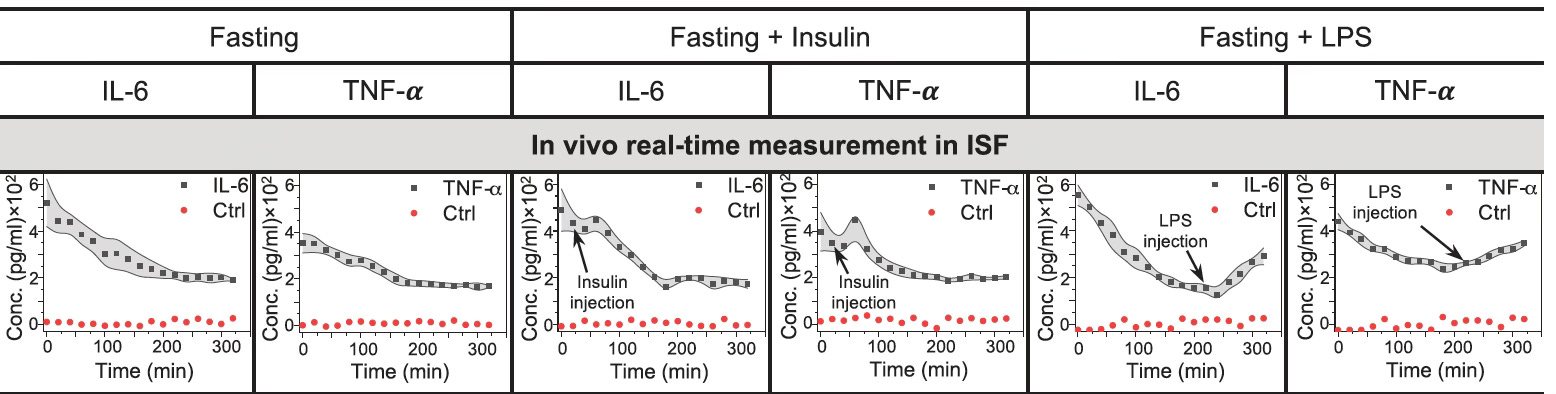
对,我们选择糖尿病模型是因为糖尿病和炎症总是相伴而生。血糖超出范围时,炎症就会开始飙升,所以我们觉得这是个好模型。我们让大鼠禁食后观察到,随着禁食时间延长,它们的促炎细胞因子水平会下降。
Yeah. So we chose a diabetes model because diabetes and inflammation go hand in hand. Right? If your glucose is out of range, your inflammation is going to start to spike, so we thought that would be a good model. And, you know, we had rats that we allowed to fast, and we could see that as they fasted, their pro inflammatory cytokines will come down.
我们给部分动物注射胰岛素后,发现促炎标志物下降得更快。有趣的是,当我们给大鼠注射胰岛素观察效果时,发现光是针头刺入就引起了轻微的炎症峰值——分辨率就是如此之高。这个发现非常...
We had animals that we would inject with insulin, and we could see the pro inflammatory markers come down even faster. Interestingly, when we, injected the rats with insulin to kinda see how that would affect things, we actually saw a little spike in inflammation just from the needle prick. That's how good the resolution is. So that was very cool to I
对此印象尤为深刻。是的。是的。
was struck by that especially. Yeah. Yeah.
是的。然后我们还给大鼠注射了会使它们炎症加剧的分子,我们确实观察到了这一现象。因此我们成功说服了自己和论文评审人员,证明我们真的能在活体动物中实时观察炎症过程。
Yeah. And then we also dosed the rats with molecules that would make their inflammation spike, and we could absolutely see that. So we were able to convince ourselves and the folks that reviewed our paper that we really could watch inflammation in real time in a living animal.
是的。正因如此,这项研究具有里程碑意义——因为此前没人真正设想过这种可能性,但你们不仅证实了其可行性,更通过令人印象深刻的动物模型进行了验证。现在看来这项技术拥有无限的临床应用前景。比如监测人们是否坚持抗炎饮食、保持运动习惯以维持低炎症水平——我们都知道'炎性衰老'是导致年龄相关疾病的重要因素。
Yeah. So this is why it was such a landmark contribution, because no one had ever really conceived that this could be possible, but you actually demonstrated it's more than possible. You demonstrated in a very impressive animal model. Now there seems to be limitless clinical applications of this. I mean, so if you were trying to monitor if a person's eating an anti inflammatory diet, or they're exercising, and they're keeping their body in their low levels of inflammation, which we know inflammaging is such a big part of how we wind up with these age related diseases.
这似乎是未来确保人体炎症状态监测的完美方案——而且不限于特定蛋白质,几乎任何蛋白质都能监测对吧?你们能实现实时监测。那么是否有可能将信号传输到智能手机上?
This seems like a perfect way in the future that we could assure that a person's inflammatory state and it doesn't have to be these proteins, it could be pretty much any protein. Right? You could that in real time. Now, do you see a way where you could get this signal to your smartphone?
当然可以。这个构想其实会延续动态血糖监测仪(CGM)的发展路径——通过组织液传感器连接手机应用,追踪能指导生活方式决策和疾病管理的生物标志物。此外还有一系列我认为非常有趣的研究应用场景。
Oh, absolutely. I mean, the the concept is to just we're we're gonna just go right alongside, you know, the way the CGMs have been developed. So sensor in the interstitial fluid app on a phone, being able to track markers that will help us make lifestyle decisions, help us manage disease. And then there's also a whole set of research applications as well that I think will be really interesting.
没错。对我而言,这些标志物将预防医学推向新纪元,你带来的是一种前所未有的高精密度生物标志物。目前我们缺乏良好的系统性血液标志物,只能用高敏C反应蛋白或白介素6这类指标——但实时连续监测将彻底改变这一局面。这项技术还能用于预防阿尔茨海默病、自身免疫性疾病等领域。
Yeah. I mean, so for for me, so into the new era of prevention that's been potentiated with these markers, that you're adding a whole different level of sophistication of marker, I would say. And we don't have very good systemic blood markers now. We use high sensitivity CRP, maybe IL six, but this is a whole different look being able to do this in continuous in real time. Now other ways that this could be used are for trying to prevent Alzheimer's disease, autoimmune diseases.
你提出的应用方向之一是通过持续监测BNP肽来预警心力衰竭。或许你可以谈谈将蛋白质监测传感器用于精准医疗的整体构想?
One of the ones that you posited was heart failure by, for example, continuous measurement of the BNP peptides that tell us about the impending heart failure. You may want to comment about this whole idea of using a sensor for protein monitoring, for precision medicine.
是的,完全正确。你描述得非常到位,在难以管理的慢性病中,心力衰竭就是个典型例子。你比我更清楚,患者可能处于心衰的不同阶段,看似状态稳定,但突然病情恶化——比如醒来发现脚踝肿胀,却难以判断原因。这时是否需要调整药物剂量?
Yeah, absolutely. You described it very well that for the chronic diseases that are hard to manage, heart failure is a classic one. You know this better than me, that you have patients in various stages of heart failure and they may be okay, and they seem to be, you know, at a a steady state. But then something happens, and they wake up, and their ankles are swollen, and it's not clear what's going on. Do medications need to be titrated?
要知道,如果能观察BNP指标过去24到48小时的变化趋势,很可能就能明确下一步治疗方案。因此我认为,如果我们能实现持续监测,慢性病管理领域绝对能为患者带来巨大改善。比如ICU的脓毒症患者,实时掌握炎症动态;还有你提到的神经退行性疾病——虽然可能先应用于模式生物而非人类,但研究神经炎症及其在脑内的爆发机制,这个应用方向非常令人着迷。
You know, if you could see what BNP had been doing over the last twenty four to forty eight hours, that would probably give you an answer in terms of what action to take next. So I think chronic disease management is is absolutely a place that we can just do so much more for patients if we're able to monitor them. Septic patients in the ICU, really understanding what inflammation, how it's trending there. Then you mentioned neurodegenerative disease. One of the things that I think is really fascinating to think about as an application, maybe not in humans, but in our model organisms, just really understanding neuroinflammation and what happens in the brain when you have a spike in inflammation.
有些被诊断为精神分裂的患者,其实只是脑部存在炎症。对症治疗后精神病症状就会消失。但当前这完全是个黑箱领域。所以这项技术不仅能造福患者,更能系统性地解答炎症如何影响人体——从全身到器官层面的作用机制。
There are people that are diagnosed as being schizophrenic, but they actually just have inflammation in their brains. When they're treated appropriately, the psychosis goes away. But it's very much a black box. So I think we can do a lot for patients if we can take the technology where I would like to, but we can also answer a lot of questions about how inflammation affects us systemically, but also at the organ level.
确实如此。正如你所说,这项技术在研究和疾病管理预防方面都有无可比拟的前景。自身免疫性疾病就是重点领域之一。现在问题是:你手握这项天才发明——
Absolutely. There's unparalleled ways that this can go forward in both, as you say, research, but also in the management of and prevention of diseases. I mean, the autoimmune disease category is way up there in the list. Now how do you move forward? You got this ingenious invention.
已经在动物模型中得到验证——该如何加速推进到临床应用阶段?
You've got a proof of it in in the animal model. How do we accelerate this so it becomes something that we could use in the clinic?
没错,这恰恰是最困难的部分。发明创造和概念验证固然艰难,我们花了多年才突破。但将技术转化为产品是全新的挑战。我既主持过学术实验室,也运营过诊断领域的初创公司——
Yeah. So that's that's actually the hard part. I mean, the the inventing and the proof of concept and all, that was hard, and it took us many years to get there. But now turning this technology into our product, that's a whole other exercise. I've I've run academic labs, but I've also run companies in the diagnostic space, startups that emerge from my labs.
我熟悉产品开发的路线图、生命周期管理等流程,这些正是下一步重点。当前我们正在确保原型机足够可靠,正在开发医用级原型机,以便商业化时能拥有扎实的起点。这项工作将持续到2026年,之后要么与雅培、德康等行业巨头合作,要么自主创立初创公司推进。我对这个方向充满决心。
I know the product development, you know, road maps, the life cycles, and all of this, and that is really what we need to do next. What we're doing right now is just making absolutely sure that we have a very robust prototype. We are developing a prototype for human use so that we can you know, when we start walking down that commercial path, we really know that we've got something robust in hand to start with. That work will be done during 2026, and then we're ready to take that next step either with a commercial partner, you know, the Abbotts, Dexcoms, you know, those players in the field, or, you know, we'll we'll go at our own and have a a startup company that that takes the next steps with it. But we're I'm I'm very committed to this.
我真心认同你提到的观点,这项技术确实可能彻底改变多种疾病的治疗方式。我们绝对希望能见证这一愿景实现。
I really believe in it just in the way that you, mentioned that this really could be transformative for the way so many diseases are managed. And so we absolutely wanna see that through.
是的。多年来我一直试图预测科技发展趋势,但从未像对这项技术这样兴奋过,莎娜。等你们准备就绪时,我想第一个报名当志愿者。可以吗?能答应我吗?
Yeah. I mean, I've, over the years, tried to anticipate where things are going, and I haven't been as excited about a new technology as this one, Shana. Now I wanna sign up as patient zero when you're ready. Okay? Can you will you let me You
明白了。
got it.
我想实时掌握自己的炎症状态。好的。现在要谈的是你们陈-扎克伯格生物中心这个非凡项目。全美只有少数几个这样的生物中心,2023年你们从众多申请城市中脱颖而出,获得了CZI的支持。
I wanna know my inflammation status in real time. Alright. Now, this is a part of something that is really, extraordinary, which is your, Chan Zuckerberg Initiative Biohub. There's only a few of these Biohubs in the country. And back in 2023, you were selected in a competition of many cities that wanted to tap into the support of CZI to do this.
能否介绍一下生物中心如何助力这类研究?
So can you tell us about, the Biohub and how it helps enable this type of work?
当然。生物中心是非常独特的生物医学研究机构,与世界顶尖研究型大学建立合作关系。在芝加哥,我们与芝加哥大学、西北大学、伊利诺伊大学厄巴纳-香槟分校合作。
Yeah. Absolutely. So the Biohubs are really unique types of biomedical research institutes. They function in partnership with top tier world class research intensive universities. In Chicago, we work with the University of Chicago, Northwestern, University of Illinois, Urbana Champaign.
我们致力于开展高风险高回报的研究,开拓那些在美国国立卫生研究院常规资助体系外、尚属空白的领域。这个模式的独特之处在于汇聚了科学家、化学家、物理学家、生物学家、工程师和AI专家,形成多学科团队攻坚克难——比如我们讨论的实时炎症监测、炎症特征分析、自身免疫疾病研究等课题,这正是芝加哥生物中心的研究重点。要知道,我主持NIH资助实验室已有二十年,能获得这种支持确实很棒。
And we're really here to do high risk, high reward research to really be out in white space where there isn't a lot of activity, in, let's say, the NIH funded, parts of biomedical research. And what's what I think is really cool about the model is that we bring together scientists, chemists, physicists, biologists, with engineers, with folks that do AI. It's very multidisciplinary, and we assemble these incredible teams to work away on hard problems, like the problems that we've been talking about, sensing inflammation, watching it in real time, profiling inflammation, understanding autoimmune disease. That's our focus at the Biohub in Chicago. You know, I've run an NIH funded lab for for twenty years, and, it's wonderful to have that kind of support.
但我们在生物中心获得的支持让我们能够快速行动,快速试错(如果需要的话),更重要的是能快速攻克那些具有重大影响的问题。
But the support that we get at the Biohub allows us to move fast, fail fast too, if we're going to, but really move fast towards problems that will have significant impact.
是的。你能获得这种额外支持很棒,尤其是在当前这个难以依赖NIH(美国国立卫生研究院)的时期,考虑到事态的发展方向。不过除了你的团队外,还有另一股重要力量——传感器领域的另一位先驱约翰·罗杰斯,他曾在伊利诺伊大学(我想也是你们联盟的一部分)工作,但显然更专注于生理传感器领域。我关注西北大学的动态,或许有失偏颇,但那里似乎已成为世界传感器和未来主义传感器的中心。
Yeah. Well, it's great that you get that added support, especially we're at a time when it's hard to count on NIH, way things are headed or going. But also, there's another force there, a major force besides your team, which is another pioneer in sensors, John Rogers, who, he was at, U of I, which I guess is also part of your consortium. But, he's more on the physiology, sensors, obviously. I look at what's going on in Northwestern, And I may be off on this, but it seems to be the capital of the world of sensors, futuristic sensors.
我认为你们团队的工作是无与伦比的。据我所知,目前还没有其他人能实现蛋白质追踪技术——这项技术本可用于追踪DNA、RNA等过去无法实现的目标。而约翰的工作,据我理解,主要聚焦在生理学领域。这样总结准确吗?
Yours is one I think that is unparalleled. I don't know anyone else who's been working on the ability to track proteins. It could be, you know, could be tracking DNA, RNA, things that we've not been able to do in the past. And whereas the work that John's been doing, as I understand it, is largely physiology centered. Is that is that a good way to summarize it?
没错。约翰是西北大学杰出的同事,在生物电子学领域堪称非凡。他的团队研发了许多令人惊叹的设备,包括大量可贴附皮肤的柔性设备。他在新生儿护理设备领域贡献卓著,为NICU(新生儿重症监护室)提供了理想的监测解决方案。
That's correct. Yeah. John is a wonderful colleague at Northwestern and a bioelectronics, you know, extraordinaire. His team builds these amazing devices, a lot of flexible devices that can go on the skin. He's done a lot of work on devices for neonatal care and, you know, just delivering the kind of monitoring capability that you would want for, babies in a a NICU.
是的,我们更侧重分子层面,而他更专注生理层面。两者高度互补——这也正是西北大学吸引我来此开展研究的原因之一,因为我们在生物电子学领域确实独树一帜。
So, yeah, we're more on the molecular side, and he's more on the physiological side. It's all very complementary, but that was one of the reasons I found Northwestern to be a really attractive place to to do my work because we we are extraordinary in bioelectronics.
有些人可能因深盘披萨知道芝加哥,而我却因这里的传感器先驱工作而熟知它。对了莎娜,如果你有任何问题,请随时留言,我们会尽量在讨论中回应。除了你们承担这项工作的联盟外,你提到的AI方向非常重要。AI领域最棘手的挑战之一就是处理连续传感器产生的数据。
Well, some people might know Chicago for deep dish pizza, but I know it for sensor pioneer work. Yeah. And by the way, if you have questions that you want to ask, Shana, please put them in the message, and I'll try to we'll try to make sure that we respond to them as we're talking. Now, besides the consortium you have, you know, that is taking on this work, you mentioned something that's really important is the AI side of it. So one of the most difficult things in AI is the analysis of data from continuous sensors.
这被称为时间序列分析。由于产生的数据量极其庞大——人们总认为基因组数据量很大,但当你用连续传感器监测,并试图结合个人其他层面的数据进行分析时...你们是否已开展这类分析工作的研究?
The words that are used are time series analysis. So in order there's so much data that's generated. People think the genome has got a lot of data. Well, you have continuous sensors going on, and you're trying to analyze that with all the other layers of a person data. So have you been working on how to do that type of analytic work?
因为这是挑战的另一部分。
Because that's another part of the challenge.
确实如此。在Biohub,我们所做的一切都有AI元素在加速或推动。传感器数据——我指的是源源不断的分子数据流——对模型开发将非常有力。随着我们采用这项技术并扩展它、多重化它,现在可能只关注两件事,但很快会扩展到十件事,几周内甚至能关注五十件事。
Absolutely. So really everything we do at the Biohub, there's an AI element that is either accelerating it or driving it. And we see sensor data I mean, a continuous stream of molecular data is something that will be very powerful for the development of of models. And I think as we take this technology and we scale it and we multiplex it and we're, you know, right now looking at two things, but then we're looking at 10 things. We're looking at 50 things over a time scale of weeks.
对吧?这是个极其复杂的数据集。我的梦想——你应该见过那些图表,比如人体内所有代谢过程的示意图,克雷布斯循环之类的各种内容。
Right? This is an incredibly complex dataset. And, you know, my dream I'm sure you've seen these charts of, like, you know, the metabolic everything in the human body. Right? The Krebs cycle and all of this different stuff.
但这些都只是教科书式的知识。人体内的实际情况要复杂得多。有了传感器,如果我们能获取实时数据,那套复杂体系对人类生理学的意义才能真正显现。但我认为,真正驱动这一切的计算模型将是关键所在。
But it's all kind of textbook y. Right? You know, in the human body, things are a lot more complicated. And with sensors, right, if we have the ability to have this real time data, that complicated scheme really comes to life in terms of what it means for human physiology. But I do think that having the computational models really driving that will be essential.
确实。我完全赞同你的观点。我是说,能够通过分析数据来告知个人他们可能即将面临心力衰竭、体内炎症水平过高或某些指标异常,并且确保这种预警足够可靠以避免误报——这本身就是一项超越你已取得成就的额外挑战,而你的现有成果已经非常了不起了。更令人惊叹的是,这只是你研究工作的一个维度。我看了你最近的论文,你在稀有细胞、淋巴细胞和巨噬细胞等领域都有深入研究。
Yeah. I couldn't agree with you more. I mean, the ability to take the analytics to inform an individual about, you know, that they could be having impending heart failure, that they're having high levels of inflammation, that something is off track, you know, to have that do that reliably so they're not getting false signals, you know, it's another part of the challenge beyond what you've already done, which is really quite extraordinary. Now what's also amazing about you is that this is only one of the dimensions of your work. I mean, I was looking at your recent publications, and it is you know, you've got all this work on rare cells, lymphocytes, and macrophages.
除此之外,你的研究还涉及许多其他方向。或许你可以给我们讲讲,虽然这部分可能是最让你兴奋的核心内容——毕竟你拥有分子探针技术,能在活体中进行研究,或者如你所说目前可能采用模型,但你们正在向细胞内递送领域拓展。这真是太厉害了。请多跟我们聊聊你现在专注的其他研究方向。
You've got, many different aspects of what you're doing that are apart from this. So maybe you can just fill us in that this is just maybe this is the principal part that's got you most excited, but you're using because you have molecular probes, you know, in the live person, or at this point, perhaps you say models, you're going in directions for intracellular delivery. I mean, wow. Tell us more about these other things that you're into now.
当然。多年来我的实验室团队从来不是只专注于单一问题的类型。我们本质上是技术开发者。我在加州理工学院接受的是化学家训练,但不是合成分子的传统化学家,而是测量分子的那类化学家。我们真正在做的是寻找那些尚未被探索的空白领域。
Sure. So my labs over the years were were really not the type of folks that just work on one problem. We're really technology developers. I was trained as a chemist at Caltech, not the molecule making kinda chemist, but, like, the molecule measuring kinda chemist. And we really just you know, we look for white space.
我们寻找未解决的问题和未被满足的需求。然后,你知道的,项目开始时我们总是站在白板前讨论:我们如何测量这个?如果能测量,我们能用它做什么?于是几年前我们启动了一个项目,想找到一种能更快筛查血液中稀有细胞的方法。虽然可以使用流式细胞仪,但要处理一毫升血液可能需要数周时间。
We look for unsolved problems, unmet needs. And then, you know, the beginning of our project is always standing at a whiteboard and saying, how can we measure this? And if we could measure this, what could we do with it? So we started a project a few years ago where we wanted a way to be able to search for rare cells in the blood much faster. You know, you can use a flow cytometer, but to get through a milliliter of blood is gonna take you weeks and weeks and weeks.
到那时细胞早就死亡了。因此我们开发了一种高通量细胞分析技术,最终能够在血液中找到那些曾进入肿瘤后又流出的免疫细胞。这些就是肿瘤反应性淋巴细胞。我们发现可以分离出足够数量的这类细胞用于肿瘤治疗。这大概就是机缘巧合在我们研究中的典型体现。
The cells would be dead by then. So we developed a high throughput technology for cellular analysis, and we ended up being able to find immune cells in the blood that had been inside of a tumor and had come out. So these are tumor reactive lymphocytes. And what we learned is that we could isolate enough of those that we could treat a tumor with them. So this is just kind of how the road of serendipity usually goes for us.
明白吗?满足未竟需求的技术平台总是需要时间才能找到真正有吸引力的应用,但我们不断努力直到有所发现。然后我们建立合作,孵化公司。特别是那家研究血液中肿瘤反应性淋巴细胞的公司,正将这种方法推向临床。我的热情所在正是开发这些技术并推动它们发展,最终为患者带来积极影响。
You know? Unmet need technology platform always takes a while to find that kind of really compelling application, but we work and work and work till we find something. And then we partner. We spin companies out. That company in particular that is taking the, blood borne tumor reactive lymphocytes is taking that approach towards the clinic, and that's really my passion is is developing these things and then trying to to move them along so that they can have a positive impact on patients.
我们对具体形式持开放态度,真正重要的是实际影响。
And we're just kind of agnostic about that. All that really matters is the impact.
确实。这个发现很惊人,因为如果你能监测正在接受癌症治疗的患者,通过观察这些肿瘤浸润淋巴细胞的变化来评估疗效,甚至能提取这些细胞用于治疗本身,这非常了不起。那么关于细胞内递送技术呢?
Yeah. Mean, that one is striking because if you can monitor a person that you're trying to treat their cancer successfully and know that you're doing well with respect to this whole tumor infiltrating macro lymphocytes. If you can know what's going on in those dynamics, know that point about you could take these cells and use them to be part of the treatment. It's pretty striking. And what about this intracellular delivery thing?
这是另一个我不太清楚的领域,没想到你们也在研究这个。
That's another zone that I was unclear. I didn't know you were working on that too.
是的。这同样是个未解的难题,是我们发现的另一个非常有趣的方向。我们试图解决的问题是:如何让分子不仅进入细胞,还能进入细胞的线粒体?毕竟线粒体承担着许多重要功能。
Yeah. That again, it was just another unsolved problem, something that we spotted that we thought was really interesting. And and the problem that we're trying to tackle there is how do you get a molecule into a cell but then into the mitochondria of the cell? Right? The mitochondria are doing all these really interesting things.
要知道,那些显然是能量生产者,但它们还有许多其他信号传递能力。线粒体中的DNA,我们尚未完全理解其功能或非功能。所以我们刚开始开发能到达那里的化学探针,这样我们就能提出许多问题,比如所有机制如何与线粒体协同工作。这非常迷人。虽然目前还没有相关初创企业,但这确实是个非常有趣的项目。
You know, those are the energy producers, obviously, but they have a lot of other signaling capabilities. There's DNA in mitochondria, which we don't completely understand what it does or doesn't doesn't do. So we just started developing chemical probes that could get there, and then we could ask a lot of questions about, how all of the machinery and mitochondria works together. And it's been really fascinating. No startup there yet, but it's been a really interesting project.
是的,是的。不,我只是想确保听众和观众意识到,尽管这项关于蛋白质连续传感器的巧妙工作很重要,但它只是你们采取的多方面方法中的一部分,这种方法相当独特且令人印象深刻。现在,让我们回到主要话题,即实时持续追踪人体内一种或多种蛋白质的能力,并在出现异常时向个体报告。
Yeah. Yeah. No. So I just wanted to make sure that people who are listening and watching realize that even though this ingenious work on the sensor, continuous sensor of proteins, it's just one part of a multifaceted approach that you're taking that are pretty unique, pretty impressive. Now, let's go back to, the principal, topic, which is the ability to track, a protein or proteins in, a person on a continuous basis in real time reporting to that individual if there's something that's off track.
在我看来,这在一定程度上源于跨学科的专业知识。你在国内顶尖机构拥有化学和生物医学工程背景,因此你的思维方式与众不同,而且你可能有一个团队支持。团队成员来自不同领域——我的意思是,当你解决这个几年前还只能想象的案例时,你是否认为关键在于你融合了生物医学不同领域的专业知识?
This came about, it seems to me, in part because of interdisciplinary expertise. You have yourself a chemistry and biomedical engineering background at the leading institutions in the country. So you think of things differently, and then you probably have a team that does that. You have people coming from different I mean, when you crack this case, which, you know, was only something you could imagine some years ago, do you think that this was the key that you just because you you have a fusion of different areas of biomedical expertise?
是的,我认为跨学科确实大有裨益。必须将不同领域的东西结合起来。团队中还有一些非常、非常有才华的工程师和化学家,他们有能力实现目标并具备整合一切的技能。但我想,长期置身于这个领域,同时跨越研究界和商业界,了解行业内未满足的需求,并理解那些重大难题也很重要。
Yeah. I think being interdisciplinary really helps. You have to bring different things together. There were also some very, very talented engineers and and chemists on the team that could make it happen and had the skills to to put it all together. But I think it's also, you know, being in the space for a while, also straddling the the research world and the commercial world and kind of knowing what the unmet needs are in the industry and just understanding those big problems.
根据我对你说过的话,我觉得自己更像是个问题解决者。我不是那种专注于基础科学的人,虽然我对那些深入研究基础科学问题的人怀有极大敬意。但对我来说,更重要的是应用层面——现在不可能实现的事情,我们如何让它成为可能。追求这类问题,正是我觉得当科学家如此棒的原因。
And I think from what I've said to you, I'm just kind of a problem person. I'm not somebody who's like a basic science. I have incredible respect for people that just go super deep with a basic science problem. But for me, it's much more about the application and what is impossible right now that we could make possible. And going after those kinds of problems, that's to me, that's why being a scientist is just so awesome.
我是说,我热爱这条探索之路,然后攻克那些可能产生重大影响的难题。
I mean, I I I love this this path of discovery and then attacking, hard problems that could have a major impact.
嗯,这确实显而易见。那么你是否知道世界上还有其他团队在做类似的工作?无需试剂,仅用微弱电力就能使蛋白质脱离以便检测。我是说,除了你们团队外,我还没听说过其他地方有这种技术——现在有其他团队也在研究这个吗?
Well, it certainly shows. Now are you aware of any other group around the world that has done work like this where without reagents, little electricity shaking off the protein to be able to assay it. Mean, this is something that I haven't heard elsewhere besides your is there any other group that's onto it now?
是的。我们团队在蛋白质传感领域最为活跃。还有一些出色的研究致力于开发针对其他小分子的传感器,远不止于葡萄糖。比如UCSB的凯文·普拉斯科、斯坦福的汤姆·索,以及辛辛那提的杰森·海琴菲尔德。
Yeah. We have been the group that's been most active on protein sensing. There is also some wonderful work on developing sensors for other small molecules kind of, you know, way beyond glucose. So there's Kevin Plasco at UCSB. There's Tom So at Stanford, Jason Heichenfeld in Cincinnati.
许多人正在利用小分子传感器研究药物在血液中的代谢过程,观察各种指标——我认为这些技术也将成为强大的临床工具。我们专注于蛋白质领域,是因为我长期关注慢性病管理的困境及其对新工具的迫切需求。但电化学传感器研发的热潮中我们并不孤单,我们都坚信持续血糖监测(CGM)模式是实现突破的路径,就像深度监测仪那样。
A lot of people that are taking sensors for small molecules, using them to look at drugs being metabolized in the the bloodstream, looking at at various things that will also, I I think, be really powerful as as clinical tools. So we've just stayed over on the protein side of things because I just historically, you know, have looked at chronic disease management and how difficult it is and the need for for other tools. But we're certainly not alone in terms of a keen interest in developing electrochemical sensors and really believing that, like, the CGM like paradigm is the way we're gonna get there, for There's a depth monitor.
这个说法很贴切。我们讨论的是纳米尺度的技术。很多人都在疑惑:纳米技术何时能改变我的生活和健康?你们似乎正在实现这一点。当下我们正处于一个独特时代,生命的大语言模型正在实现数字生物学愿景,让生物学在多方面成为工程学科。
Is is a good way to put it. And we're talking about nanoscale, nanotechnology. And a lot of people have been wondering, when is nanotechnology gonna change my life and my health? It seems like you've you've been doing that. Now we're also in a very unique era where, this kind of large language of life models, so many things that are fulfilling this kind of digital biology or biology becoming an engineering discipline in many respects.
你们的工作正是典范。不仅解码生命语言,更能以我们几年前——甚至几个月前——难以想象的方式理解个体生命与健康。那么接下来何去何从?总结来说,你们正推进蛋白质传感器的临床转化,或许一年半后就能应用于人体?
And your work exemplifies that. So things are really taking off in terms of this, not just the language of life, but being able to understand a person's life and health on a basis that we probably might not have thought about you know, a few years ago, maybe even a few months ago. So where do we go from here? I guess, just to sum up, you're you're pursuing the clinical path for the protein sensor. Maybe you'll be able to get into people in a year and a half perhaps.
这个预期合理吗?
Is that fair?
这正是我们的目标。
That's that's what we're aiming for.
好。我报名当第一个受试者。
Right. And you sign I'm signing myself up to be the first one.
埃里克,我们正在录音,所以我们会采纳你的建议。
This is being recorded, Eric, so we'll take you up on that.
那会很令人兴奋。是的,你所做的事情确实非同寻常。我要为此祝贺你。如果在我们结束前有任何问题,现在是发消息的好时机。
That'd be exciting. Yeah. What you're doing is is really extraordinary. I just wanna congratulate you on that. And if there's any questions before we wrap up, this is a good time to put them in the message.
有人问到了秋水仙碱。比如,如果你患有动脉粥样硬化,并且你的动脉有炎症标记,你能看出药物是否在减轻炎症吗?你大概会同意这是衡量抑制炎症能力的好方法吧?
Somebody did ask about colchicine. Like for example, if you have atherosclerosis and you had inflammation in your denoting artery inflammation, would you be able to see whether the medications are bringing down the inflammation? You would agree that's probably a good way to gauge the ability to suppress inflammation?
是的,完全同意。目前我们主要关注全身性炎症。只要你知道的任何标志物最终能给出正确的间质液检测结果,我们就能获取数据。但我们也在研发一些设备,比如可以植入心脏靠近病灶,这样我们就能获取器官层面的炎症数据,而不只是观察全身情况。我认为适应性是存在的。
Yeah, absolutely. I mean, right now we are focused on systemic inflammation. So if whatever markers you know, give you the right output end up in the interstitial fluid, we can get at that. But we are also looking at developing devices that, for example, could be implanted in the heart to be closer to the source of the problem so that we can get at organ level inflammation rather than kind of looking at everything going on in the body. So I think the adaptability is there.
我总是感到惊叹。你知道,当我与心脏病专家交谈时,似乎心脏和设备结合能做很多事情。已经有很多成果了。所以我认为这是未来非常有潜力的应用方向。
I'm always amazed. You know, when I I talk to cardiologists, it seems like there's a lot you can do with the heart and devices. There's a lot that's been done already. So I think that's a very interesting potential future application.
是的。我认为你甚至可能通过已植入动物模型的传感器就能捕捉到动脉内的情况,看看是否抑制了炎症。还有人问到长新冠问题,这非常有趣,因为这种情况下免疫系统是失调的。
Yeah. No. I think you probably could pick up what's going on in the arteries without even just from the sensor you had already put in the animal model and see whether you're suppressing inflammation. Another person asked about long COVID. And that's really intriguing because here you have dysregulated immune system.
通常炎症水平很高,而我们却没有治疗方法。所以这可能是验证治疗效果的好方法,看看是否在长新冠治疗上取得进展。我们甚至没有生物标志物,但你的传感器或许能照亮这个领域。你不觉得吗?
You have often high levels of inflammation. And then we don't have a treatment. So this might be a really good way, a validated treatment, to see whether or not you're making progress in in long COVID. We don't even have a biomarker, but it could be your sensor is a way to really light that area up. Don't you think?
我确实这么认为。我是说,任何具有那种黑箱特性的事物,对吧,我们真的不了解其驱动因素。人们某天感觉好些,却不知原因;另一天又感觉更糟。
I I do think so. I mean, anything that is that has that kind of black box kind of feature to it, right, where we just really don't understand the drivers. People feel better on a given day. They don't know why. They feel worse on another day.
如果我们有生化数据,或许能解析清楚。自身免疫疾病也存在类似情况,那些病情反复波动的患者尝试通过调整饮食或生活方式来改善,但很难理解关键调控点在哪里。拥有生化数据将带来巨大改变。
If we had the biochemical data, we could probably deconvolute that. Same thing with the autoimmune diseases that kind of have these spikes and people are trying to modify diet or lifestyle in different ways, but it's just really hard to understand what the levers are. Having biochemical data would make a huge difference.
好的。我们已经探讨了几个非常精彩的问题。我还想说,在座的各位——无论是现场参与者还是通过直播/录播观看的朋友们——我们此刻正窥见未来。因为这为我们提供了促进个体健康的新机遇,确实非同寻常。
Alright. Well, we touched on a few of the questions, which are really good one. I also wanted to say, gotten a glimpse to the future here, folks, those of you who are, here with us live or listening or watching the archive. The reason is because this is giving us a new opportunity for individual promoting the health of an individual. So, it's really pretty extraordinary.
或许今日你们尚未察觉,到2027年就可能在人群体检中看到成果。但你们在此开创的事业已足够非凡。肖恩,我想再次强调,你的贡献堪称天才之作。希望人们能关注西北大学、芝加哥以及CZI支持的研究项目,这些都将孕育出重大突破。
You may not know it today, and you may start seeing results in people in 2027. But what you started here is just so extraordinary. So, Shane, I I just wanna say again, you know, what you've done, I consider ingenious. I think now, hopefully, people will know Northwestern and Chicago and the efforts that are being supported there by CZI is something that is just to watch carefully. There's a lot gonna a lot of great stuff gonna happen out of it.
希望你们持续与我们保持联系。值得一提的是,凯莉教授和她的团队本月将发表一篇关于该主题的精彩综述,敬请期待。这仅仅是医学革命的开端,它将在现有基础上实现飞跃,实在令人叹服。感谢各位的参与。
And so I hope you'll keep us posted. I do wanna say there's another really impressive review coming out on this topic by Professor Kelly and her colleagues, so stay tuned for that later this month. And it's just the beginning of a revolution occurring in medicine that adds on to what we have today. It's really so darn impressive. So thanks for joining.
对开场时的音频技术问题我们深表歉意,所幸最终得以解决。已有数百人参与本次活动,后续还将有数千人观看录播。莎娜,谢谢你,也感谢大家对我们初期技术问题的包容。
We're sorry for the technical problems on the beginning with audio, but I think we finally got that resolved. And we've had several 100 people join us, and I'm sure thousands more will be watching subsequently. So, Shana, thank you. And thanks again for bearing with the issues that we had technically to get started.
这是我的荣幸。非常感谢你,埃里克。
My pleasure. Thank you so much, Eric.
好的,保重。
All right. Take care.
好的,再见。
Okay. Bye bye.
关于 Bayt 播客
Bayt 提供中文+原文双语音频和字幕,帮助你打破语言障碍,轻松听懂全球优质播客。