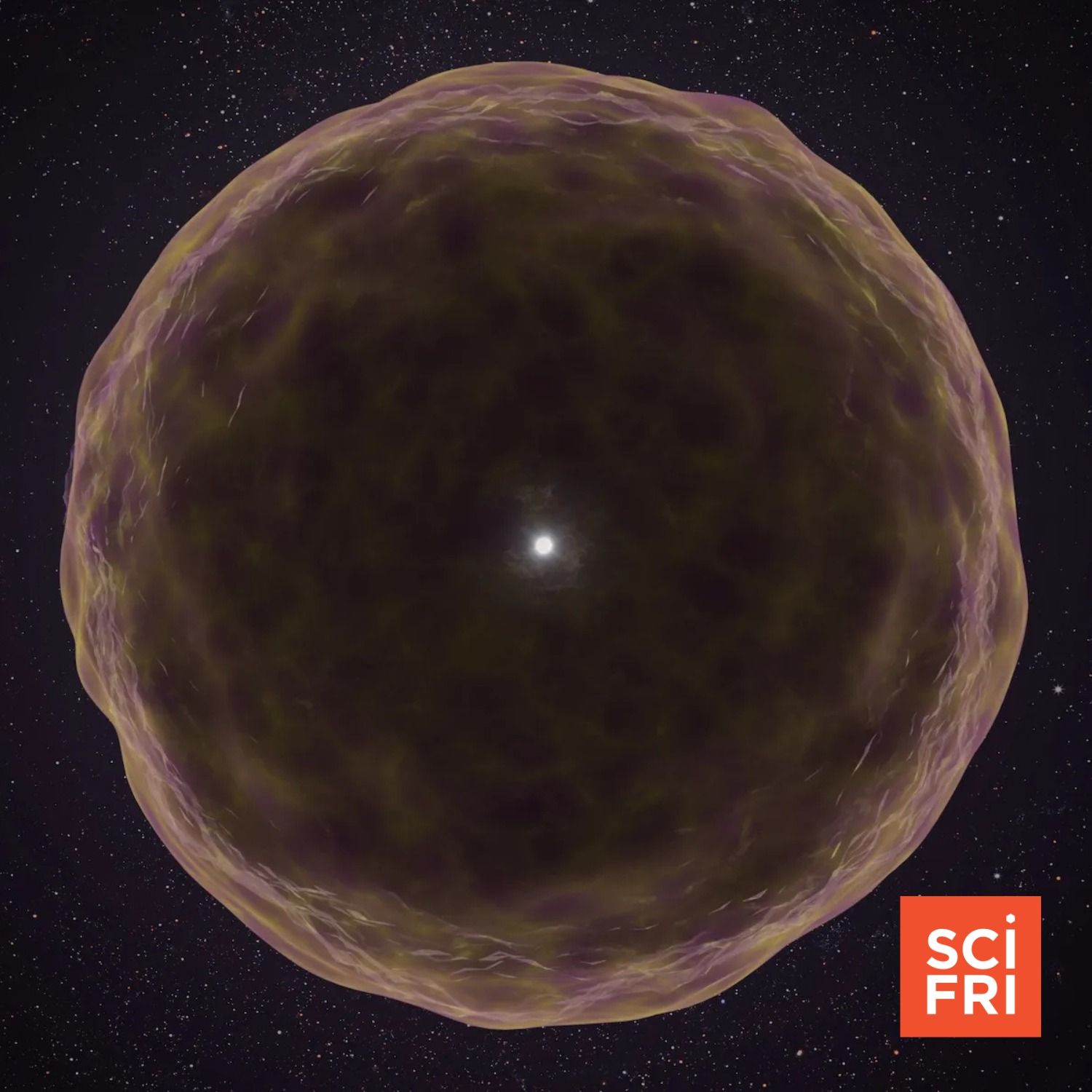
本集简介
双语字幕
仅展示文本字幕,不包含中文音频;想边听边看,请使用 Bayt 播客 App。
大家好,我是弗洛拉·利希特曼,您正在收听《科学星期五》节目。今天播客中,天文学家们窥见了一颗爆炸恒星内部,并发现了一些意外惊喜。
Hey. I'm Flora Lichtman, and you're listening to Science Friday. Today in the podcast, astronomers caught a glimpse inside an exploding star and found some surprises.
我们立刻意识到这是前所未见的现象,但当时并不清楚实际观测到的究竟是什么。
We immediately realized this is something that we have never observed before, but we didn't know what we actually did observe.
你可能认为恒星只是一团炽热气体。没错它确实炙热,但新研究表明恒星不仅仅是古老的气体团。本周研究人员报告称,他们观测到了这些氢氦元素层之下隐藏的部分结构——至少在一颗特殊超新星内部是如此。他们发现了分层结构,就像一颗巨型绽放的洋葱。天文学家捕捉到这颗恒星爆发瞬间,当外层物质剥离后,他们得以窥见其中某个内层结构。
You might think of a star as just a mass of incandescent gas. Yo ho, it is hot, but a new study suggests stars aren't just a big old mass of gas. This week, researchers report that they've observed some of what lies beneath all of that hydrogen and helium, at least inside one unusual supernova. And they found layers, like a giant blooming onion. Astronomers spotted this star in the act of exploding, and they were able to see one of those inner layers after all that outer star stuff was stripped away.
现在连线本研究作者史蒂夫·舒尔策博士进行讨论。他是西北大学塞拉中心的研究员,该中心是跨学科天体物理探索与研究机构。史蒂夫,欢迎来到《科学星期五》。
Joining me now to talk about it is study author, doctor Steve Schultze. They're a research associate at Northwestern University Sierra. That's the center for interdisciplinary exploration and research in astrophysics. Steve, welcome to Science Friday.
你好弗洛拉,很高兴认识你。
Hi, Flora. Nice to meet you.
我也很高兴认识你。我一直在尝试寻找合适的比喻——用巨型绽放洋葱来形容有多离谱?嗯。
Nice to meet you too. So I've been I've been trying to come up with the right analogy. Mhmm. How off base is a giant blooming onion?
这个描述简直完美无缺。
This is absolutely perfect perfect description.
我觉得你是在客气,不过请继续。
So I think you're being kind, but go ahead.
是的。本质上恒星最初是巨大的氢气球体,但通过核聚变会转变成壳层结构——这正像是洋葱的形态。所以恒星在生命末期时,它们就是巨大的宇宙洋葱。
Yeah. So essentially, a star starts as a huge ball of hydrogen. But then through nuclear fusion it gets transformed into a structure of shells. This is essentially how an onion looks like. So stars at the end of their lives, they're huge cosmic onions.
明白了。那么捕捉到恒星生命中这种戏剧性时刻本身有多罕见或不可思议呢?
Okay. So how unusual or unlikely was it to even capture this kind of dramatic moment in this star's life?
我们每晚都能常规探测到超新星爆发。但这个特殊天体是我们前所未见的,甚至未曾预料其存在。当我们开始分析数据并意识到手中发现的意义时,完全被震撼了。论文刚发表,仿佛重新经历了自发现以来的所有情感。
So we detect exploding stars routinely every night. This particular object is something that we have never observed before and we didn't even expect that something like this would exist. So when we started to see the data and grasp what we are actually holding in our hands, we were completely awestruck. And the paper just came out and it's like reliving all of the emotions again since discovery.
等等,最初获取数据时是情绪激动的时刻吗?
Wait. Was it an emotional moment when you first got the data?
倒不是情绪化,而是那种'哇,你究竟发现了什么'的惊叹。
I wouldn't say emotional, but it's like, wow, what have you just discovered?
你看到它时知道自己发现了什么吗?
Did you know what you had when you saw it?
并不清楚。当我们探测到这个天体时,试图获取光谱——因为光谱能揭示超新星抛射物的成分,比如氢、氦等元素的含量。但这次我们立即意识到这是前所未见的现象,却不知道实际观测到的是什么。这个天体的特殊之处在于,我们从未观测到如此高度剥离的恒星爆发。
No, not really. So when we detected the object, tried to get a spectrum because the spectrum tells us something about the composition of the supernova ejector. So for instance how much hydrogen is there, how much helium is there, etc. But in that particular case we immediately realized this is something that we have never observed before but we didn't know what we actually did observe. What is unusual about this object is that we have never observed an explosion of such a highly stripped star.
我们甚至不知道这类恒星能存在,更没想到它们也能以超新星形式爆发。
We didn't even know that these stars could exist and that they could actually also explode as a supernova.
你所说的'剥离'具体指什么?
Okay. So when you say stripped, what do you mean?
想象宇宙洋葱结构。恒星可能通过星风失去外层壳,也可能因核心不稳定而发生喷发。这种通过星风、喷发或伴星相互作用失去物质的过程,我们称之为剥离。剥离不仅会导致少量质量损失,实际上可能让恒星失去多层'洋葱皮'。
So we have our cosmic onion, and, stars can lose, their outer shells, for instance, through stellar winds. They could also have eruptions because of some instabilities in their very cores. And this process of losing material through winds, eruptions or interaction with a companion star, this is what we call stripping. And the stripping cannot only lead to losing a small amount of mass, it can actually lead to losing shells of this cosmic onion.
明白了。所以它失去了外层...失去了外壳。就像洋葱皮那样。
Okay. So it's lost its outer it's lost its outer shell. It's outer. It's the onion skin.
正是如此。而且不止一层,可能失去多层。最外层是氢,接着是氦层,然后是碳氧层,再往内有镁、氖和氧层,氧硅层,最终是铁核。通常我们观测到的剥离恒星爆发,大多只失去了氢包层或暴露出氦层。
Exactly. And not just one, but can can also lose several of those. The autonomous shell is hydrogen. Then comes helium, then comes carbon oxygen, then magnesium, neon and oxygen, oxygen silicon, and eventually the ion core. So when we usually observe explosions from stars that were stripped, usually they have lost the hydrogen envelope or maybe then exposed the hydrogen layer.
它们可能还失去了氢壳层,于是我们只能看到碳氧层。但我们从未观测到失去更多壳层甚至可能爆炸的恒星。
They could have also lost the hydrogen shell and then we only see the carbon oxygen. But we have never observed stars that that lost even more shells and that it could also explode.
我这么理解:缺失的壳层被剥离并非因为超新星爆炸,而是可能通过其他多种方式发生,最后就留下了这些物质。
So I here's what I understand. The missing shells get stripped off, not because of the supernova explosion, just because that can happen in a number of other ways. And then you have this stuff left behind.
没错。令我们惊讶的是,恒星几乎能完全失去所有壳层,而我们看到的只是它最核心的部分。
Right. For us, it was surprising that the star could essentially lose almost all of its shells, and we could just see at the very core or the very heart of the star.
你们观测到的那个内核是什么?
And what is that inner core that you're looking at?
我们在内核中发现存在氧硅壳层。虽然早有理论预测恒星应具有这种结构,但从未被实际观测到。因此这一发现对验证现有恒星形成与演化模型至关重要。
Okay. So what we found is that in the inner core shells exist, and we found that there is an oxygen silicon shell. There were predictions that stars should have this kind of structure, but it was never observed. So this discovery was very important to confirm our existing models of how stars should form, how they should evolve.
首先,能证实理论总是件好事。
Well, sounds nice to be right, you know, first of all.
确实。
Yes.
这个发现是否改写了我们原有的恒星认知?
Is there anything about the finding that is rewriting what we thought we knew about stars?
我们观测到的一个现象极其费解——氦元素的存在。这种元素本应在恒星生命更早阶段就被消耗殆尽,不该有残留,但我们却发现了氦。这完全不符合任何理论模型。我们咨询了多位研究恒星演化与爆发的建模专家——
One of the things that we observed, is actually extremely puzzling, and this is the presence of helium. This is an element that should have been consumed at a much earlier stage of the star's life. So there should be no helium left, but we found helium. And this is very puzzling for us and this is also not expected by, any model. And we ask several people who study, or who develop models for stars and how stars evolve, how they could explode.
所有人都认为不该存在残留氦元素。目前这是个巨大的未解之谜。
They all didn't expect that there should still be helium. So it's a huge mystery at the moment.
理论天体物理学家们对此是感到高兴还是有点恼火呢?
Are the theoretical astrophysicists happy about this or, like, annoyed?
我认为他们会非常高兴,因为现在他们可以摆弄自己的模型了。他们能观察并思考:该如何调整模型来匹配这些观测结果。或许还会想,这类物质可能吻合,也可能现有模型都不适用。那样我们就需要全新的理论框架。所以这对理论天体物理学家来说应该是非常激动人心的。
Well, I think they will be very happy because now they can, play with their models. They can see, okay, how can we tune them to match these observations. So maybe also be like, okay, well, maybe this type of stuff fits or maybe none of the existing models fits. Then we need something completely new. So it will be I think it is very exciting for, theoretical astrophysicists.
你怎么知道外层物质是被剥离了,而不是与你观测到的重元素发生了聚变?
How do you know that the outer the outer layers got stripped away instead of just got fused into the heavier elements that you see?
是这样的:恒星诞生时是个巨大的气体球。在生命末期会形成洋葱般的分层结构,每一层壳都有特定化学成分——最外层是氢,往里是氦、碳、氧等等。
Okay. So when a star is born, it is this huge ball of gas. And the end of its life, it has this onion structure. And each layer of these shells in the onion have a particular chemical composition. Hydrogen on the outside, helium, carbon, oxygen and so on.
这些壳层中的物质无法继续聚变,因为元素聚变需要极高的密度和温度,而这些壳层不具备这样的条件。
The material that is always in these shells, it cannot fuse further because in order to fuse elements, need high densities, need high temperatures, And those conditions are not met in these shells.
明白了。
Got it.
既然我们在光谱中没有观测到这些元素,就意味着这颗恒星早在很久以前就失去了这些壳层。
So since we do not observe these elements in the spectra that we obtained, means that the star must have lost those shells a very long time ago.
我正想问这个。一颗恒星死亡或爆发需要多长时间?
Well, I was going to ask that. I mean, how long does it take for a star to die or to explode like this?
这是个很好的问题。恒星演化极其复杂,取决于多种参数,有时突发的微小变化可能导致演化路径的巨大改变。就这个特定案例而言,我们对前身星的可能形态和演化过程有些设想,但并非绝对确定。
Right. This is a very good question. The evolution of stars is very, very complex, and it depends on various parameters that can be maybe some abrupt changes that can lead to huge changes in the evolution of a star. In this particular case, we have some ideas of how this progenitor star could have looked like or how it could have evolved. But we are not absolutely certain.
目前主流假说认为,前身星在开始爆发时是颗质量极大的恒星。我们推测其质量大到核心的温度密度极高,致使核心区域的光子相互聚变产生电子-正电子对。而光子原本是抵抗引力坍缩的稳定因素,这意味着光子减少会导致恒星轻微收缩,可能引发剧烈的核聚变爆发,释放巨大能量。
Our leading hypothesis is that the progenitor star was a very massive star when it started to explode. And we think that it was so massive that the temperatures and the densities in the core were so huge that the photons that live in the very course, they fuse together and produce electron positron pairs. And because the photons, they are stabilizing the star against the gravitational collapse. This means then that if there are less photons, then the star contracts a little bit. And this could lead to some explosive nuclear fusion and which can liberate a lot of energy.
我们认为这颗恒星可能经历过几次这种配对不稳定性。随后可能发生的情况是,这颗质量极大的恒星——我们估计它在临终前大约有60个太阳质量——经历了首次泛稳定性阶段,损失了约19个太阳质量的物质。这是巨量物质的抛射,同时它还抛出了数个这样的物质壳层。
And we think that the star could have experienced this kind of pair instability a few times. And what could happen then is that you have this very massive star. We think it was around 60 solar masses shortly before it died. It experienced its first pan stability, lost about 19 solar masses. So it's a lot of material and at the same time it also expelled several of those shells.
当恒星抛射出如此多的物质时,它几乎处于崩溃边缘。它差点就爆炸了,但最终没有。因此它成了一个非常松散的天体,花费了几千年时间重新收缩,重新启动核聚变。接着它又经历了一次泛稳定性阶段,失去更多物质后再次收缩,循环往复。每一次新的脉动都会剥离更多物质,最终连部分富含硅的物质也流失了。具体时间尺度极不确定,因为这取决于众多因素,整个过程可能持续了几千年。
When the star ejected so much material, it was almost at its breaking point. So it almost exploded, but it didn't. So it was a very fluffy object, and it took a few thousand years for the start to contract again, start nuclear fusion again. Then it experienced another of those pan stability episodes, lost more material, contracts again, experiences this again, and with each of these new pulses it sheds more material and eventually it also loses some of this silicon rich material. And the exact time scales are very uncertain because this depends on a lot of different factors and so maybe this is something that happened over the time span of a few thousand years.
也可能耗时更久些。这个天体过程的确切时间尺度尚属未知,需要理论天体物理学家进行深入研究。这对理解21YFJ的本质及其特殊行为至关重要。
Maybe it could have also taken a bit longer. The exact time scales of this process in object is unknown and this is something that theoretical astrophysicists need to investigate in great detail. And this is very important to understand what is 21 YFJ and why it did what it did.
太精彩了。你们接下来有什么计划?
I love that. What comes next for you?
好的。我们下一步是探测更多天体样本。单个案例远远不够,我们需要发现类似天体。通过研究同类型的更多样本,才能更准确掌握它们的核心特性,以及这类爆炸最可能的形成机制。
Okay. So the next thing for us is a to detect more objects. One object is not enough. We want to find similar objects. And then by studying more objects of the same type, we can get a better idea of of their core properties and also what was the most likely scenario for this type of explosion.
另一方面,超新星2020YFJ是个极端特例,其特性与已知超新星类别差异如此显著,以至于我们认为可能还存在其他未被发现的超新星类别。现在或许正迎来类似淘金热的时刻——大家都在试图寻找已知超新星类别与2021YFJ展现的新类别之间缺失的演化环节。
The other thing is that the supernova twenty twenty YFJ is such an extreme object and the properties are so starkly different from the other supernova classes that we know that we actually think there could be also some there could be other classes of supernovae that we haven't detected yet. So there might be now something like a gold rush moment where we all try to find the missing link between the known supernova classes and, this new supernova class that, 2021 YFJ showed us.
超新星的缺失环节,这个说法太棒了。我想没有比这更完美的收尾了。谢谢史蒂夫。
This the missing link of supernova. I love that. I think that's the perfect place to land. Thanks, Steve.
谢谢芙罗拉。
Thank you, Flora.
以上是西北大学跨学科探索与天体物理研究中心(CIERA)研究员史蒂夫·舒尔策博士的分享。感谢收听,别忘了在收听平台为我们评分评论,这对节目推广和新听众触达大有帮助。本期节目由查尔斯·伯格奎斯特制作。
Doctor Steve Schulze, a research associate at Northwestern University's Sierra, the Center for Interdisciplinary Exploration and Research in Astrophysics. Thanks for listening. Don't forget to rate and review us wherever you listen. It really does help us get the word out and get the show in front of new listeners. Today's episode was produced by Charles Bergquist.
我是芙罗拉·里奇曼,感谢您的聆听。
I'm Flora Lichtman. Thanks for listening.
关于 Bayt 播客
Bayt 提供中文+原文双语音频和字幕,帮助你打破语言障碍,轻松听懂全球优质播客。